Muscle Tissues + Structure AND Introduction to the Sliding Filament Model
Objectives:
distinguish between the different types and characteristics of muscle tissue
label and identify the different structures present in a skeletal muscle
review basic concepts of biochemistry
differentiate between the proteins, enzymes, and other biochemicals important in the Sliding Filament Model of muscle contraction
Part 1: Types of Muscle Tissue
Why?
Before we can start learning about specific muscles and how they work, we need to discuss what makes muscle tissue different from other tissue. Additionally, although we're going to be focusing mostly on skeletal muscle for the unit, it's important to know that there are three types of muscle in the human body.
Note: Section 9.1 of the textbook may come in handy for questions 4-7.
5 points
5
Question 1
1.
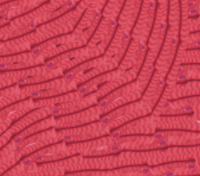
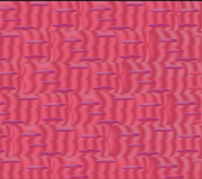
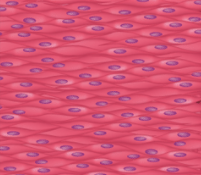
There are three types of muscle tissue in the human body: Skeletal, Smooth, and Cardiac. Watch the video about these muscle types: (use the blue link)
Next, for each muscle type, determine its:
location
a picture of the tissue
appearance
whether the muscle is voluntary or involuntary (can be used more than once)
how many nuclei are in the cells of the muscle type
cells contain one nuclei
Location: Walls of the Heart
Location: Blood vessels, digestive tract
cells contain multiple nuclei
cells contain one or two nuclei
Involuntary
Voluntary
Appearance: Smooth
Appearance: Striated
Location: Connected to bones
Skeletal muscle
Smooth muscle
Cardiac muscle
7 points
7
Question 2
2.
Using the information above, match the following muscles with their type.
The muscle surrounding the aorta (the main artery running through the abdominopelvic cavity)
The muscle surrounding the stomach and small intestine
The abdominal muscles (the "six pack" muscles)
The sternocleidomastoid (helps us shake our head 'yes' and 'no')
The muscle surrounding the right atrium of the heart
The biceps brachii (helps to bend the elbow)
The muscle surrounding the left ventricle of the heart
Skeletal muscle
Smooth muscle
Cardiac muscle
1 point
1
Question 3
3.
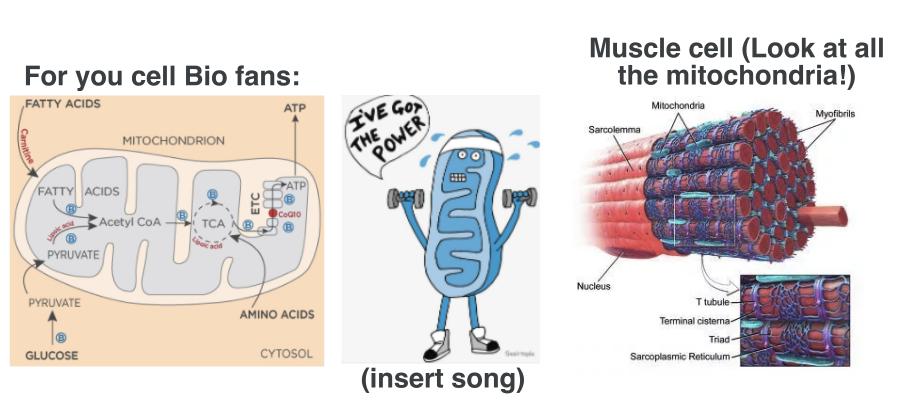
All of the types of muscle discussed above contain many mitochondria (yes, the POWERHOUSE of the cell!)
Why do you think that muscle cells contain more mitochondria than most other cells of the body?
2 points
2
Question 4
4.
Smooth, skeletal, and cardiac muscle all have four properties in common:
excitability
contractility
extensibility
elasticity
On a separate sheet of paper, draw a picture describing each of these terms as it relates to muscles. Use the template below. (Remember to refer back to the textbook and resist the temptation to google!)
Part 2: Skeletal Muscle Structure
Section 9.2 in your textbook
1 point
1
Question 5
5.
Why are skeletal muscles called skeletal muscles? (In other words - what do they have to do with the skeletal system?)
Read the passage below about skeletal muscles. As you are reading, color and label the diagram in number 9.
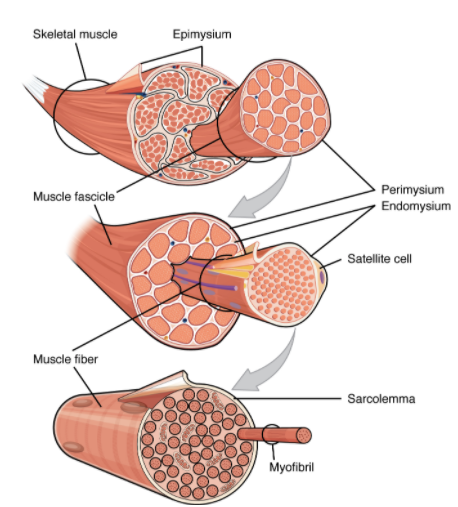
Each skeletal muscle is an organ that consists of various integrated tissues. These tissues include skeletal muscle fibers, blood vessels, nerve fibers, and connective tissue. Each skeletal muscle has three layers of connective tissue (called "mysia"; the suffix “-mysium”) that enclose it and provide structure to the muscle as a whole, and also compartmentalize the muscle fibers within the muscle. Each muscle is wrapped in a sheath of dense, irregular connective tissue called the epimysium, which allows a muscle to contract and move powerfully while maintaining its structural integrity. The epimysium also separates muscle from other tissues and organs in the area, allowing the muscle to move independently.
Inside each skeletal muscle, muscle fibers are organized into individual bundles, each called a fascicle, by a middle layer of connective tissue called the perimysium. This fascicular organization is common in muscles of the limbs; it allows the nervous system to trigger a specific movement of a muscle by activating a subset of muscle fibers (individual muscle cells) within a bundle, or fascicle of the muscle. Inside each fascicle, each muscle fiber is encased in a thin connective tissue layer of collagen and reticular fibers called the endomysium. The endomysium contains the extracellular fluid and nutrients to support the muscle fiber. These nutrients are supplied via blood to the muscle tissue.
In skeletal muscles that work with tendons to pull on bones, the collagen in the three tissue layers (the mysia) intertwines with the collagen of a tendon. At the other end of the tendon, it fuses with the periosteum coating the bone. The tension created by the contraction of the muscle fibers is then transferred through the mysia, to the tendon, and then to the periosteum to pull on the bone for movement of the skeleton. In other places, the mysia may fuse with a broad, tendon-like sheet called an aponeurosis, or to fascia, the connective tissue between skin and bones. The broad sheet of connective tissue in the lower back that the latissimus dorsi muscles (the “lats”) fuse into is an example of an aponeurosis.
Every skeletal muscle is also richly supplied by blood vessels for nourishment, oxygen delivery, and waste removal. In addition, every muscle fiber in a skeletal muscle is supplied by the axon branch of a somatic motor neuron, which signals the fiber to contract. Unlike cardiac and smooth muscle, the only way to functionally contract a skeletal muscle is through signaling from the nervous system.
4 points
4
Question 6
6.
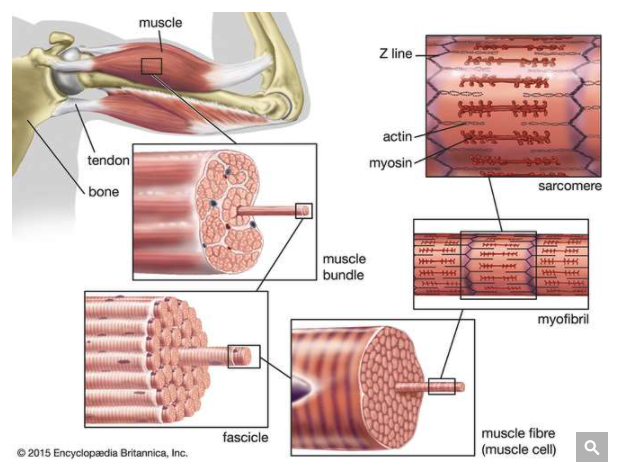
Using the reading above, color the diagram with the colors indicated on the key. Additionally, label the following terms on the diagram:
endomysium
perimysium
epimysium
muscle fiber
muscle
tendon
fascicle
myofibril
1 point
1
Question 7
7.
How are you feeling about the terms from #9?
endomysium
tendon
perimysium
fascicle
epimysium
myofibril
muscle
muscle fiber
I get this term!
I kind of understand this term
What on earth is this thing?
1 point
1
Question 8
8.
Now, compare your diagram in #9 with the diagram below.
Now - How are you feeling about the terms from above?