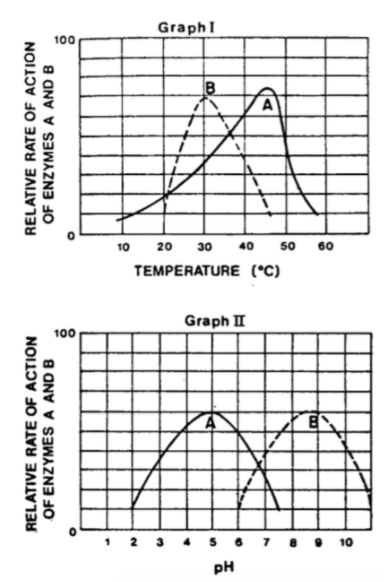
Under which conditions is enzyme A most productive?
Under which conditions is enzyme A most productive?
Under which conditions is enzyme A most productive?
Which of the following is true?
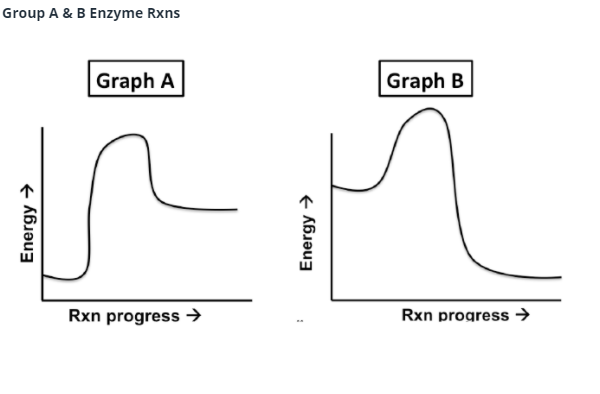
On BOTH graphs below, please draw in the enzyme-catalyzed versions of those reactions.
Which of the following are true about an enzyme-catalyzed reaction happening at Vmax?
Which of the following is(are) true for anabolic reactions. There may be more than one answer.
Which of the following is(are) true about enzyme catalyzed reactions?
Increasing the substrate concentration in an enzymatic reaction could overcome which of the following?
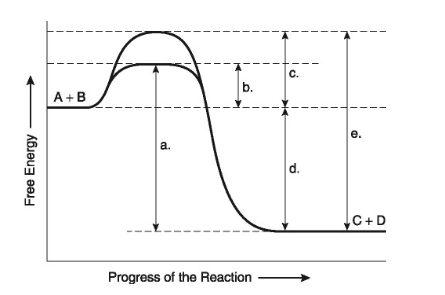
The following graph is based on the reaction A + B --> C + D
Which of the following represents the difference between the free energy content of the reactants and the free energy content of the products?
Competitive inhibitors block the entry of substrate into the active site of an enzyme. On which of the following properties of an active site does this primarily depend?
A series of enzymes catalyze the reaction X → Y → Z → A. Product A binds to the enzyme that converts X to Y at a position remote from its active site. This binding decreases the activity of the enzyme. The information above tells us that which of the following is true?
A group of AP Biology students is testing the effect of the amount of peroxidase enzyme on oxygen production. In cells, peroxidase breaks down hydrogen peroxide into water and oxygen gas. Identify an appropriate control group for this experiment.
The graph below shows the accumulation of product over time. Calculate the rate of enzyme-catalyzed reaction for the (2S) line on the graph. You must show all work in order to receive credit. You may use the writing tools or the text tools.