Log in
Sign up for FREE
arrow_back
Library

Photosynthesis quiz

star
star
star
star
star
Last updated over 5 years ago
12 questions
1
1
1
1
1
1
1
1
1
1
2
3
Question 1
1.

Question 2
2.

Question 3
3.

Question 4
4.

Question 5
5.

Question 6
6.

Question 7
7.

Question 8
8.

Question 9
9.

Question 10
10.

Question 11
11.

On the diagram below, please draw H+ being pumped by the ETC in the photosystems, AND H+ diffusing through ATP synthase. Also indicated where O2 is utilized by writing in where and how (either typed description or chemical formula for the reaction is fine). BE CLEAR on the direction/location in which each is occurring.

Question 12
12.

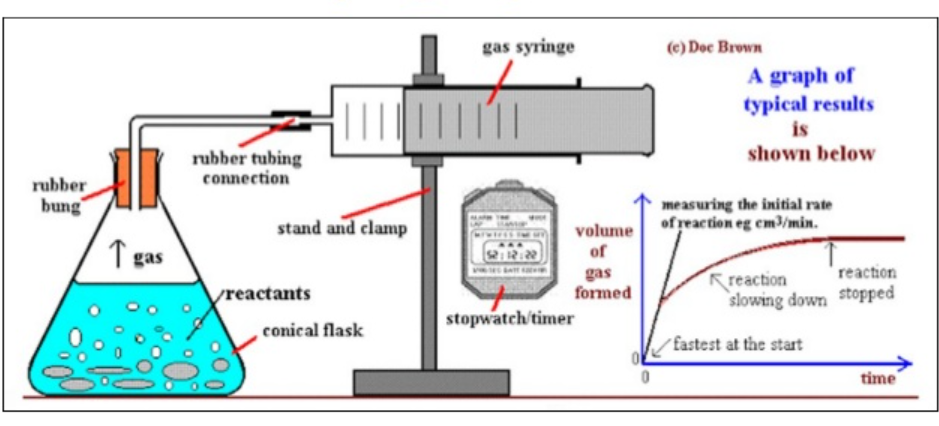
a)The experiment below is set up to measure the rate of photosynthesis. The flask are spinach chads (the gray disks) and sodim bicarbonate (the white dots). There is a light shining on the flask (you just can't see it 😄 )
Volumetric measurements are taken by reading the syringe to show the volume of gas that is changing.


In a BRIEF paragraph, answer the following questions.It could be based on a lab you viewed, or another version, as long as it uses this set-up.

a) describe the independent and dependent variables that COULD be recorded using this set up.
b) using the variables you indicated in part a, describe what would be a good positive control group.

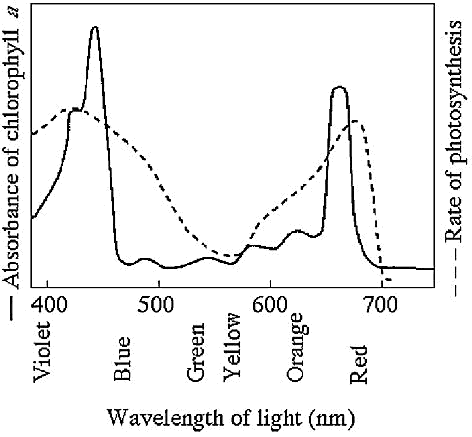
The figure shows the absorption spectrum for chlorophyll a and the action spectrum for photosynthesis. What colors of light are least effective in driving photosynthesis?
orange-red
green-yellow
violet blue
yellow-orange
Which of the following statements correctly summarizes a redox reaction that occurs in photosynthesis?
CO2 is oxidized to form glucose.
Water is reduced to form O2.
CO2 is reduced to form glucose.
O2 is oxidized to form water.
Glucose is oxidized to form CO2.
A reduction in the amount of NADP+ available in plant cells in the light will ultimately result in which of the following effects?
an increase in the rate of oxygen production
an increase in the rate of the Calvin cycle
a decrease in the rate of cyclic electron flow
a decrease in the rate of linear electron flow
Which of the following statements correctly describes a reaction associated with photosystem II?
Electrons are passed from the P680 chlorophyll to oxygen (O2).
The P680 chlorophyll donates a pair of electrons directly to NADP+, producing NADPH.
Light energy excites electrons in the thylakoid membrane electron transport chain.
Electrons released from the P680 chlorophyll are replaced by electrons derived from water.
Chemiosmosis in chloroplasts involves which of the following processes?
diffusion of electrons through the thylakoid membrane
formation of glucose from carbon dioxide
reduction of water to produce oxygen
establishment of a proton gradient across the thylakoid membrane
Theodor W. Engelmann illuminated a filament of algae with light that passed through a prism, thus exposing different segments of algae to different wavelengths of light. He added aerobic bacteria and then noted in which areas the bacteria congregated. He found that the largest groups were found in the areas illuminated by the red and blue light. This experiment helped to determine the relationship between which of the following parameters?
wavelengths of light and the amount of heat released
wavelengths of light and the rate of photosynthesis
heterotrophic and autotrophic organisms
wavelengths of light and the rate of aerobic respiration
the concentration of carbon dioxide and the rate of photosynthesis
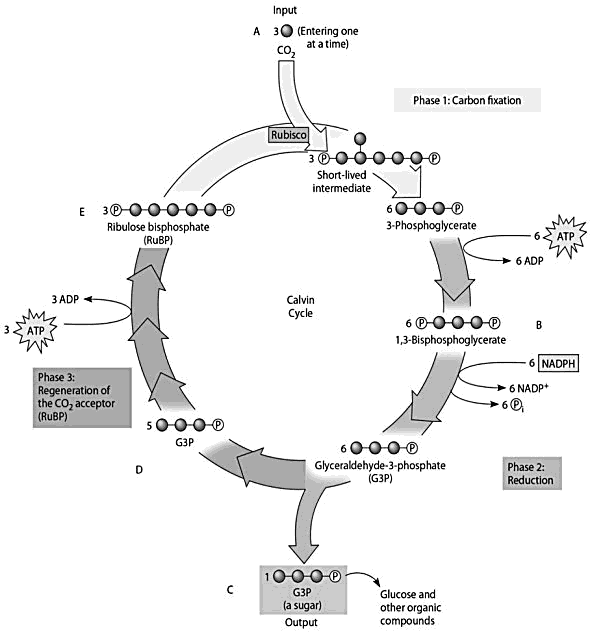
Use the figure and the compounds labeled A, B, C, D, and E to answer the following question.
Which best describes what is occuring to 1,3-bisphosphoglycerate?

it is being reduced by NADP+
it is being oxidzided by NADP+
it is being reduced by NADPH
it is being oxidized by NADPH
What is the primary function of the Calvin cycle?
to produce oxygen by oxidizing water
to produce simple sugars from carbon dioxide
to produce carbon dioxide for use in the light reactions of photosynthesis
to regenerate ATP for use in the light reactions of photosynthesis
An early step in the process of carbon fixation combines three molecules of CO2 with three molecules of RuBP to produce three 6-carbon molecules, which are immediately converted to six 3-carbon molecules. These six molecules are phosphorylated and reduced to produce glyceraldehyde 3-phosphate (G3P). What additional events occur to complete the Calvin cycle?
release of one G3P to make sugars and regeneration of citrate
release of one G3P to make sugars and regeneration of NADPH from NADP+
release of two G3P to make sugars and regeneration of ATP from ADP
release of one G3P to make sugars and regeneration of RuBP
Which of the following statements best explains how the energy in a photon of light is stored in a molecule of the sugar G3P? *
Light energy directly provides energy to ATP synthase, which produces ATP during the light reactions.
Light energy energizes electrons to make ATP and NADPH, which provide energy to produce G3P in the Calvin cycle.
Light energy directly provides energy to RuBP and CO2, which produce G3P in the Calvin cycle.