Log in
Sign up for FREE
arrow_back
Library

V1.1 - AP U4 2020

star
star
star
star
star
Last updated about 5 years ago
28 questions
2
2
2
2
2
2
2
2
2
2
2
2
2
2
2
2
2
2
2
2
Question 1
1.


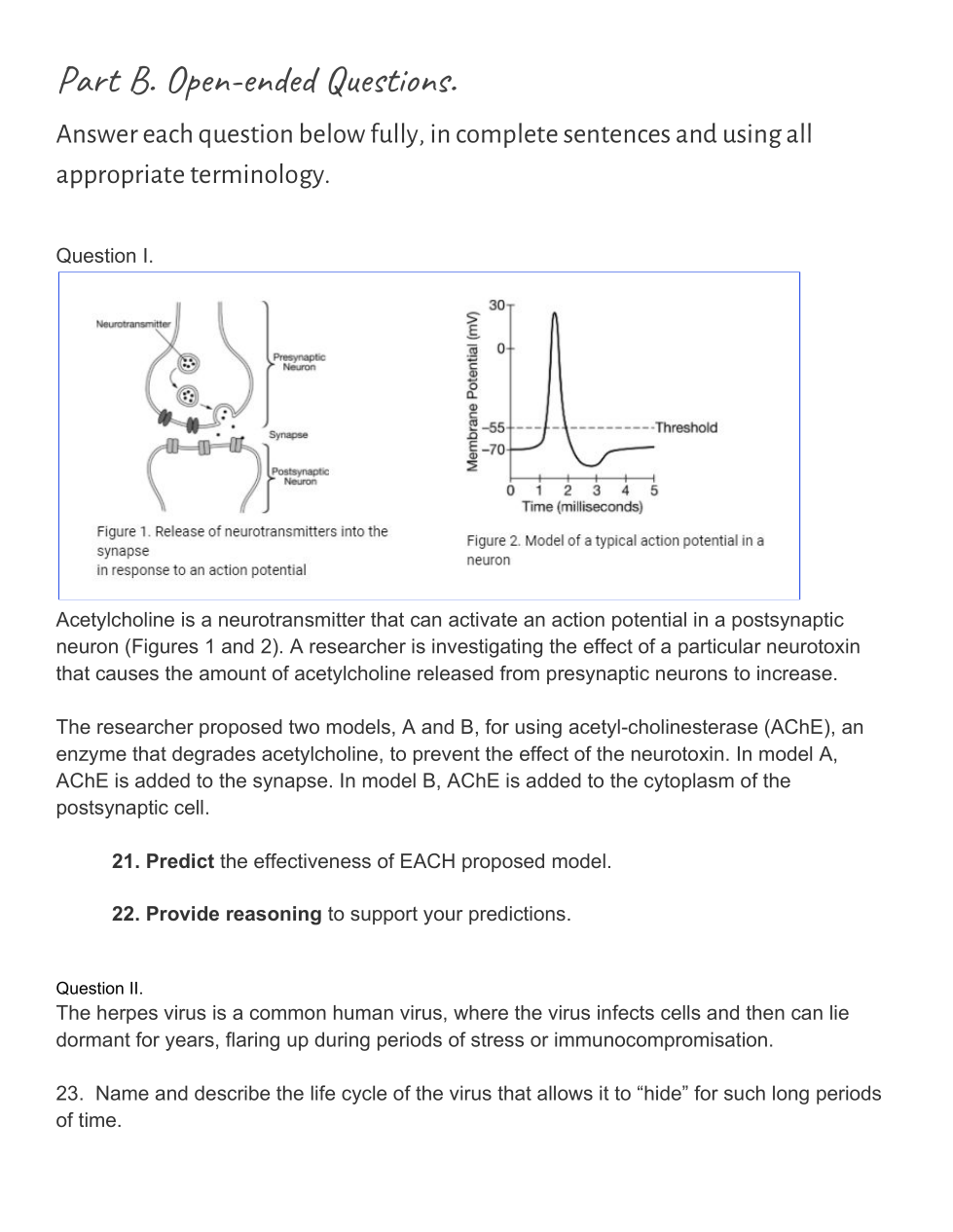
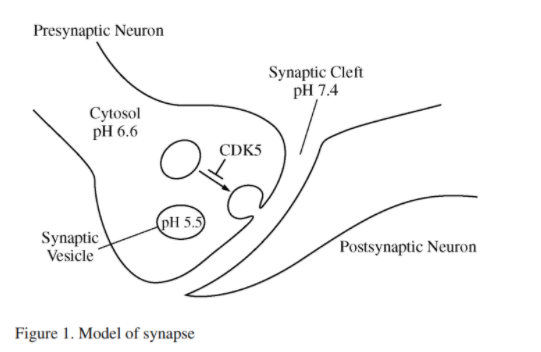
Researchers investigating the regulation of neurotransmitter release from presynaptic neurons proposed a model (Fig. 1) in which CDK5, a protein expressed in axon terminals, inhibits the movement of synaptic vesicles to the presynaptic membrane.

To test their model, the researchers used a modified version of green flourescent protein (GFP*). In slightly alkaline conditions, GFP* exhibits a bright green flourescence. In acidic conditions GFP* exhibits no flourescence. Using standard techniques, the gene encoding GFP* is easily introduced into living cells. By engineering the expression of GFP* in laboratory-cultured nerve cells, the researchers found that a bright green flourescence was exhibited only when a pre-synaptic neuron was given a certain stimulus.
Previous experiments indicate that CDK5 is active only when attached to a protein called p35. Which of the following best predicts how p35 might play a role in regulating neuron function?

Question 2
2.

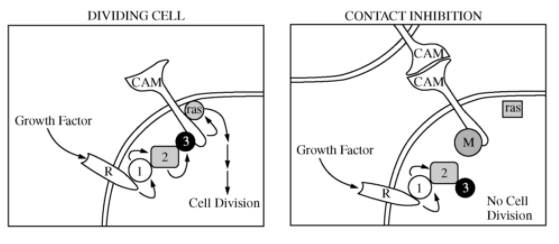
Many human cells can be stimulated to divide by hormonelike growth factors that bind to receptor proteins (R) on the plasma membrane and trigger an internal signal-transduction cascade. In many cases, however, the process of contact inhibition prevents mitosis when cells are in direct contact with one another. Contact inhibition occurs when proteins called cell adhesion molecules (CAMs) interact, causing them to change shape so that the growth-factor signaling proteins that normally associate with CAMs are replaced by another protein, called M. Both pathways are depicted in the figures below.


Which of the following statements accurately uses the information presented to support the hypothesis that interruption of M function in a single body cell can result in cancer?

Question 3
3.

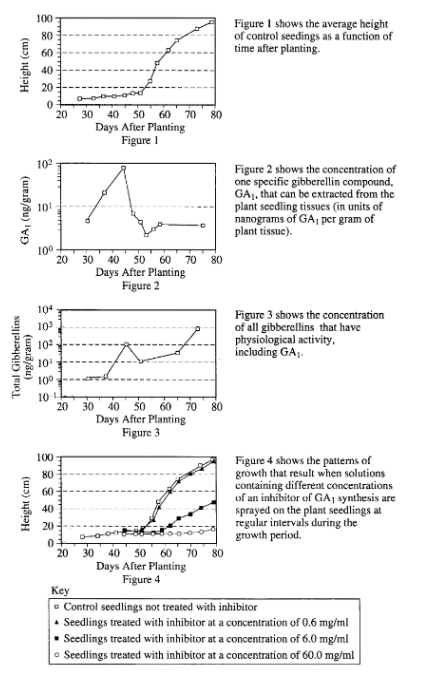
The following questions refer to the data in Figures 1 through 4 below, which were collected during a study of the growth of plant seedlings.


When the concentration of GA1 is highest, the average height of the control seedlings is approximately

Question 4
4.

If chemical signals in the cytoplasm control the progression of a cell to the M phase of the cell cycle, then fusion of a cell in G1 with a cell in early M phase would most likely result in the

Question 5
5.

The endocrine system incorporates feedback mechanisms that maintain homeostasis. Which of the following demonstrates negative feedback by the endocrine system?

Question 6
6.

Which of the following diagrams best represents hormone-activated gene expression?

Question 7
7.

What happens during anaphase?

Question 8
8.

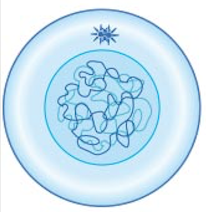
What part of cellular division is this cell going through?

Question 9
9.

Inflammatory responses may include which of the following?

Question 10
10.

An otherwise healthy student in your class is infected with EBV, the virus that causes infectious mononucleosis. The same student had already been infected when she was a child, and she had merely experienced a mild sore throat and swollen lymph nodes in her neck. This time, though infected, she does not get sick. Which cells were responsible for producing the antibodies the FIRST time she got sick?

Question 11
11.

Which of the following is true?

Question 12
12.

An individual’s humoral response to a particular antigen differs depending on whether or not the individual has been previously exposed to that antigen. Which of the following graphs properly represents the humoral immune response when an individual is exposed to the same antigen more than once?

Question 13
13.

Which of the following representations best shows a portion of an axon at rest (before or after an action potential)?

Question 14
14.

Information is transmitted through the nervous system when one neuron signals another neuron. The structure of neurons enables transmission to proceed quickly and efficiently. Which of the following diagrams correctly identifies both the structure of neurons and the direction of information flow between neurons?

Question 15
15.

Question 16
16.

Human papillomavirus can cause cervical cancer. The virus itself produces a protein called E6. E6 is a protein that binds p53, which is a protein produced by a common tumor supressor gene.

Based on this fact and what you know about tumor suppressor genes, what effect do you think E6 binding has?

Question 17
17.

What is the main prerequisite for clearance at the G2 checkpoint?

Question 18
18.

Quorum sensing is triggered to begin when
___________.

Question 19
19.

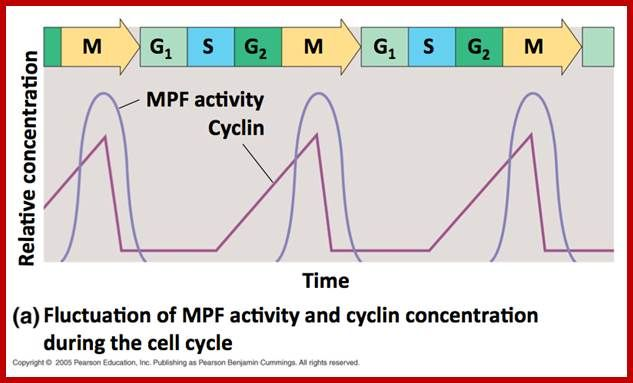
When are CDKs PRESENT inside the cell during the cell cycle?

Question 20
20.


In the diagram above, notice that cyclin levels CYCLE (get the name now?), and MPF (maturation promoting factor, a specific name of a cyclin/CDK complex) follows the same pattern. When cyclin levels are high, MPF activity is high, and vice versa. The height of activity peaks at M phase. This tells us that the role of this active complex is to move through M phase, and then cyclin levels, and MPF activity levels, drop off quickly after that.

Given all this information, what do you know about associated CDK levels during the time shown on this graph?

4
Question 21
21.

Predict the effectiveness of EACH proposed model.

4
Question 22
22.

Provide reasoning to support your predictions.

4
Question 23
23.

Name and describe the life cycle of the virus that allows it to “hide” for such long periods of time

1
Question 24
24.

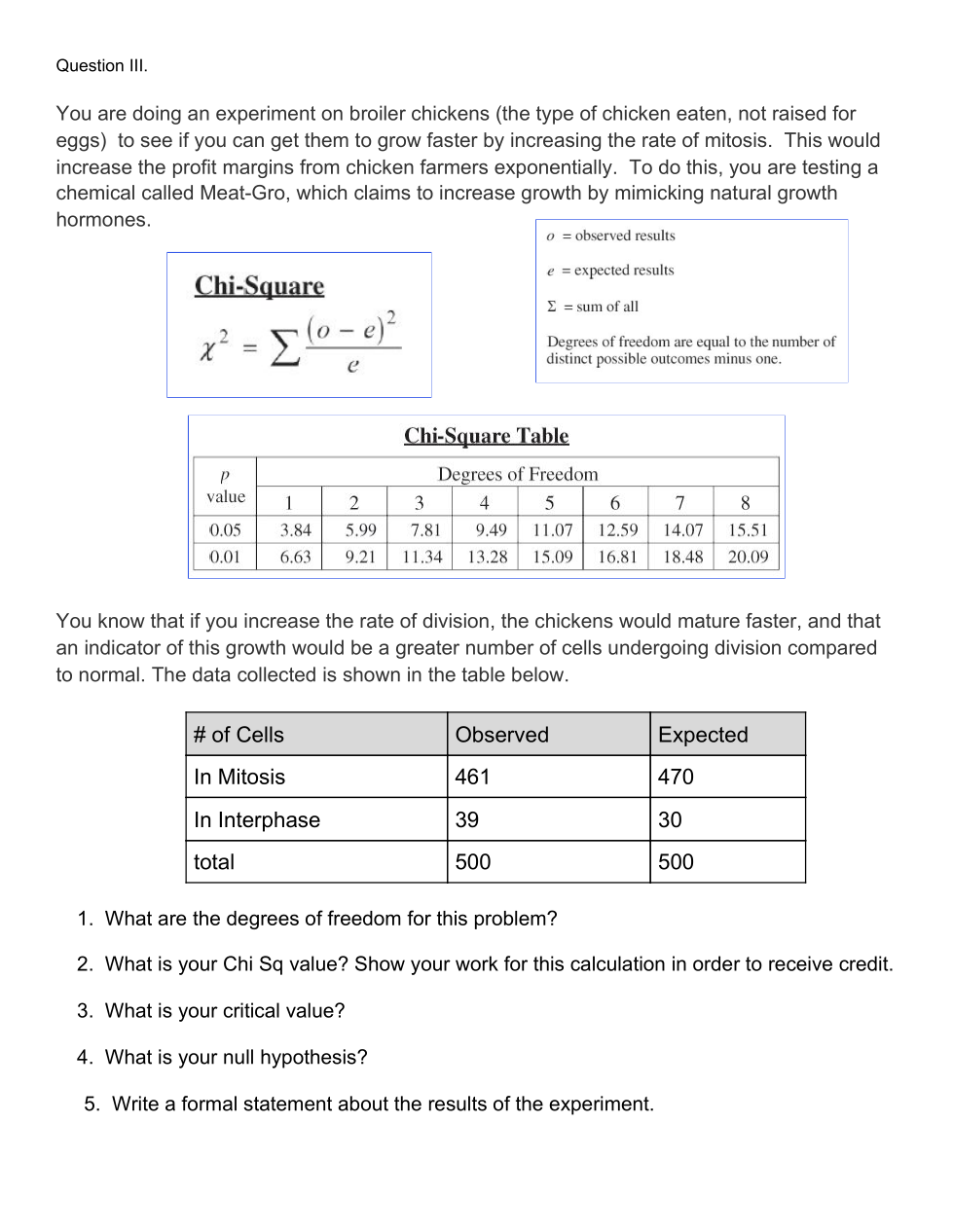
What are the degrees of freedom for this problem?

2
1
Question 26
26.

What is your critical value?

1
3
Degradation of p35 results in increased synaptic activity.
Attachment of p35 to synaptic vesicles results in increased synaptic activity.
Elevated intracellular levels of p35 result in increased synaptic activity.
The receptor proteins of body cells will no longer bind to growth-factor proteins.
Growth-factor signaling can trigger mitosis in cells that are in direct contact with other cells.
60 cm
85 cm
95 cm
30 cm
10 cm
Prophase
Metaphase
Interphase
clotting proteins migrating away from the site of infection
release of substances to decrease the blood supply to an inflamed area
increased activity of phagocytes in an inflamed area
plasma cells
memory B cells
natural killer cells
What property would prevent the ligands of cell-surface receptors from entering the cell?
The molecules bind to the extracellular domain.
The molecules are attached to transport proteins that deliver them through the bloodstream to
target cells.
The molecules are hydrophilic and cannot penetrate the hydrophobic interior of the plasma
membrane.
The ligands are able to penetrate the membrane and directly influence gene expression upon receptor binding.
When E6 binds to p53, the activity of p53 is increased, which slows down the cell cycle further
cell has reached a sufficient size
associated CDK levels would remain very high the whole time
associated CDK levels would be constant, probably at a mid to high level the whole time.
Question 25
25.

What is your Chi Sq value? Show your work for this calculation in order to receive credit. Please round to the nearest .01

Question 27
27.

What is your null hypothesis?

Question 28
28.

Write a formal statement about the results of the experiment.