#601 - Plants and Snails Oh MY!
star
star
star
star
star
Last updated over 5 years ago
23 Nsɛmmisa

1
1
1
1
1
1
1
1
1
1
1
1
1
1
1
1
1
1
1
1
1
1
1
Directions: Follow the instructions to go through the simulation. Respond to the questions and prompts in the orange boxes.
Vocabulary: aerobic respiration, bromothymol blue (BTB), carbon dioxide-oxygen cycle, indicator, interdependence, photosynthesis
Prior Knowledge Questions (Do these BEFORE using the Gizmo.)
What important gas do we take in when we breathe?
Why don’t we run out of the important gases that we need to stay alive?
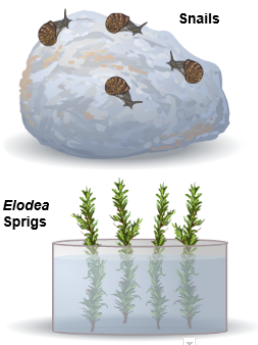
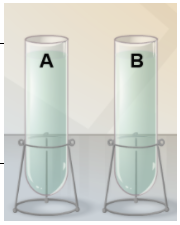
In the Plants and Snails Gizmo, each of the test tubes contains water and a small amount of bromothymol blue (BTB). BTB is a chemical indicator. An indicator changes color when the chemicals in the water change.
With the lights set to on, drag a snail into one test tube and a plant into another. Press Play. After 24 hours, what is the color of each tube?
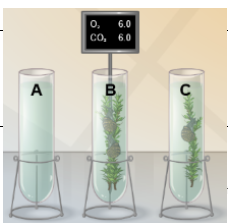
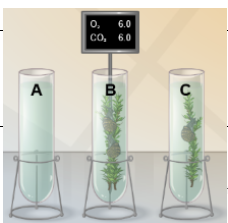
Select Show oxygen and CO2 values. Place the O2/CO2 probe in each tube. The probe shows the levels of two gases, oxygen (O2) and carbon dioxide (CO2), in the tubes. We call these amounts the gas levels.
When the water turns blue, which gas is most common?
When the water turns yellow, which gas is most common?
What does it tell you when the water is green?
Get the Gizmo ready:
Click Reset
Clear all of the test tubes.
Turn on Show oxygen and CO2 values.
Analyze: Study your data on gases given off by plants. What gas do plants give off in the light?
Analyze: Study your data on gases given off by plants. What gas do plants give off in the dark?
Analyze: Study your data on gases given off by animals. What gas do animals give off in the light?
Analyze: Study your data on gases given off by animals. What gas do animals give off in the dark?
How do these results compare to your plant results? (especially plants in the dark)
Infer: Describe the carbon dioxide-oxygen cycle by completing the sentences below: Some will be used more than once
oxygen (O2)
carbon dioxide (CO2)
Animals breathe in
Animals breathe out
In sunlight, plants take in
and release
Activity B: Interdependence
Get the Gizmo ready:
Click Reset.
Clear all of the test tubes.
Turn the light switch to on.
Check Show oxygen and CO2 values.
Does the color of the water in the tube change?
What happens to the O2 and CO2 levels?
What would happen if
you had two snails, and two sprigs with the lights on?
you had two snails and two springs with the lights off?
Run a few different scenarios and record your findings in your note book
Generalize: Describe how plants and animals each contribute to the survival of the other. Be specific.
Get the Gizmo ready:
Click Reset.
Clear all of the test tubes.
Turn the light switch to on.
Check Show oxygen and CO2 values.
Observe: Put two Elodea sprigs into a test tube. Put the O2/CO2 probe into the tube with the Elodea. Click Play. As the Gizmo runs, Pause it a few times.
How do the oxygen (O2) and carbon dioxide (CO2) levels change over time?
What is always true about the total amount of O2 and CO2 in the test tube?
What happens when the CO2 reaches zero?
How do the gas levels change?
What is the total of O2 and CO2?
How do the gas levels change?
What is the total of O2 and CO2?
Challenge: In the process of photosynthesis, plants use carbon dioxide (CO2), water (H2O), and light energy to produce a sugar (C6H12O6) and oxygen (O2). In the process of aerobic respiration, animals and plants release energy from sugar and oxygen and produce carbon dioxide and water. The chemical equations that describe these reactions look like this:
6CO2 + 6H2O + light 🡪 C6H12O6 + 6O2 C6H12O6 + 6O2 🡪 6CO2 + 6H2O + energy
How do these equations explain why the total amount of O2 and CO2 remains the same?