Is this relation a function?
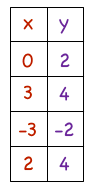
Is this relation a function?
The domain of a function is represented by...
Select all that apply.
The range of a function is represented by...
Select all that apply.
In order to be a function....
Given the function f(x), find f(4).
What is the zero of the function?
Given the function g(x), find x when g(x) = 3.
What is the zero of the function?
Given the function k(x), find x when k(x) = -1.
Is this relation a function?
Is this relation a function?

Is this a function or a relation?
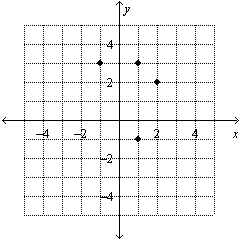
What is the range of the function? Type your answer in set builder notation.

What is the domain of the function? Type your answer in set builder notation.
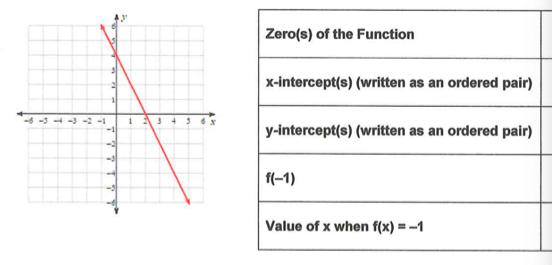
Zero(s) of the function
X-intercept(s) written as an ordered pair.
y-intercept(s) written as an ordered pair.
f(-1)=?
Identify the domain of the graph. Use set builder notation. NO SPACES!
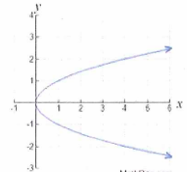
Remember, in order to write less than or equal to you write <=. In order to write greater than or equal to you write >=. In order to write all real numbers use R.
Identify the range of the graph. Use set builder notation. NO SPACES!
Remember, in order to write less than or equal to you write <=. In order to write greater than or equal to you write >=. In order to write all real numbers use R.
Identify the domain of the graph. Use set builder notation. NO SPACES!
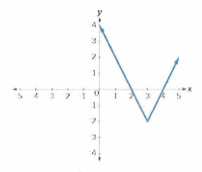
Remember, in order to write less than or equal to you write <=. In order to write greater than or equal to you write >=. In order to write all real numbers use R.
Identify the range of the graph. Use set builder notation. NO SPACES!
Remember, in order to write less than or equal to you write <=. In order to write greater than or equal to you write >=. In order to write all real numbers use R.
Identify the domain of the graph. Use set builder notation. NO SPACES!
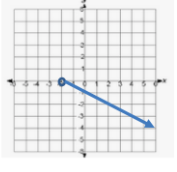
Remember, in order to write less than or equal to you write <=. In order to write greater than or equal to you write >=. In order to write all real numbers use R.
Identify the range of the graph. Use set builder notation. NO SPACES!
Remember, in order to write less than or equal to you write <=. In order to write greater than or equal to you write >=. In order to write all real numbers use R.
Identify the domain of the graph. Use set builder notation. NO SPACES!
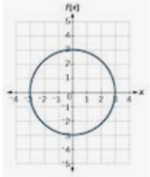
Remember, in order to write less than or equal to you write <=. In order to write greater than or equal to you write >=. In order to write all real numbers use R.
Identify the range of the graph. Use set builder notation. NO SPACES!
Remember, in order to write less than or equal to you write <=. In order to write greater than or equal to you write >=. In order to write all real numbers use R.
The value of x when f(x)= -4