The sentence below from the section "2. So Does Your Heart" helps prove the claim that changes in gravity dramatically affect the cardiovascular system over time.
Without gravity, however, the heart and blood vessels change – and the longer the flight, the more severe the changes.
Which sentence from the article provides further support for the claim?
Read the list of sentences from the article.
1.Like inactivity, space flight leads to the loss of both strength and skeletal muscle mass, in a process known as atrophy.
2.During long spaceflights on the ISS, research found that 37 crew members experienced a decrease in average strength of between 8 and 17 percent.
3.They make the new material they need or get rid of any material that isn't needed.
4.During spaceflight, however, the balance of these two processes changes, which leads to reduced bone mineral.
Which two sentences taken together provide the BEST explanation for WHY the body loses muscle and bone mass while in space?
Read the section "3. Fitness Suffers."
What does this section explain that other sections do NOT?
What is the MAIN reason the author includes the section "5. Your Immune System Suffers"?
Select the paragraph from the section "Known And Unknown Dangers" that explains some of the potential risks astronauts face.
Read the paragraph from the section "Rocket Transported Blood Samples To Earth."
Generally speaking, there were just about as many epigenetic changes in Scott as there were in his twin. The biggest difference was observed nine months into Scott's space mission. There were changes near genes that handle immune system response. The immune system protects the body from diseases. The researchers believe these changes were because Scott had signs of inflammation. This is a normal response when the body is hurt or sick and needs to heal.
What conclusion is BEST supported by the paragraph above?
Which two of the following sentences from the article include central ideas of the article?
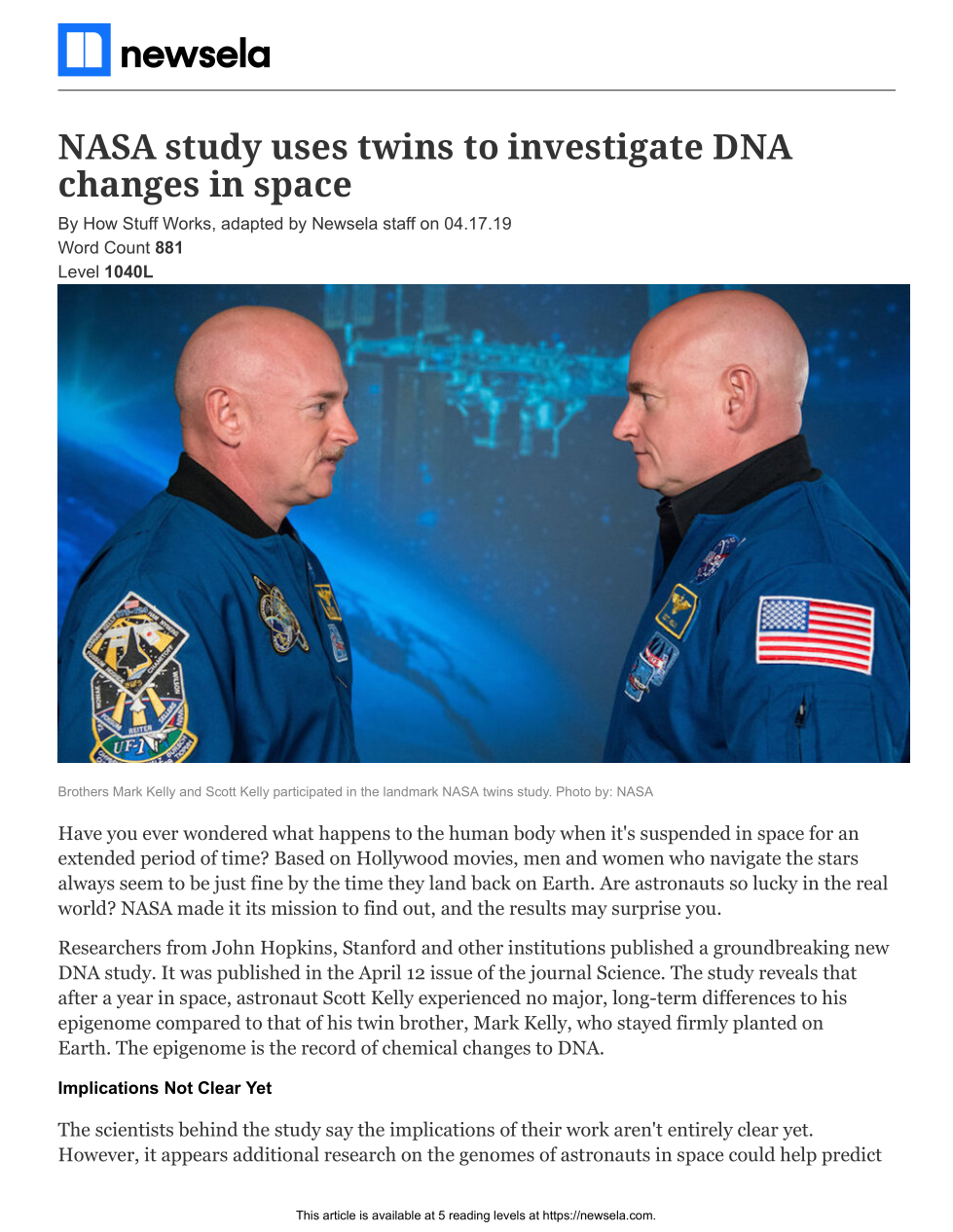
1. The study reveals that after a year in space, astronaut Scott Kelly experienced no major, long-term differences to his epigenome compared to that of his twin brother, Mark Kelly, who stayed firmly planted on Earth.
2. However, it appears additional research on the genomes of astronauts in space could help predict what kinds of unique health issues they may be at risk for.
3. Genes are made up of DNA, which contains the instructions for how each part of the body works and is passed on from parents to children.
4. If you're wondering how in the world Scott's samples reached the scientists from space, they were transported via a rocket
Which statement would be MOST important to include in a summary of the article?
What is the author's purpose of passage #2?
How does the author support the purpose identified in #9?
Use both passages to answer the following question:
What conclusion can the reader draw using information from both passages?
After reading the third passage, which answer choice BEST defines exposition in a plot.
Which paragraphs in the excerpt make up the exposition?
What do you learn about Roko's character from paragraphs 6, 7 and 8?
Which sentence from paragraph 4 contains an example of direct characterization?
Which of the following paragraphs contains details that show a type of conflict Roko faces?
In the paragraph you identified in part A, what type of conflict does Roko face?
Which sentence from the excerpt shows the main conflict in "The Wounded Wolf" has been resolved?
Which sentence from the excerpt MOST CLEARLY show's the author's use of imagery?
To which sense does the imagery MOST CLEARLY appeal from question 19?
Review the details in paragraph 1. When can you conclude "The Wounded Wolf" takes place?
Review the details in paragraph 2. What can you infer about the ways in which wolves communicate?
In which paragraph does the tone of the excerpt change?
How does the tone of the paragraph chosen in # 23 differ from the tone of the other paragraphs?
What theme do the details in paragraphs 11 and 12 MOST CLEARLY suggest?
Which details from paragraphs 11 and 12 BEST convey the theme?
When scientists talk about epigenetic changes, they're referring to chemical DNA changes. These tiny alterations may have a major effect on a person's health. Epigenetic changes simply change how genes are expressed. They do not change a person's genetic code itself. Potential problems pop up when epigenetic changes happen at the wrong time or place. In turn, they cause certain genes to turn on or off at the inappropriate time and place. Epigenetic changes happen in natural processes like aging. They also happen when one has a disease like cancer.
A major advantage of this new research is the fact that it studies twins who naturally have the same genetic material. The study subjects offer a rare and unique glimpse into the potential for long-term genetic changes in space. However, the researchers are quick to admit the study was too small, and more testing is essential. "Since we only have two people in our study, we can't say that these changes are due to space travel itself," Feinberg said. "We need more studies of astronauts to draw such conclusions."