In a statistics course, a linear regression equation was computed to predict the final exam score from the score on the first test. The equation was ŷ = 10 + .9x where y is the final exam score and x is the score on the first test. Carla scored 95 on the first test. What is the predicted value of her score on the final exam?
(a) 95
(b) 85.5
(c)90
(d) 95.5
(e) None of the above
Refer to the previous problem. On the final exam Carla scored 98. What is the value of her residual?
(a)98
(b) 2.5
(c) -2.5
(d) 0
(e) None of the above
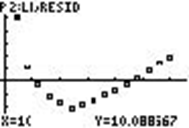
A study of the fuel economy for various automobiles plotted the fuel consumption (in liters of gasoline used per 100 kilometers traveled) vs. speed (in kilometers per hour). A least squares line was fit to the data. Here is the residual plot from this least squares fit. What does the pattern of the residuals tell you about the linear model?
(a) The evidence is inconclusive
(b) The residual plot confirms the linearity of the fuel economy data
(c) The residual plot clearly contradicts the linearity of the data.
(d) There are not enough data points to make a conclusion
(e) None of the above
All but one of the following statements contains a blunder. Which statement is correct?
(a) There is a correlation of 0.54 between the position a football player plays and their weight.
(b) The correlation between planting rate and yield of corn was found to be r = 0.23
(c) The correlation between the gas mileage of a car and its weight is r = 0.71 MPG.
(d) We found a high correlation (r = 1.09) between the height and age of children.
(e) We found a correlation of r = –.63 between gender and political party preference
In regression, the residuals are which of the following?
(a) Those factors unexplained by the data
(b) The difference between the observed responses and the values predicted by the regression line
(c) Those data points which were recorded after the formal investigation was completed
(d) Possible models unexplored by the
(e) None of the above
What does the square of the correlation (r^2) measure?
(a) The slope of the least squares regression
(b) The intercept of the least squares regression line
(c) The extent to which cause and effect is present in the data
(d) The fraction of the variation in the values of y that is explained by least-squares regression on the other
(e) It measures the number of outliers
If removing an observation from a data set would have a marked change on the position of the LSRL fit to the data, what is the point called
(a) Robust
(b) A residual
(c) A response
(d) Influential
(e) None of the above
A researcher finds that the correlation between the personality traits “greed” and “superciliousness” is –.40. What percentage of the variation in greed can be explained by the relationship with superciliousness?
(a) 0%
(b) 16%
(c) 20%
(d) 40%
(e) 60%
The following are resistant to outliers:
(a) Least squares regression
(b) Correlation coefficient
(c) Both the least square line and the correlation coefficient
(d) Neither the least square line nor the correlation coefficient
(e) It depends
If dataset A of (x,y) data has correlation coefficient r = 0.65, and a second dataset B has correlation r = –0.65, then
(a) The points in A exhibit a stronger linear association than B.
(b) The points in B exhibit a stronger linear association than A.
(c) Neither A nor B has a stronger linear association.
(d) You can’t tell which dataset has a stronger linear association without seeing the data or seeing the scatterplots