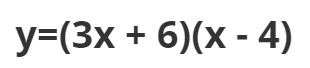
Guided Practice: Find the x-intercepts of this quadratic function without graphing it:
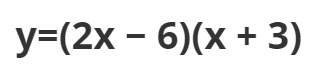
Guided Practice: Find the x-intercepts of this quadratic function without graphing it:
Guided Practice:
Connecting intercepts and factors
Graph the Function y=(x − 3)(x + 5)
Where does the parabola intercept (cross) the x-axis?
What is the connection between the x-intercepts of the function y = (x − 3)(x + 5) and the factors: (x − 3) and (x + 5)
Graph the Function y=(x + 6)(x + 2)
1) What are the x-intercepts? (Where the graph crosses the x-axis)
2) What is the axis of symmetry? (The middle of the parabola)
Graph the function y=(x + 6)(x + 2). What is the relationship between the axis of symmetry and its intercepts?
Guided Practice
Graph the function using its intercepts.
Graph the function using its intercepts.
Graph the function using its intercepts.
Graph the function using its intercepts.
Guided Practice: Find the x-intercepts of this quadratic function without graphing it:
Find the x-intercepts of this quadratic function without graphing it:
The height of a football after it has been kicked from the top of a hill can be modeled by the equation:
Where h is the height of the football in feet and t is the time in seconds. How long is the football in the air?
Graph the function to answer the question.
Graphing and Interpreting Quadratic Functions:
The height of a flare fired from the deck of a ship can be modeled by h = (−4t + 24)(4t + 4) where h is the height of the flare above water in feet and t is the time in seconds. Find the number of seconds it takes the flare to hit the water.
Graph the function to answer the question.
Solve this linear equation.
Solve this linear equation.
Solve this quadratic equation graphing
x=
x=
Solve this quadratic equation graphing.
x=
x=
Solve this quadratic equation graphing.
x=
x=
Solve this quadratic equation graphing.
x=
x=
Solve this quadratic equation graphing.
x=
x=
Solve this quadratic equation graphing.
x=
x=
Solve this quadratic equation graphing.
x=
x=
Solve this quadratic equation graphing.
x=
x=
A bird is in a tree 30 feet off the ground and drops a twig that lands on a
rosebush 25 feet below. The function h (t) = -16t²+ 30, where t represents the time
in seconds, gives the height h, in feet, of the twig above the ground as it falls. When
will the twig land on the bush?
Solve this quadratic equation graphing.
t=
A trampolinist steps off from 15 feet above ground to a trampoline 13 feet
below. The function h (t) = -16 t²+ 15, where t represents the time in seconds, gives
the height h, in feet, of the trampolinist above the ground as he falls. When will the
trampolinist land on the trampoline?
Solve this quadratic equation graphing.
t=
Graph each quadratic function and each of its linear factors. Then identify the x-intercepts and the axis of symmetry of each parabola.
Left x-intercept
Right x-intercept
Axis of Symmetry
Vertex
Graph each quadratic function and each of its linear factors. Then identify the x-intercepts and the axis of symmetry of each parabola.
Left x-intercept
Right x-intercept
Axis of Symmetry
Vertex
Graph each quadratic function and each of its linear factors. Then identify the x-intercepts and the axis of symmetry of each parabola.
Left x-intercept
Right x-intercept
Axis of Symmetry
Vertex
Graph each quadratic function and each of its linear factors. Then identify the x-intercepts and the axis of symmetry of each parabola.
Left x-intercept
Right x-intercept
Axis of Symmetry
Vertex
Graph each quadratic function and each of its linear factors. Then identify the x-intercepts and the axis of symmetry of each parabola.
Left x-intercept
Right x-intercept
Axis of Symmetry
Vertex
Graph each quadratic function and each of its linear factors. Then identify the x-intercepts and the axis of symmetry of each parabola.
Left x-intercept
Right x-intercept
Axis of Symmetry
Vertex
Mutlitply the binomials:
Mutlitply the binomials:
Factor each expression. Be sure to check for a GCF first.
Factor each expression. Be sure to check for a GCF first.
Factor each expression. Be sure to check for a GCF first.
Factor each expression. Be sure to check for a GCF first.
Solve this equation:
6x-9=45
What does is it mean to solve an equation?
Solve the following Quadratic function:
(2x + 3)(x + 1) = 0
x=
x=
Solve the following Quadratic function:
x(8x + 3) = 0
x=
x=
Solve the following Quadratic function:
(x - 7)(x + 7) = 0
x=
x=
Solve the following Quadratic function:
2x2 + 5x + 2 = 0
x=
x=
Solve the following Quadratic function:
3x2 + 22x + 35 = 0
x=
x=
Solve the following Quadratic function:
7x2 - 60x + 32 = 0
x=
x=
Factor and solve:
3x2 - x - 14 = 0
x=
x=
Factor and solve:
3x2 + 17x - 28 = 0
x=
x=
People frequently need to calculate the area of rooms, boxes or plots of land. An example might involve building a rectangular box where one side must be twice the length of the other side.
For example, if you have only 4 square feet of wood to use for the bottom of the box, with this information, you can create an equation for the area of the box using the ratio of the two sides. This means the area -- the length times the width -- in terms of x would equal x times 2x, or 2x2. This equation must be less than or equal to four to successfully make a box using these constraints.
Jason jumped off a cliff into the ocean in Acapulco while vacationing with some friends. His height as a function of time could be modeled by the function h(t) = -16t²+ 16t + 480 , where t is the time in seconds and h is the height in feet.
How long did it take for Jason to reach his maximum height?
What was the highest point that Jason reached?
Jason hit the water after how many seconds?
If a toy rocket is launched vertically upward from ground level with an initial velocity of 128 feet per second, then its height h after t seconds is given by the equations h(t) = -16t²+ 128t (if air
resistance is neglected).
How long will it take for the rocket to return to the ground?
After how many seconds will the rocket be 112 feet above the ground?
How long will it take the rocket to hit its maximum height?
What is the maximum height?
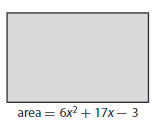
For each rectangle with area given, determine the binomial factors that describe the dimensions.
Length
Width
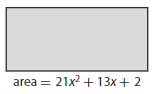
For each rectangle with area given, determine the binomial factors that describe the dimensions.
Length
Width
Find the length and width of a rectangle whose length is 5 cm longer than its width and whose area is 50 cm².
length
width
The width of a rectangle is six
meters less than its length. If the
area of the rectangle is 112 m² , find
the dimensions of the rectangle.
The length of a rectangle is one
foot more than twice its width. If
the area of the rectangle is 300 ft²,
find the dimensions of the rectangle.