Log in
Sign up for FREE
arrow_back
Library
Knowledge Test #01
By Michael Dobson
star
star
star
star
star
Share
share
Last updated about 5 years ago
25 questions
Add this activity
1
1
1
1
1
1
1
1
1
1
1
1
1
1
1
1
1
1
1
1
1
1
1
1
1
Question 1
1.
How can you lower the risk of hydroplaning?
Do not speed when the roads are wet.
Use tires with proper air pressure.
Replace tires with bad tread.
All of the above.
Question 2
2.
A driver should be extra alert to motorcyclists, bicyclists, and pedestrians because:
They’re difficult to see in traffic.
They obey different traffic laws than larger motor vehicles.
They always have the right-of-way.
They don’t have rearview mirrors.
Question 3
3.
If you become stranded in a snowstorm, the best thing to do is to:
Get out of the car and go for help.
Lay down in your car and go to sleep.
Walk into the road and get the attention of other drivers.
Stay in the car, as you are most likely to be found when you stay in your vehicle.
Question 4
4.
In Virginia, all passengers under the age of 18 must:
Properly use a seat belt, but only if they are sitting in the front seat.
Properly use a seat belt, but only if they are sitting in the back seat.
Not be buckled into a seat belt.
Properly use a seat belt, regardless of where they are seated.
Question 5
5.
Drivers who have consumed alcohol before getting behind the wheel:
Are always aware of the risks they are taking.
Do not have sufficient control over their bodies and minds or the vehicles being driven.
Are better drivers because they are more careful than sober drivers.
Have quicker reaction times.
Question 6
6.
When approaching a railroad crossing warning sign:
Be ready to drive faster than the train.
Be prepared to stop if a train is nearby.
Look for a way around any lowered gates.
Assume no trains are nearby and continue driving normally.
Question 7
7.
If a transit vehicle is signaling to re-enter the main roadway following a stop, you must:
Honk to let them know you’re there.
Move to the left lane.
Yield.
Speed up to pass.
Question 8
8.
You must yield the right-of-way to:
Pedestrians who are crossing a public street or highway.
Funeral processions.
Military convoys.
All of the above.
Question 9
9.
When parking uphill next to a curb, set the parking brake and:
Keep the rear tires against the curb.
Keep the front tires straight ahead.
Turn your steering wheel away from the curb.
Turn your steering wheel toward the curb.
Question 10
10.
It is best to keep a space cushion:
Only in back of your vehicle.
Only on the left and right sides of your vehicle.
Only in front of the vehicle.
On all sides of the vehicle.
Question 11
11.
The effect that lack of sleep has on your safe driving ability is the same as:
The effect that alcohol has.
The effect that amphetamines have.
The effect that anger has.
The effect that driving with teenagers has.
Question 12
12.
When driving on slick roads, you should:
Take turns more slowly than usual.
Change lanes quickly.
Accelerate quickly.
Brake hard.
Question 13
13.
What is a "No zone?"
A designated no passing zone
A one-way traffic area
The blind spot of a large vehicle
An area designated for motor vehicles
Question 14
14.
You are approaching a railroad crossing that has no visible gates or flashing lights, but has a standard crossbuck. You should:
Approach all tracks with extreme caution and cross only when you know that there is no train coming.
Turn your radio down to hear if there may be an approaching train.
Only continue once cleared to do so by a flagger, if applicable.
All of the above.
Question 15
15.
A slow-moving vehicle emblem is:
A rectangular red sign.
A circular green sign.
A diamond-shaped yellow sign.
A triangular orange sign.
Question 16
16.
If you stop along the road at night:
Turn off all your lights.
Use your parking lights only.
Use your headlights only.
Turn on your emergency flashers and leave your low beams turned on.
Question 17
17.
You are driving up a hill and are approaching a heavy truck from the rear. You should know that:
The truck may be traveling at a speed slower than the posted speed limit.
You may not be able to safely pass the truck.
You may not be able to legally pass the truck.
All of the above.
Question 18
18.
Bicycles are:
Required to stay on the sidewalks.
Considered vehicles but do not have the same rights as motor vehicles.
Considered vehicles and have the same rights as motor vehicles.
Required to stay on bicycle paths.
Question 19
19.
If you drink alcohol socially, what helps ensure safe driving?
Drink coffee before driving.
Ride home with a friend who has not been drinking.
Take a cold shower before driving.
Stop drinking one half hour before driving.
Question 20
20.
When is it illegal to drive below the speed limit?
When driving slowly disrupts the normal flow of traffic
When in heavy traffic in a construction zone
Only when driving in rural areas.
When driving under adverse weather conditions
Question 21
21.
The driver's left arm and hand are extended downward. This hand signal means that the driver plans to:
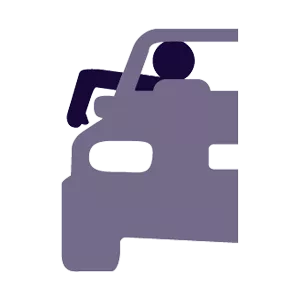
Turn left.
Turn right.
Stop.
Start up.
Question 22
22.
What do speed limit signs indicate?
Potential driving speeds for the area
The maximum or minimum speed that is legally allowed to be driven
The speed drivers should drive in heavy traffic
The speed drivers should drive under poor conditions
Question 23
23.
A professional truck driver must:
Own an 18-wheeler.
Have a valid commercial driver license.
Have a fishing license.
Have a hunting license.
Question 24
24.
Increase your following distance when:
Driving behind a large vehicle that blocks your vision.
Exiting an expressway.
Following a motorcycle.
All of the above.
Question 25
25.
You want to turn left at an intersection. The light is green but oncoming traffic is heavy. You should:
Use the next intersection.
Wait at the crosswalk for traffic to clear.
Wait in the center of the intersection for traffic to clear.
Take the right-of-way since you have a green light.