AP Unit 3 Exam

Last updated almost 5 years ago
21 questions
Unit 3 Exam AP Biology
It is against the Academic Integrity policy of our district to discuss, share, hint or dessiminate any information pertaining to this test, until such time as the test is released. It is also against said policy to ask for or receive outside help, either from a person, study tools, or the internet. Consequences such as revoked test access and zero points alloted for test scores, and/or NHS and recommendation letters implications, are all possible. By signing your name on the space below, you are reaffirming your acceptance of these policies and accepting the consequences should you fail to abide by these policies.
0

Sign your name below using the squiggle tool. It doesn't have to be neat.


2.5

Which molecule gets oxidized during glycolysis of cellular respiration?

2.5

  1. Which terms applies to glycolysis? check all that apply

2.5

What molecule acts as the final electron acceptor of cellular respiration?

2.5

Use the following passage and data tables to answer the following question
Students investigated the effect of light on the carbon cycle in aquatic ecosystems by performing the controlled experiment summarized below.
The students placed equal amounts of water (pH 7) from a large aquarium in glass beakers. The students transferred aquatic plants from the aquarium to several of the beakers, and then they placed equal numbers of the beakers in the light or the dark (Figure 1: groups I and II). Similarly, the students transferred goldfish from the same aquarium to other beakers, and then they placed equal numbers of those beakers in the light or dark (*Figure 1: groups III and IV). Finally, the students placed an equal number of beakers containing water only in the light or dark (Figure 1: Groups V and VI).
After exposing the samples to light or dark for one hour, the students recorded the pH of the water in each beaker. Carbon dioxide dissolved in water will lower the pH of an aqueous solution. In the experiment, the students used changes in pH to monitor changes in the amount of Carbon dioxide in the water. For each treatment group, the students calculated the mean pH and standard error, as documented in the table below.


To investigate whether an organism in the study is capable of both photosynthesis and respiration, a comparison of which treatment groups is the most appropriate?
2.5

The reaction for photosynthesis is
6CO2 + 6H20 --> C6H12O6 + 6O2
If the input water is labeled with a radioactive isotope of oxygen, 18O, then the oxygen gas released as the reaction proceeds is also labeled with 18O. Which of the following is the most likely explanation?

2.5

Which of the following questions is most relevant to understanding the Calvin cycle?

2.5

Use the following passage and data tables to answer the following question
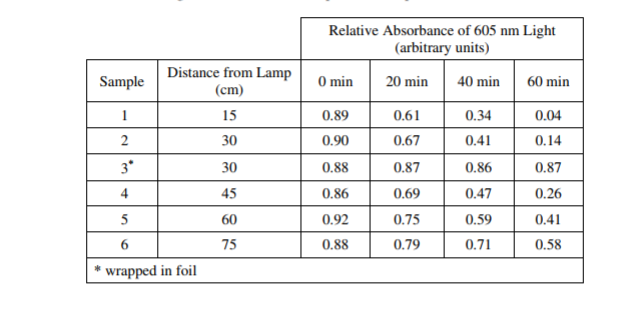
Photosynthetic activity can be measured using chloroplasts suspended in a buffered solution containing DCPIP, a blue dye that can accept electrons from the electron transport chain of photosynthesis.

Transfer of electrons to DCPIP decreases the relative absorbance of a specific wavelength of light (605 nm) by a solution that contains the dye. In other words, as more electrons are released from the chloroplasts and transferred to DCPIP, the dye becomes more clear and less blue, and the relative absorbance at 605 nm decreases.

A buffered solution containing chloroplasts and DCPIP was divided equally among six identical samples. The samples were placed at various distances from a lamp, and then all samples were exposed to white light from the lamp for 60 minutes at room temperatures. Sample 3 was wrapped in foil to prevent any light from reaching the solution. At 20-minute intervals, the photosynthetic activity in each sample was determined by measuring the relative absorbance of 605 nm light. The results of the experiment are provided below.

Tube #3 was most likely playing what role in the experiment?

2.5

A scientist is comparing the characteristics of a C3 plant, wheat, and a C4 plant, sugarcane. Which of the following is true regarding these two plants?

2.5

In a biological reaction, succinate dehydrogenase catalyzes the conversion of succinate to fumarate. The reaction is inhibited by malonic acid, a substance that resembles succinate but cannot be acted upon by succinate dehydrogenase. Increasing the amount of succinate molecules to those of malonic acid reduces the inhibitory effect of malonic acid. Select the correct identification of the molecules described in the reaction

2.5

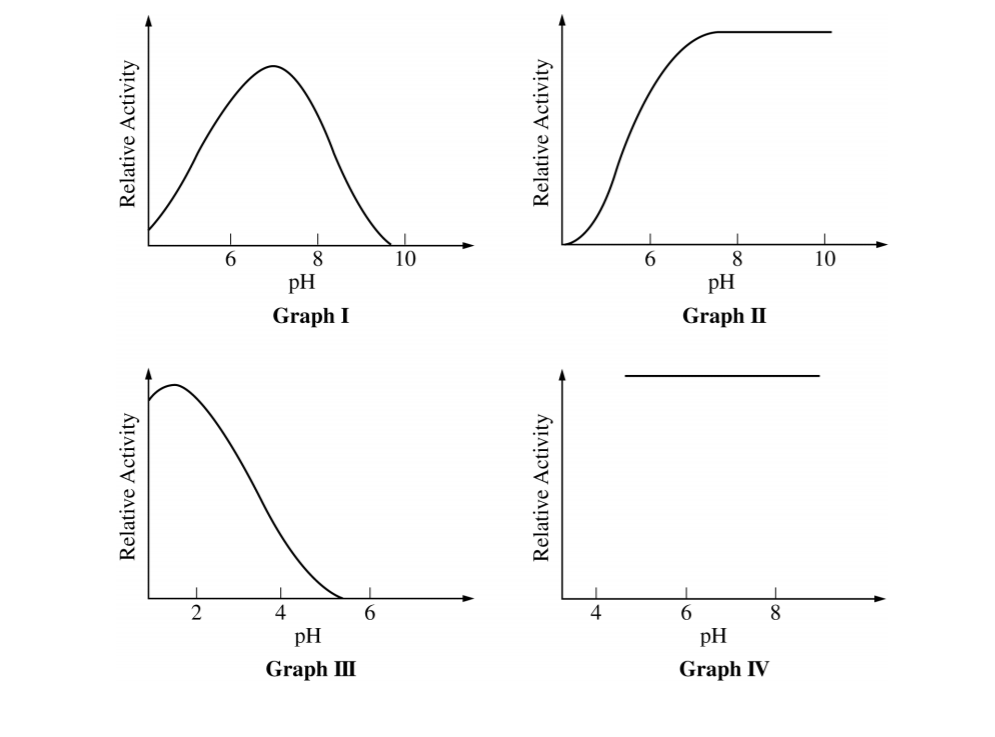
Graphs I - IV depicts the effect of pH on the activity of four different enzymes.

The most likely explanation for the results shown in graph I is that

2.5

Hemoglobin is a protein that delivers oxygen to red blood cells. If a certain mutation occurs in a single amino acid, the result is a disease called sickle cell anemia. Sickle cell hemoglobin proteins can be described as having:

2.5

During aerobic cellular respiration, a proton gradient in mitochondria is generated by ____ and used primarily for ____.

2.5

Glycolysis is considered ancient, one of the first metabolic pathways to evolve because

2.5

In anaerobic respiration glycolysis is followed by fermentation – the conversion of pyruvate to alcohol or lactic acid. The purpose of this step is to allow the cell to

2.5

Which of the following are products of the light reactions of photosynthesis that are utilized in the Calvin cycle?

2.5

Which of the following statements is true regarding enzymatic reactions?

2.5

If enzymes could not be used during a reaction, which of the following COULD be added to a system to make the reaction occur?

2.5

Oxygen is produced when


6

A rice grain is a fruit that encloses a seed. Most of the dry mass of a rice grain is starch. In rice plants starch is produced by hydrolyzing sucrose and then linking the released glucose molecules together into starch (Figure 1). The optimal temperature range for starch synthase activity in a particular stain of rice is 27- 30 °C. The optimal temperature range for sucrose synthase in the strain is 30-35 °C
Describe how temperatures above 35 °C most likely affect the structure and function (be specific!) of starch synthase in the particular strain. Using the information provided, predict the most likely consequences to starch content in mature rice grains if the rice is grown in an area where the average temperature during the growing season is 33 °C .

2

Explain why feedback inhibition, such as shown in the diagram here, would be beneficial to the cell.