Sci. 8- Mix & Flow of Matter: Section 2 Quiz
star
star
star
star
star
Last updated 4 months ago
17 Nsɛmmisa
This briefing document summarizes the key concepts presented in the following review notes, focusing on the particle model of matter and its application to understanding the properties and behaviors of pure substances, mixtures, and solutions. The document outlines the classification of matter, the processes of dissolving and solubility, factors affecting these processes, and practical applications of separation techniques like paper chromatography.
Main Themes and Important Ideas:
1. Particle Model of Matter as the Foundation:
The excerpts establish the particle model of matter as the fundamental explanation for the behavior of substances. Key tenets of this model include:
"All matter is made up of tiny particles."
"Different substances have different particles."
"The particles are always moving and vibrating."
"The particles in matter may be attracted to each other or bonded together"
"The particles have spaces between them"
"The particles flow in a fluid by moving freely past one another and at rest have a flat surface." This distinction explains why solids do not flow at rest.
The model explains mixing as the process where "smaller particles fill the spaces between the larger particles."
It also highlights that "in some substances particles can be attracted more to particles in other substances than to its own particles," which is crucial for understanding dissolving.
2. Pure Substances vs. Mixtures:
Pure substances are defined by their "own unique set of properties, or characteristics."
Mixtures contain "two or more pure substances, which have their own distinct properties (some of which may be hidden)."
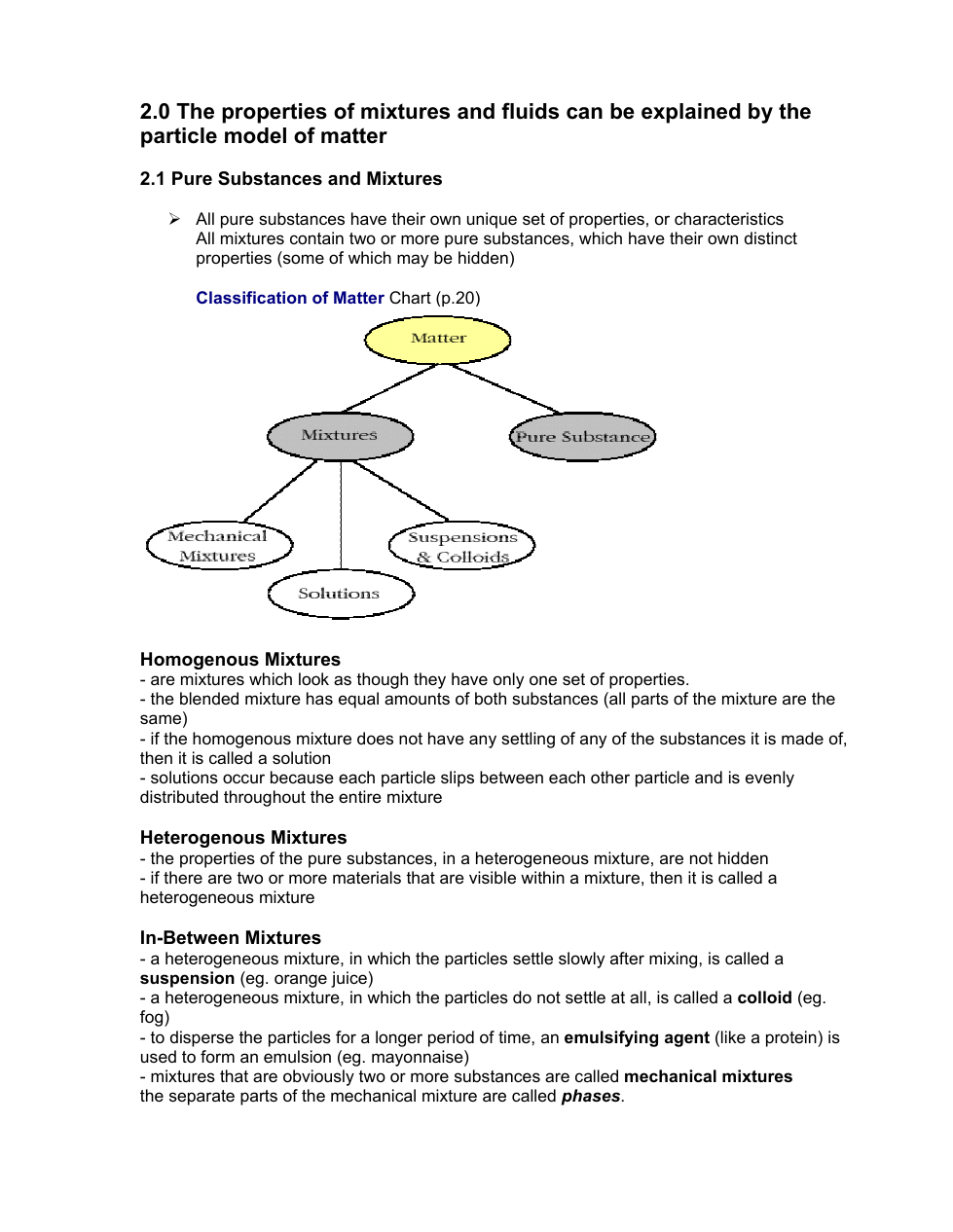
A Classification of Matter Chart (p.20) is referenced, suggesting a visual organization of these concepts.
Mixtures are further categorized into:
Homogenous Mixtures: These "look as though they have only one set of properties" and have "equal amounts of both substances" throughout. If there is no settling, it is called a solution, where "each particle slips between each other particle and is evenly distributed throughout the entire mixture."
Heterogenous Mixtures: The "properties of the pure substances...are not hidden," and "two or more materials that are visible within a mixture" are present.
In-Between Mixtures:Suspensions: Heterogeneous mixtures where "the particles settle slowly after mixing (eg. orange juice)."
Colloids: Heterogeneous mixtures where "the particles do not settle at all (eg. fog)." Emulsifying agents (like protein in mayonnaise) can be used to form emulsions and "disperse the particles for a longer period of time."
Mechanical Mixtures: Mixtures that are "obviously two or more substances" with "separate parts...called phases."
3. Paper Chromatography for Identifying Pure Substances and Solutions:
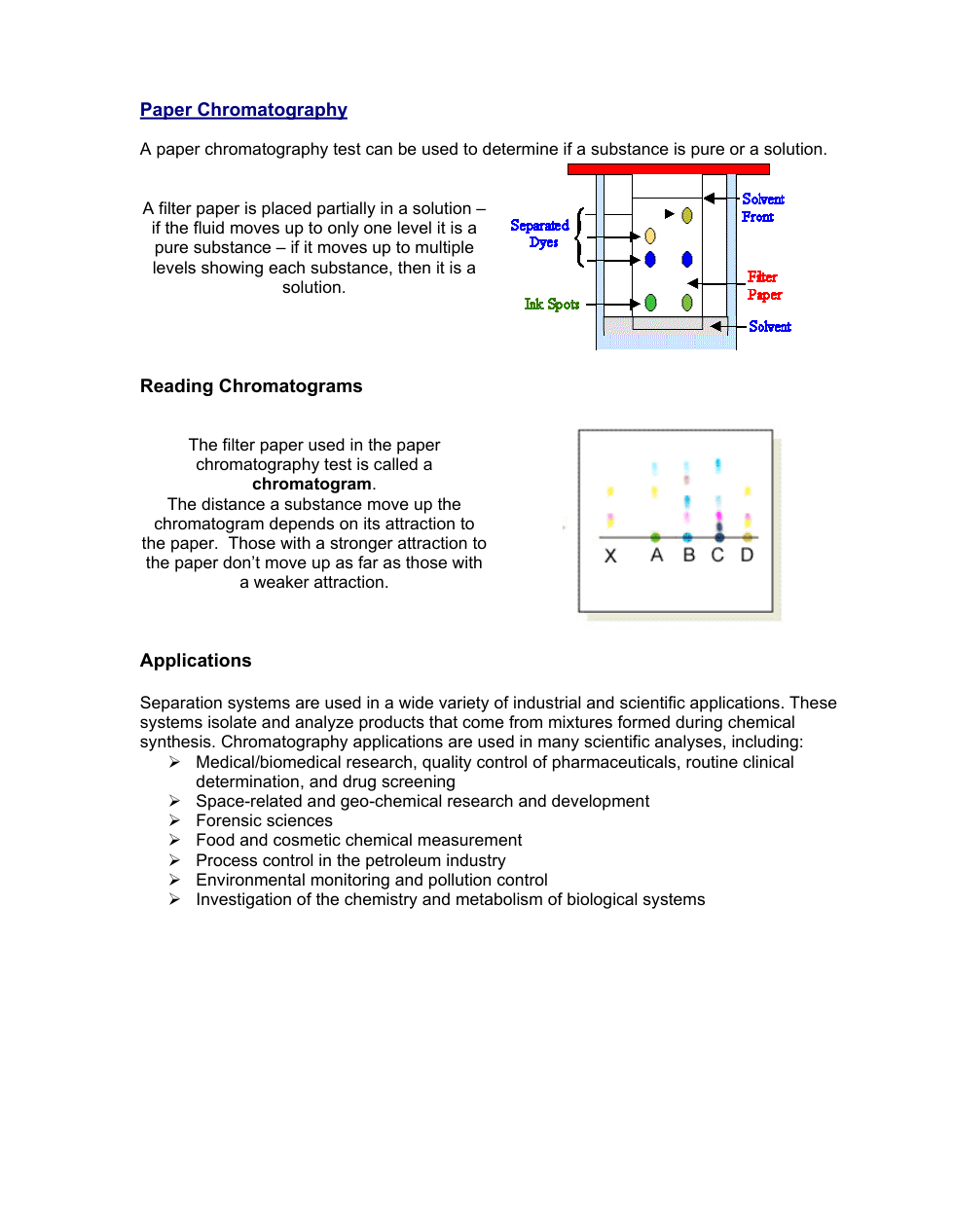
Paper chromatography is presented as a method "to determine if a substance is pure or a solution."
The process involves placing filter paper partially in a solution. "If the fluid moves up to only one level it is a pure substance – if it moves up to multiple levels showing each substance, then it is a solution."
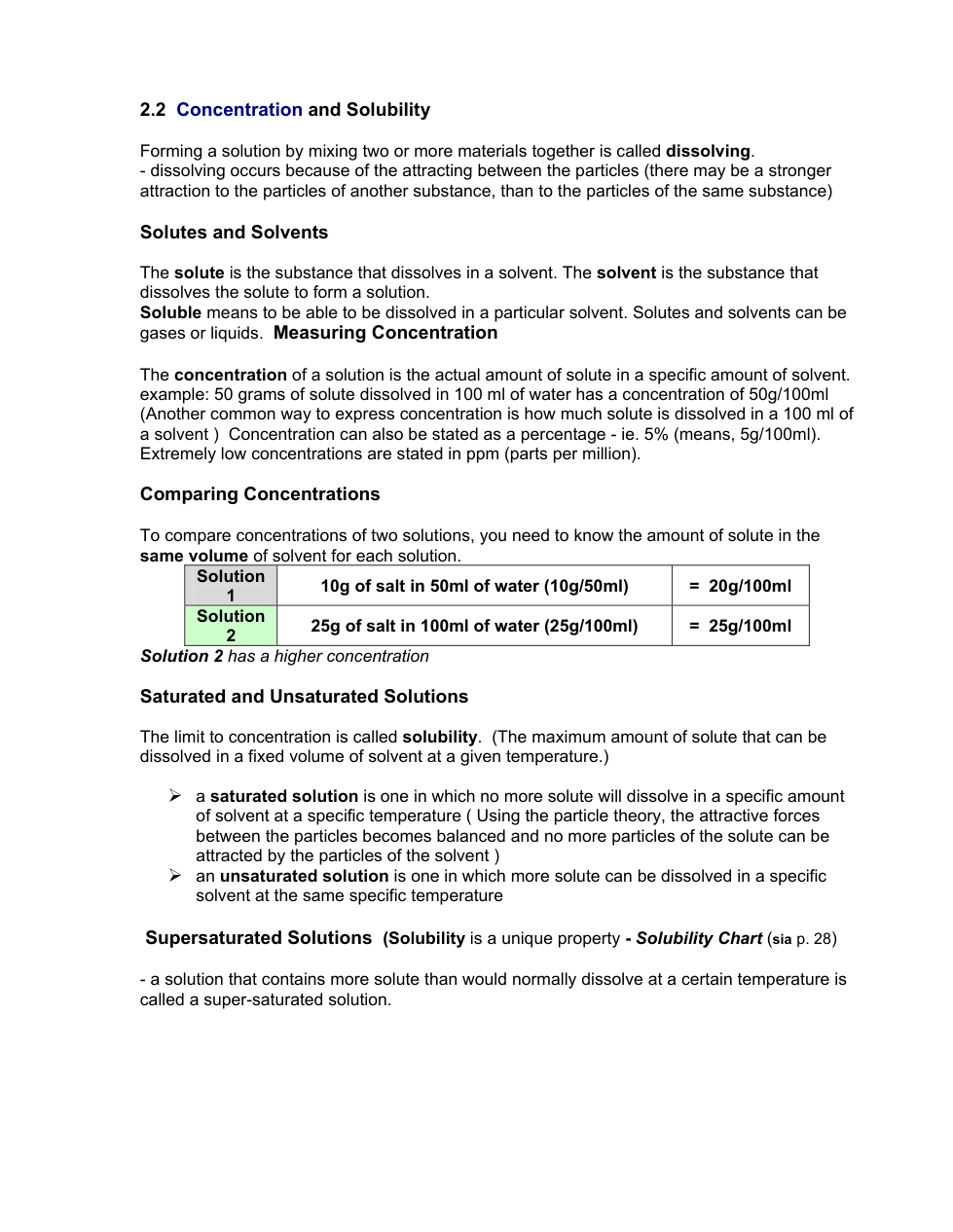
The filter paper after the test is called a chromatogram.
The distance a substance moves on the chromatogram depends on its "attraction to the paper." Substances with a "stronger attraction to the paper don’t move up as far as those with a weaker attraction."
Applications of Chromatography: The document lists a wide range of industrial and scientific applications for separation systems and chromatography, including:
Medical/biomedical research and pharmaceuticals
Space and geochemical research
Forensic sciences
Food and cosmetics
Petroleum industry process control
Environmental monitoring
Biological systems research
4. Concentration and Solubility in Solutions:
Dissolving is defined as "forming a solution by mixing two or more materials together" and occurs due to "the attracting between the particles."
Solute is "the substance that dissolves in a solvent," and solvent is "the substance that dissolves the solute to form a solution." A substance that "can be dissolved" is described as soluble. Solutes and solvents can be gases or liquids.
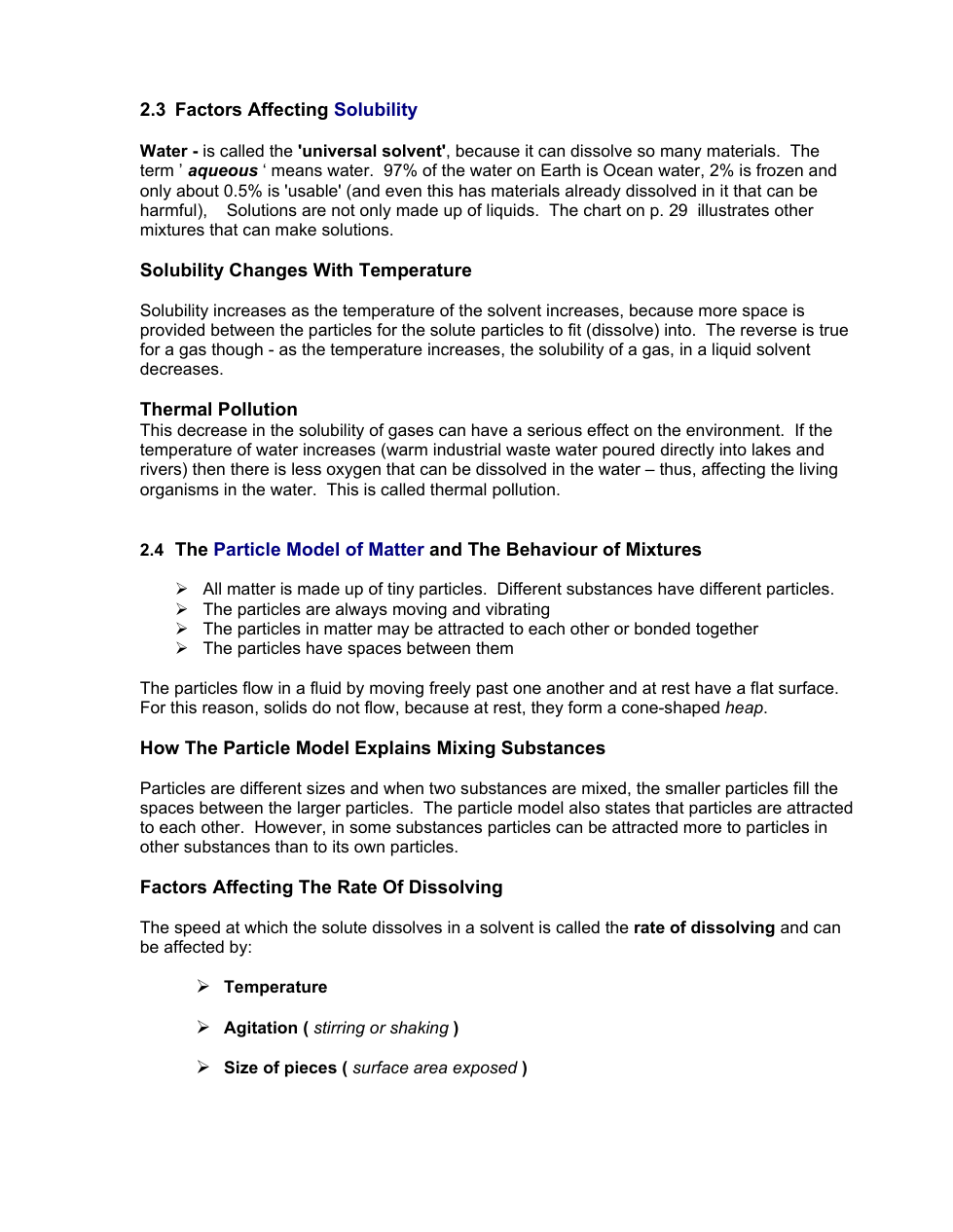
Measuring Concentration: Concentration is "the actual amount of solute in a specific amount of solvent," often expressed in grams per 100 ml (e.g., "50 grams of solute dissolved in 100 ml of water has a concentration of 50g/100ml"). It can also be expressed as a percentage (e.g., "5% (means, 5g/100ml)") or in ppm for very low concentrations.
Comparing Concentrations: Requires knowing "the amount of solute in the same volume of solvent for each solution."
Solubility: Defined as "the maximum amount of solute that can be dissolved in a fixed volume of solvent at a given temperature." This limit defines whether a solution is saturated or unsaturated.
A saturated solution is one where "no more solute will dissolve...at a specific temperature." This occurs when "the attractive forces between the particles becomes balanced and no more particles of the solute can be attracted by the particles of the solvent."
An unsaturated solution is one where "more solute can be dissolved...at the same specific temperature."
A supersaturated solution "contains more solute than would normally dissolve at a certain temperature." A Solubility Chart (sia p. 28) is mentioned as a resource for this property.
5. Factors Affecting Solubility:
Water is highlighted as the "'universal solvent'," capable of dissolving many materials. The term "'aqueous'" means water. The document also notes the limited availability of "usable" fresh water and the presence of dissolved materials.
Solutions can be formed from various combinations of states of matter, as illustrated in a chart on p. 29.
Temperature significantly affects solubility:
For most solids and liquids, "solubility increases as the temperature of the solvent increases, because more space is provided between the particles for the solute particles to fit (dissolve) into."
For gases in liquid solvents, "as the temperature increases, the solubility of a gas...decreases."
Thermal Pollution: The decrease in gas solubility due to increased water temperature (e.g., from industrial waste water) can lead to less dissolved oxygen, "thus, affecting the living organisms in the water."
6. Factors Affecting the Rate of Dissolving:
The rate of dissolving (how quickly a solute dissolves) is influenced by:
Temperature: Higher temperature generally increases the rate.
Agitation (stirring or shaking): Increases the rate by bringing fresh solvent into contact with the solute.
Size of pieces (surface area exposed): Smaller pieces (larger surface area) dissolve faster.
Quotes:
"All mixtures contain two or more pure substances, which have their own distinct properties (some of which may be hidden)"
"Homogenous Mixtures - are mixtures which look as though they have only one set of properties."
"if the homogenous mixture does not have any settling of any of the substances it is made of, then it is called a solution - solutions occur because each particle slips between each other particle and is evenly distributed throughout the entire mixture"
"Heterogenous Mixtures - the properties of the pure substances, in a heterogeneous mixture, are not hidden"
"a heterogeneous mixture, in which the particles settle slowly after mixing, is called a suspension (eg. orange juice)"
"a heterogeneous mixture, in which the particles do not settle at all, is called a colloid (eg. fog)"
"a solution that contains more solute than would normally dissolve at a certain temperature is called a super-saturated solution."
"Water - is called the 'universal solvent', because it can dissolve so many materials."
"Solubility increases as the temperature of the solvent increases, because more space is provided between the particles for the solute particles to fit (dissolve) into."
"as the temperature increases, the solubility of a gas, in a liquid solvent decreases."
"The speed at which the solute dissolves in a solvent is called the rate of dissolving and can be affected by: Temperature, Agitation ( stirring or shaking ), Size of pieces ( surface area exposed )"
Conclusion:
The notes offer a comprehensive introduction to the particle model of matter and its application to understanding mixtures and solutions. The document clearly defines key terms, classifies different types of mixtures, explains the concepts of concentration and solubility, and highlights practical techniques like paper chromatography. It also emphasizes the influence of factors like temperature on solubility and the dissolving rate, including the environmental impact of thermal pollution. The particle model serves as a unifying concept to explain the observed properties and behaviors of matter in its various forms.

Use the words to complete a visual organizer, showing the relationships between and among the words provided. Use each word or phrase only once.
Mixtures can be made with solids, liquids or gases. The kind of mixture or solution that is referred to as heterogeneous is a mixture or solution which...
For some fluids, paper chromatography is a test that determines whether a substance is a ...
An insulating foam is sprayed into cracks to seal them. The gas and liquid together make a ...
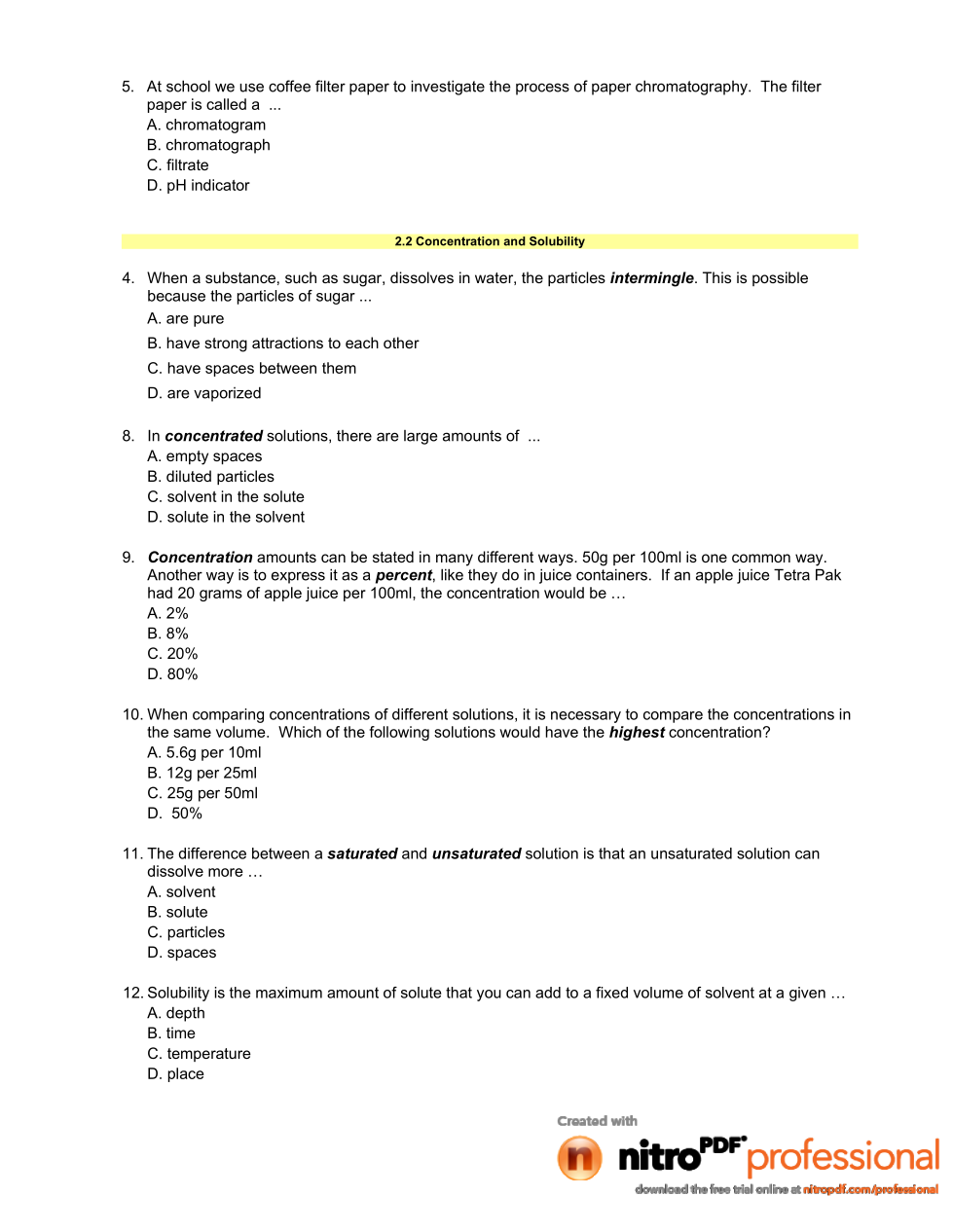
At school, we use coffee filter paper to investigate the process of paper chromatography. The filter paper is called a ...
When a substance, such as sugar, dissolves in water, the particles intermingle. This is possible
because the particles of sugar ...
In concentrated solutions, there are large amounts of ...
Concentration amounts can be stated in many different ways. 50g per 100 ml is one common way. Another way is to express it as a percent, like they do in juice containers. If an apple juice Tetra Pak had 20 grams of apple juice per 100 ml, the concentration would be ...
When comparing concentrations of different solutions, it is necessary to compare the concentrations in the same volume. Which of the following solutions would have the highest concentration?
The difference between a saturated and unsaturated solution is that an unsaturated solution can dissolve more ...
Solubility is the maximum amount of solute that you can add to a fixed volume of solvent at a given...
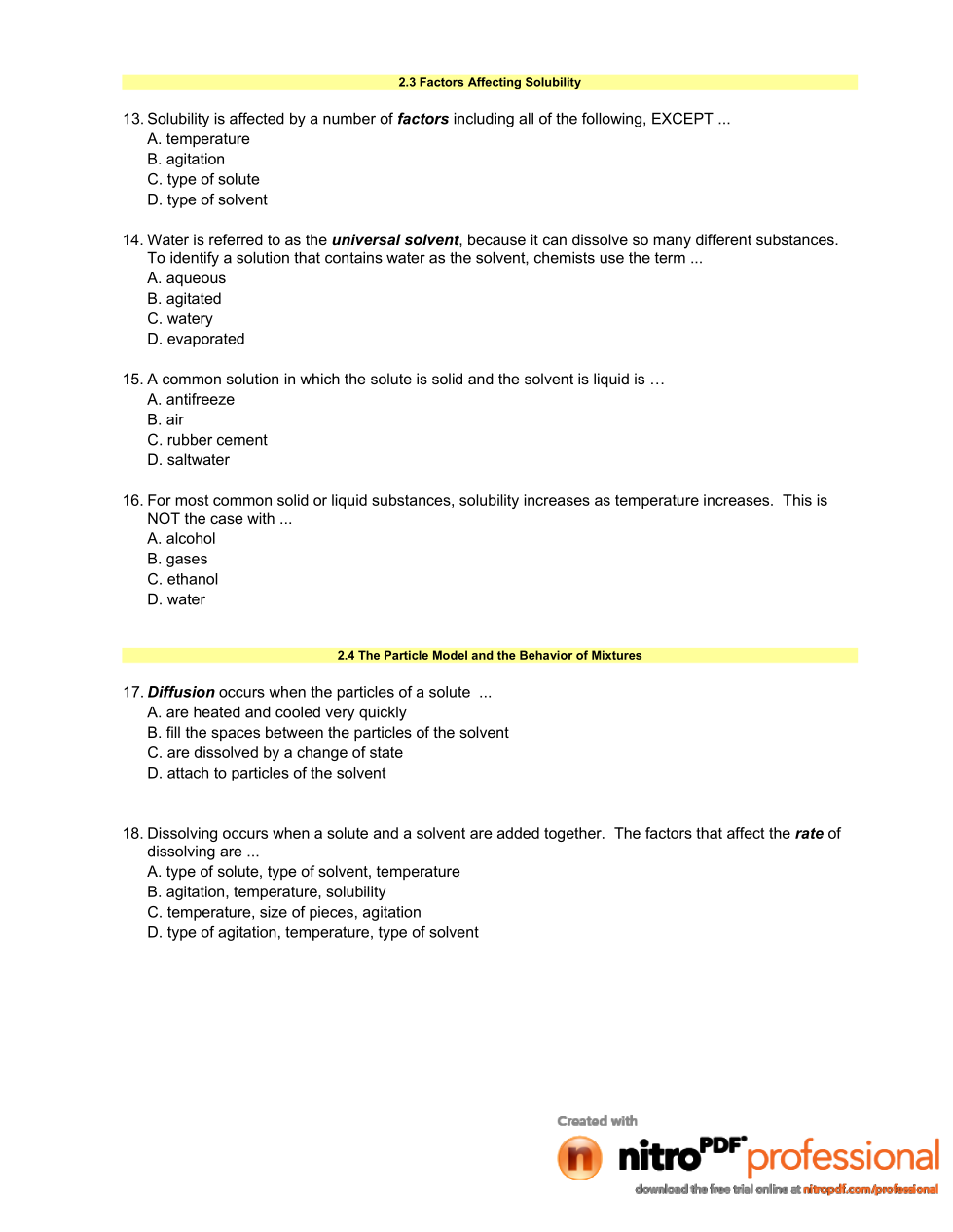
Solubility is affected by a number of factors, including all of the following, EXCEPT ...
Water is referred to as the universal solvent, because it can dissolve so many different substances. To identify a solution that contains water as the solvent, chemists use the term ...
A common solution in which the solute is solid and the solvent is liquid is ...
For most common solid or liquid substances, solubility increases as temperature increases. This is
NOT the case with...
Diffusion occurs when the particles of a solute ...
Dissolving occurs when a solute and a solvent are added together. The factors that affect the rate of
dissolving are ...