8th Science- Winter Break Assignment
star
star
star
star
star
Last updated about 3 years ago
14 Nsɛmmisa

0
0
0

0
0
0
0
0
0
0
0
0
0
0
Have a great few weeks off! You have worked so hard this year and have earned this break. This packet is due January 6, students who do not complete this will be asked to complete it when we return to school. Enjoy time with those who you love and care about, and I cannot wait to hear about all of your adventures when we return.
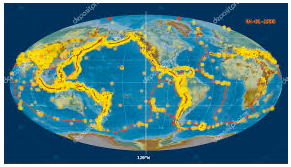
Define potential energy in your own words.
Define kinetic energy in your own words.
1. Identify the energy type for the following items (a-e).
i. Energy: the ability to make things move or change
ii. Potential Energy: the energy that is stored in an object or system
iii. Kinetic Energy: the energy that an object has because it is moving
iv. No energy (N/E): Not moving, would need energy transferred into it to move
a) Food that can be converted to human energy
b) A fan not spinning
c) Light waves from the sun
d) Sound waves from the radio
e) A stretched rubber band
Two magnets are pushed with a force of 10N to the right
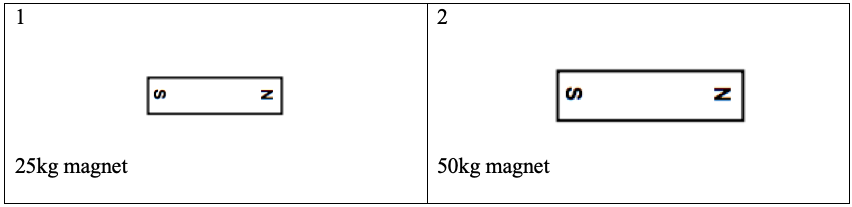
Which magnet will travel at a greater velocity after the collision? (think: mass and velocity acceleration)
What is the relationship between mass and velocity? (assume force is constant)
CFS:
· accurately identifies the changes to each object when a force is applied
· accurately describes the relationship between force, mass and velocity
How could you force Magnet 1 and Magnet 2 to move at the same velocity after a second collision?
CFS:
· accurately identifies the changes to each object when a force is applied
· accurately describes the relationship between force, mass and velocity
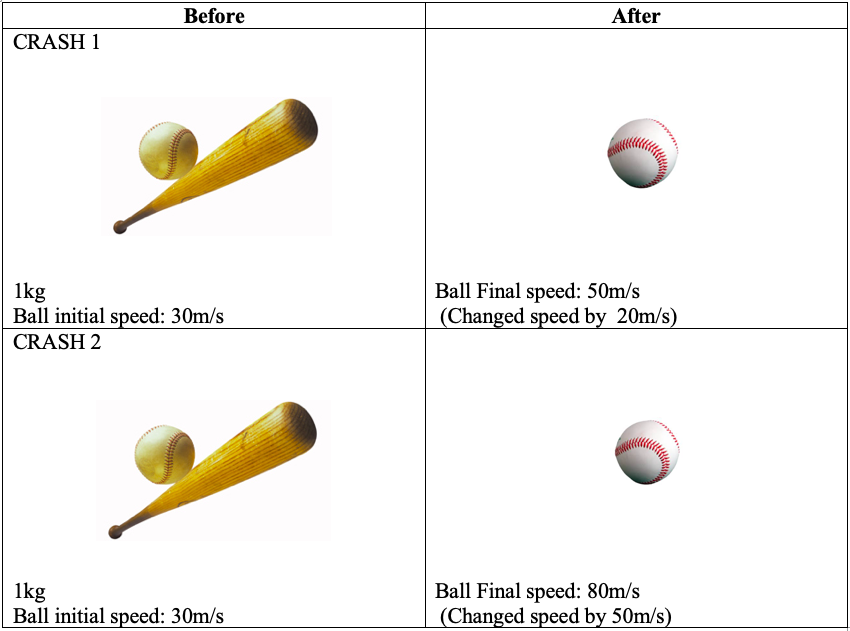
In which crash did the ball experience a greater force?
Why do you think Crash 1 or 2 has more force than the other? Use the words (force, mass, change in speed)
CFS:
· accurately describes the relationship between force, mass and velocity
Complete the following mathematical questions using the equations provided.
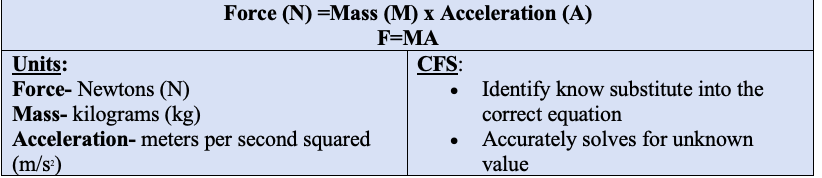
Teacher Example: Group one found that their jar lid traveled at 10ms/2 . If their jar lid had a mass of 1kg what was the force applied to the jar lid?

A person pushes a car and applies 50N of force to the back of the car. If the car had a mass of 100kg . What was the acceleration of the car?
A piece of paper is thrown at 30m/s2. If the paper has a mass of .1kg . What was the force applied to the paper?
How much force would you need to apply to each magnet for them to both move at and acceleration of 100 m/s2.
Magnet 1 (25kg)
Magnet 2 (50gk)
Complete the following repelling and attracting magnetic diagrams by:
a. Identifying the missing poles
b. Drawing magnetic field lines for each magnetic pair
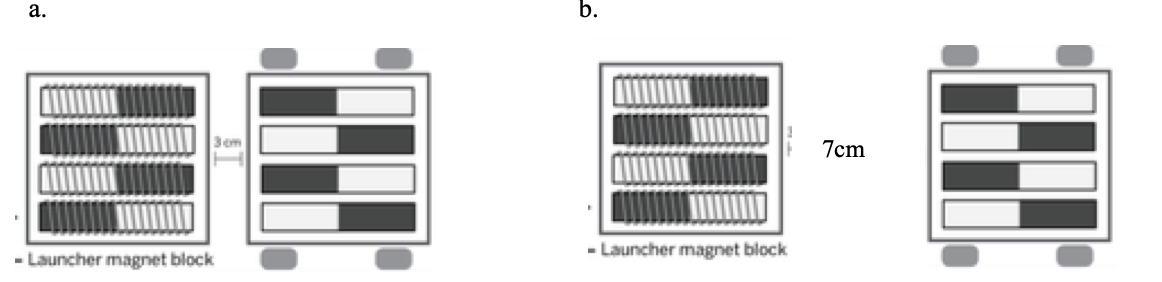
Why do you think Model 1 or 2 will move at a greater velocity than the other? Use the 3 of the words (distance, force, potential energy, strength)
CFS:
· Accurately identify how magnetic arraignment impacts velocity
· Accurately describes the relationship between magnetic forces and velocity