Log in
Sign up for FREE
arrow_back
Library
APUSH Period 3.1 Quiz (Ch. 7-8) - SY2021
By Haiyen Truong
star
star
star
star
star
Share
share
Last updated over 1 year ago
10 questions
Add this activity
1
2
3
4
5
zoom_in
1
KC 2.2.I
NAT 2.0
1
KC 3.1.I
WXT 1.0
1
KC 3.1.II
NAT 1.0
1
KC 3.2.I
NAT 1.0
1
KC 3.1.II
POL 1.0
6
7
8
9
10
zoom_in
1
CUL 1.0
KC 3.1.II
1
KC 3.2.I
NAT 1.0
RAG.01
1
IIUR.01
KC 3.1.II
WOR 2.0
1
CUL 4.0
IIRC.02
KC 3.1.II
1
CUL 4.0
IIUR.01
KC 3.1.II
Question 1
1.
In colonial elections,
the right to vote was reserved for property holders.
most eligible voters zealously exercised their right to vote.
average citizens were usually elected to office.
slavery came to be a dominant issue.
Question 2
2.
Despite some economic benefits, the American colonists generally disliked the mercantile system because it
required American colonists to show economic initiative and self-sufficiency on the world market that they were unwilling to show.
stifled economic initiative and forced colonists to depend on British government agencies and creditors.
favored the northern over the southern colonies.
forced the South into a one-crop economy.
Question 3
3.
Colonists objected to the enactment of the Stamp Act in 1765 because they
opposed all taxes.
objected to its violation of “no taxation without representation.”
desired immediate political independence from Great Britain.
believed it could not be repealed.
Question 4
4.
As the War for Independence began, the colonies had the advantage of
a well-organized, strongly committed, and united population.
many outstanding civilian and military leaders.
potential aid from the Armed Neutrality League.
highly reliable and well-supplied troops.
Question 5
5.
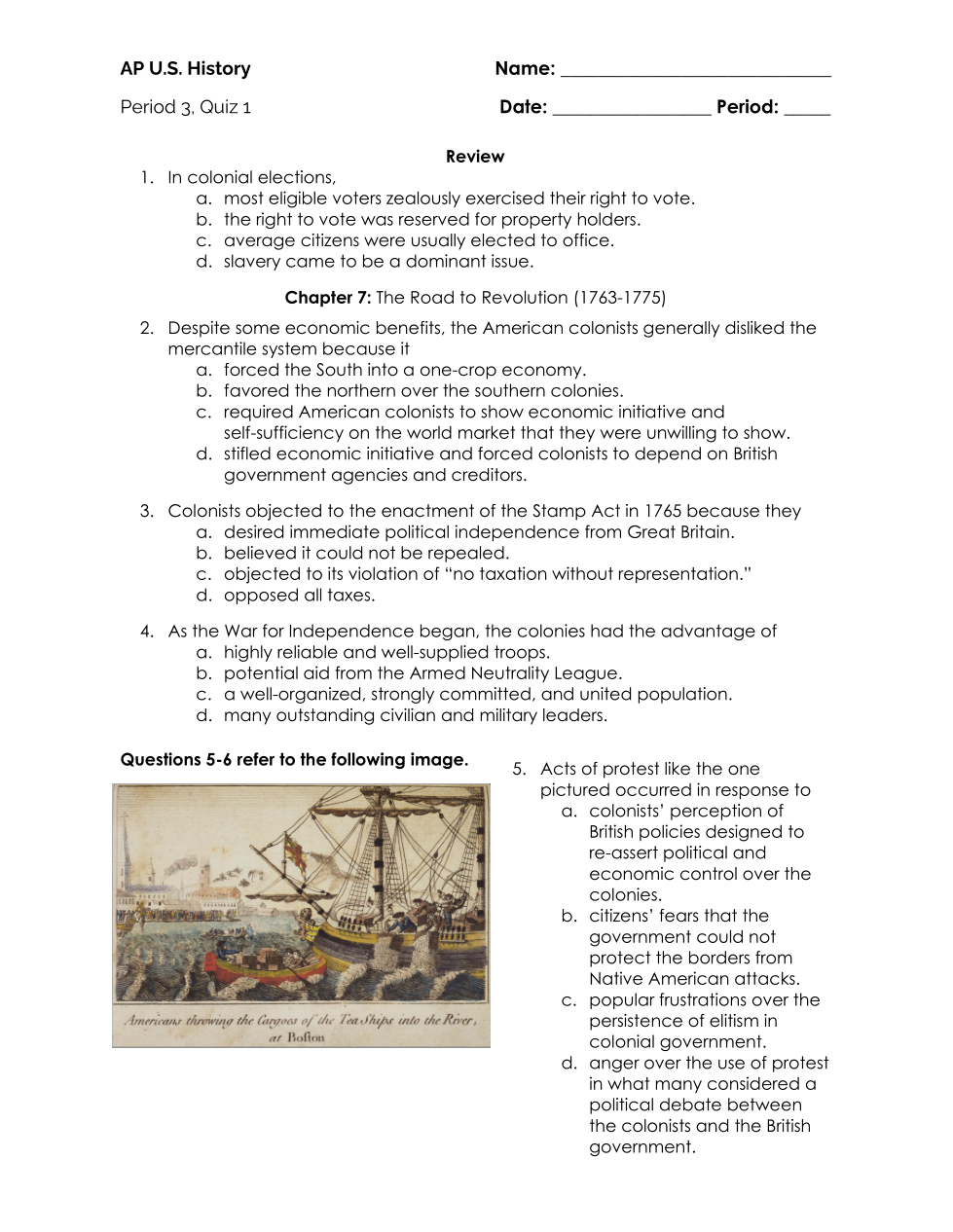
Acts of protest like the one pictured occurred in response to
citizens’ fears that the government could not protect the borders from Native American attacks.
anger over the use of protest in what many considered a political debate between the colonists and the British government.
popular frustrations over the persistence of elitism in colonial government.
colonists’ perception of British policies designed to re-assert political and economic control over the colonies.
Question 6
6.
The British response to events like the one pictured here
helped consolidate European support for the British crown.
strengthened the resolve of more colonists to resist British policies.
attempted to counteract the colonists financial advantages.
were based on the British commitment to the Enlightenment.
Question 7
7.
The Declaration of Independence did all of the following
EXCEPT
offer the British one last chance at reconciliation.
invoke the natural rights of humankind to justify revolt.
catalog the tyrannical actions of King George III.
argue that royal tyranny justified rebellion.
Question 8
8.
The American military alliance with France
was less important to American success than the popular militia.
forced Britain into a worldwide struggle for its life.
was based on shared revolutionary ideals.
became a permanent source of strength to both countries.
Question 9
9.
To encourage African Americans to fight in the Revolutionary War, Hamilton suggested in the excerpt that they should be promised
equal wages with white soldiers.
an end to prejudice.
effective leadership from officers.
emancipation from slavery.
Question 10
10.
Which of the following was the primary reason for Hamilton’s call for African American soldiers?
General Washington entrusted that blacks would make good soldiers.
the Declaration of Independence called for equal rights.
the New York militia was short of troops.
the British were recruiting African Americans.