It is against the Academic Integrity policy of our district to discuss, share, hint or dessiminate any information pertaining to this test, until such time as the test is released. It is also against said policy to ask for or receive outside help, either from a person, study tools, or the internet. Consequences such as revoked test access and zero points alloted for test scores, and/or NHS and recommendation letters implications, are all possible. By signing your name on the space below, you are reaffirming your acceptance of these policies and accepting the consequences should you fail to abide by these policies.
0 points
0
Question 1
1.
Sign your name below using the squiggle tool. It doesn't have to be neat.
2.5 points
2.5
Question 2
2.
Which molecule is the result of a reduction in the Krebs Cycle?
2.5 points
2.5
Question 3
3.
Which terms applies to photosynthesis? check all that apply
2.5 points
2.5
Question 4
4.
What molecule acts as the final electron acceptor of photosynthesis?
2.5 points
2.5
Question 5
5.
Use the following passage and data tables to answer the following question
A student placed 20 tobacco seeds of the same species on moist paper towels in each of two petri dishes. Dish A was wrapped completely in an opaque cover to exclude all light. Dish B was not wrapped. The dishes were placed equidistant from a light source set to a cycle of 14 hours of light and 10 hours of dark. All other conditions were the same for both dishes. The dishes were examined after 7 days, and the opaque cover was permanently removed from dish A. Both dishes were returned to light and examined again at 14 days. The following data were obtained.
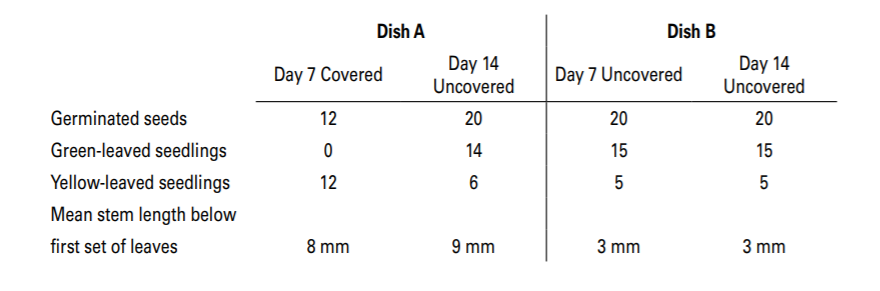
The most probable cause for the difference in mean stem length between plants in dish A and plants in dish B is which of the following
2.5 points
2.5
Question 6
6.
Two nutrient solutions are maintained at the same pH. Actively respiring mitochondria are isolated and placed into each of the two solutions. Oxygen gas is bubbled into one solution. The other solution is depleted of available oxygen. Which of the following best explains why ATP production is greater in the tube with oxygen than in the tube without oxygen?
2.5 points
2.5
Question 7
7.
Use the following passage and data tables to answer the following question
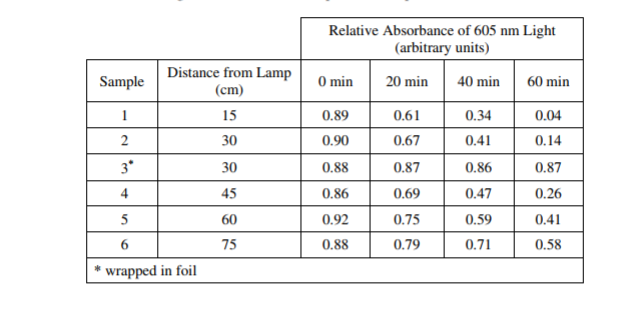
Photosynthetic activity can be measured using chloroplasts suspended in a buffered solution containing DCPIP, a blue dye that can accept electrons from the electron transport chain of photosynthesis.
Transfer of electrons to DCPIP decreases the relative absorbance of a specific wavelength of light (605 nm) by a solution that contains the dye. In other words, as more electrons are released from the chloroplasts and transferred to DCPIP, the dye becomes more clear and less blue, and the relative absorbance at 605 nm decreases.
A buffered solution containing chloroplasts and DCPIP was divided equally among six identical samples. The samples were placed at various distances from a lamp, and then all samples were exposed to white light from the lamp for 60 minutes at room temperatures. Sample 3 was wrapped in foil to prevent any light from reaching the solution. At 20-minute intervals, the photosynthetic activity in each sample was determined by measuring the relative absorbance of 605 nm light. The results of the experiment are provided below.
A conclusion that can be drawn from the experiment is that
2.5 points
2.5
Question 8
8.
Which of the following statements regarding photorespiration is true?
2.5 points
2.5
Question 9
9.
In a biological reaction, succinate dehydrogenase catalyzes the conversion of succinate to fumarate. The reaction is inhibited by malonic acid, a substance that resembles succinate but cannot be acted upon by succinate dehydrogenase. Increasing the amount of succinate molecules to those of malonic acid reduces the inhibitory effect of malonic acid. Select the correct identification of the molecules described in the reaction
2.5 points
2.5
Question 10
10.
Consider the metabolic pathway shown below. If there is feedback inhibition, which product (B to E) would most likely inhibit which enzyme (1 to 4)?
Enzymes: 1 2 3 4
product/reactant: A ----> B ----> C -----> D -----> E
2.5 points
2.5
Question 11
11.
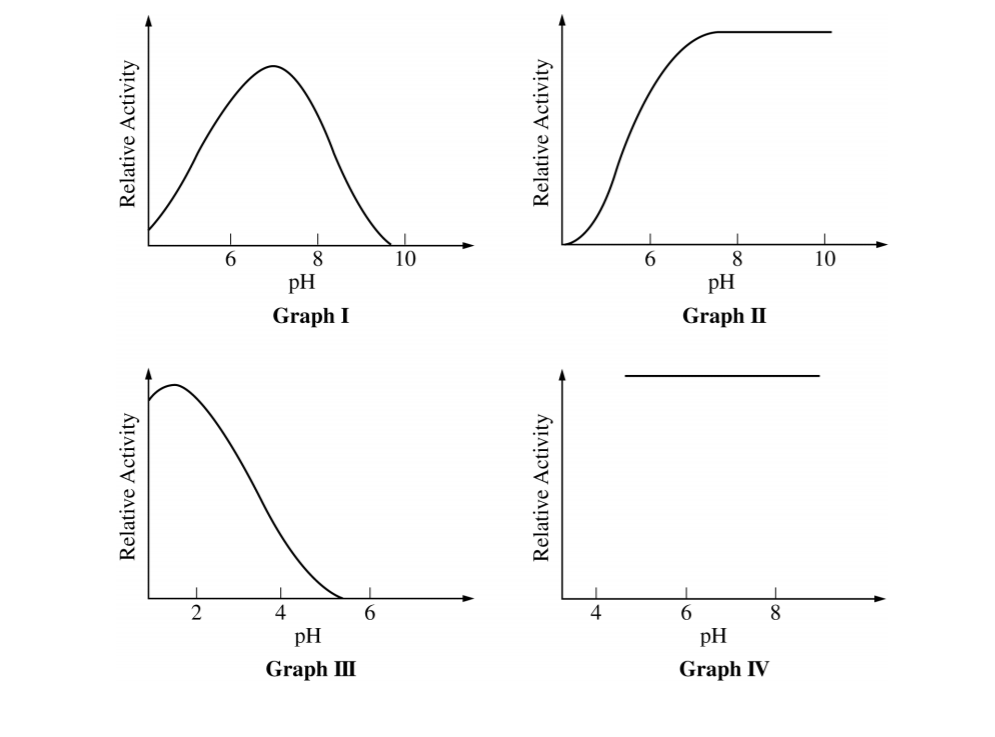
Graphs I - IV depicts the effect of pH on the activity of four different enzymes.
Graphs representing enzymes sensitive to changes in pH are best represented by which of the following graphs
2.5 points
2.5
Question 12
12.
The CTFR protein is made up of 1,480 amino acids linked together in a chain. Some humans produce a version of the CTFR protein in which phenylalanine (an amino acid) has been deleted from the amino acid chain. Which of the following best predicts how the amino acid deletion will affect the structure of the CTFR protein?
2.5 points
2.5
Question 13
13.
The ATP made during glycolysis is generated by
2.5 points
2.5
Question 14
14.
Fats and proteins can be used as fuel in the cell because they
2.5 points
2.5
Question 15
15.
Muscle cells in oxygen deprivation gain which of the following from the reduction of pyruvate?
2.5 points
2.5
Question 16
16.
In thylakoids, protons travel through ATP synthase from the thylakoid space to the stroma. Therefore, the catalytic sites of ATP synthase, where ADP +P will bind, would be located
2.5 points
2.5
Question 17
17.
In an enzyme catalyzed reaction, increasing substrate concentration will
2.5 points
2.5
Question 18
18.
The impact of which of the following could be reduced by increasing the substrate concentration?
2.5 points
2.5
Question 19
19.
Rubisco
8 points
8
Question 20
20.
An absorption spectrum indicates the relative amount of light absorbed across a range of wavelengths. The graphs below represent the absorption spectra of individual pigments isolated from two different organisms. One of the pigments is chlorophyll A, commonly found in green plants (remember green plants do not absorb green wavelengths of light). The other pigment is bacteriorhodopsin, commonly found in purple photosynthetic bacteria (so they do not absorb purple light). The table above shows the approximate ranges of wavelengths of different colors in the visible light spectrum.
Identify the pigment (chlorophyll A or bacteriorhodopsin) used to generate the absorption spectrum in each of the graphs above. Justify your answer.
then
In an experiment, identical organisms containing the pigment from Graph II as the predominant light-capturing pigment are separated into three groups. The organisms in each group are illuminated with light of a single wavelength (650 for the first group, 550 nm for the second group, and 430 nm for the third group). The three light sources are of equal intensity, and all organisms are illuminated for equal lengths of time. Predict the relative rate of photosynthesis in each of the three groups. Justify your predictions.