What is the domain of the function pictured?
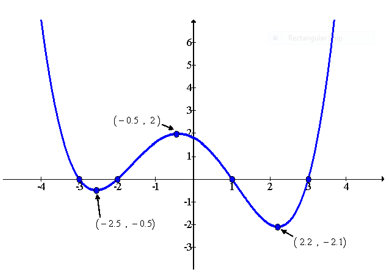
What is the domain of the function pictured?
Solve the following quadratic equation using Quadratic Formula. Your answer should be an EXACT value.
Simplify AND write in standard complex form:
Simplify:
Simplify AND write in standard complex form:
Find ALL the solutions to the equation:
Identify the fourth term of the binomial expansion:
what does this information tell you about the value of 2 in the function?
Factor the polynomial completely:
Find all ZEROS to the function:
Which of the following could NOT be a rational root of
Solve:
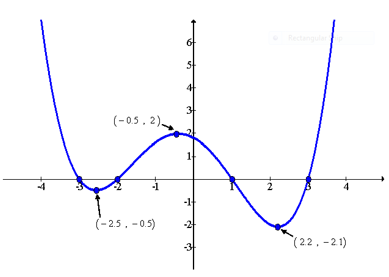
What is the domain of the function pictured?
What is the range of the function pictured?
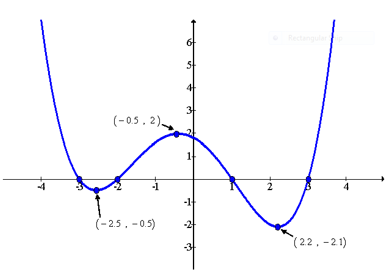
What are the ZEROS of the function?
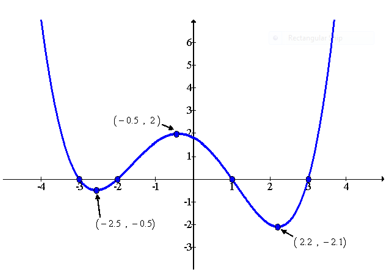
Over which interval(s) is the function INCREASING?
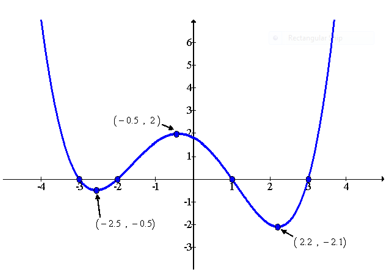
What is the RELATIVE MAXIMUM y-value of the function?
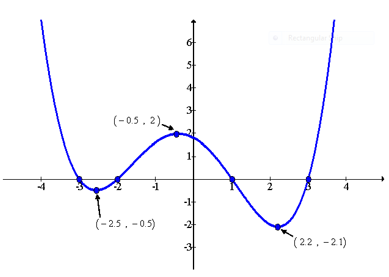
What is the end behavior of the function?
What is/are the solution(s) of the system below? You MUST use substitution or elimination to solve.
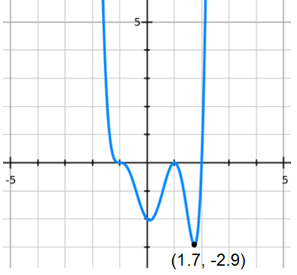
Using the graph of the function, find the average rate of change over the interval [-1, 1.7]. Round your answer to TWO DECIMAL PLACES.
What are the excluded values, if any, for the following rational expression?
Simplify:
Simplify:
Simplify:
Simplify:
Solve. Remember to check for extraneous solutions!
Which of the graphs best represent the function:
Identify the HORIZONTAL ASYMPTOTE of the rational function.
Identify the X-INTERCEPT of the rational function. (WRITE YOUR ANSWER AS AN ORDERED PAIR)
Identify the Y-INTERCEPT of the rational function. WRITE YOUR ANSWER AS AN ORDERED PAIR.
Identify the HOLE of the rational function. WRITE YOUR ANSWER AS AN ORDERED PAIR.
Identify the VERTICAL ASYMPTOTE of the rational function.
Identify the HORIZONTAL, VERTICAL, and SLANT ASYMPTOTES of the rational function: