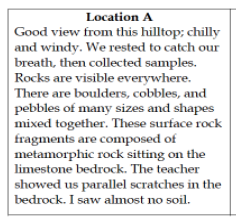
What method of erosion (water, wind, gravity, or glaciers) formed the features at this location? Answer the questions using the C-E-R method below. Answer questions 14-16 in complete sentences.
What is meant by “horizontal sorting” (describe how the sediments are sorted)?
How is the changing velocity of a stream related to horizontal sorting?
Directions: Practice using this chart on page 6 of your ESRT.
Look at all the titles for both the X and Y axes.
Notice that the axes are NOT linear. They are called a logarithmic or exponential scale. This means that each major division is 10X the previous value.
When asked to NAME particles, go to the stream velocity, go up to the curved line and notice the name of the particle at the exact point where you have stopped. This particle and all others below it can be carried at that water velocity. Particles above that point cannot be carried.
You should use the edge of a piece of paper to align your water velocity and/or particle diameter with the curved line. If you try to "eye ball" your answer, you may get an incorrect answer.
Name ALL the particles (sediments) that will be carried by water velocity of 1cm/sec
Name ALL the particles (sediments) that will be carried by water velocity of 30 cm/sec
Name ALL the particles (sediments) that will be carried by water velocity of 200 cm/sec
What particle(s) will be deposited if a stream moving at 100 cm/sec suddenly decreases in velocity to 10 cm/sec
State the water velocity necessary to maintain the transport of 6.4 cm particle diameter
Describe how wind deposits sediments as it slows.
How can sand dunes help tell the wind direction?
Directions: Read the text about glacial erosion and answer the following questions
What is the driving force behind glacial movement?
What are the two ways that glaciers erode (remove and transport sediments)?
What evidence would support that glacial erosion has occured?
mixture of particles and rocks of all sizes.
sorted sediments (by size) because of velocity
Deltas
Glacial erratics
Dunes
sorted sediments (by size) because of velocity
moraines
landslides
mudflow
rounded sediments
angular sediements
angular sediements
mixture of particles and rocks of all sizes.
Glacier depositional features
Water depositional features
Wind depostional features
Gravity depostional features
What method of erosion (water, wind, gravity, or glaciers) formed the features at this location? Answer the questions using the C-E-R method below. Answer questions 14-16 in complete sentences.
Claim: Answer the question in a complete sentence.
Evidence: What are two observable characteristics that led you to your claim.
Reasoning: Why do your observable characteristics support your claim? (Provide the scientific background that explains the presence of this characteristic)