Which of the figures below shows the translation described by the rule (x, y) --> (x + 4, y + 4)
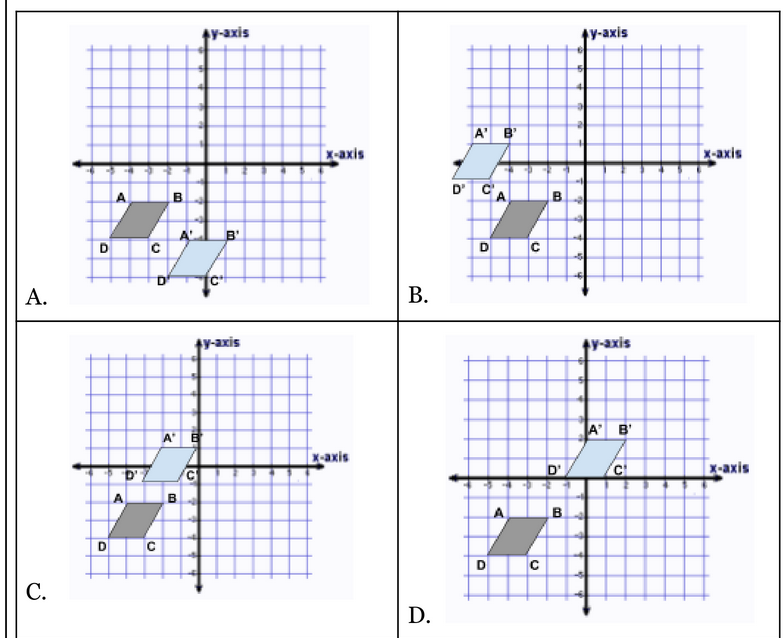
Which of the figures below shows the translation described by the rule (x, y) --> (x + 4, y + 4)
A change in position, size, or shape of a figure on a coordinate plane.
A type of transformation that results in the enlargement or reduction of an image.
A type of transformation involving a slide of the graphed figure.
A type of transformation involving a flip of the graphed figure.
A type of transformation in which a figure is turned about a fixed point a certain number of degrees.
A figure is translated 3 units to the right and down 2 units. Select the algebraic expression that shows how the translation affects the coordinates of the preimage.
Which of the figures below shows the translation described by the rule (x, y) --> (x + 4, y + 4)
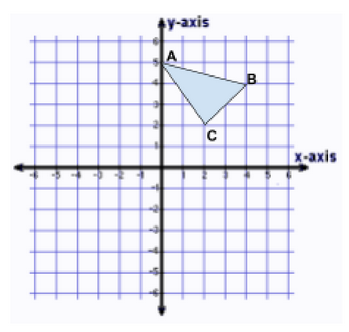
∆ABC is reflected over the y-axis to create ∆A'B'C'. What algebraic representation explains the effect of this reflection?
∆ABC is reflected over the x-axis to create ∆A'B'C'. What algebraic representation will be applied to complete this transformation?
Quadrilateral KLMN has vertices: K(3, -2) L(6, -3) M(8, -6) and N(5, -5). The figure is rotated 90° clockwise about the origin. What are the coordinates of M'?
Rectangle WXYZ has vertices: W(-2, -3) X(-2, 1) Y(4, 1) and Z(4, -3). The figure is rotated 90° counter-clockwise about the origin. What are the coordinates of Z'?
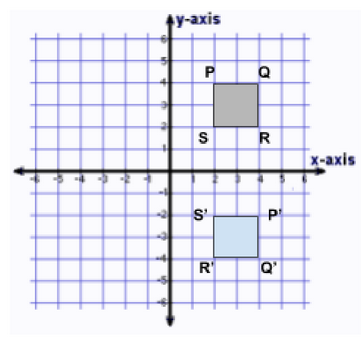
Given the transformation below, which of the following transformation rules represents the transformation from square PQRS to square P'Q'R'S'?
Which transformation does NOT produce congruent figures?
Which transformation does NOT produce congruent figures?
Rectangle ABCD has vertices: A(0, -2) B(0, 1) C(4, 1) and D(4, -2). After a transformation is applied to the rectangle, it's image has vertices: A'(2, 0), B'(-1, 0), C'(-1, 4) and D'(2, 4). Which of the following transformations was applied to the rectangle?
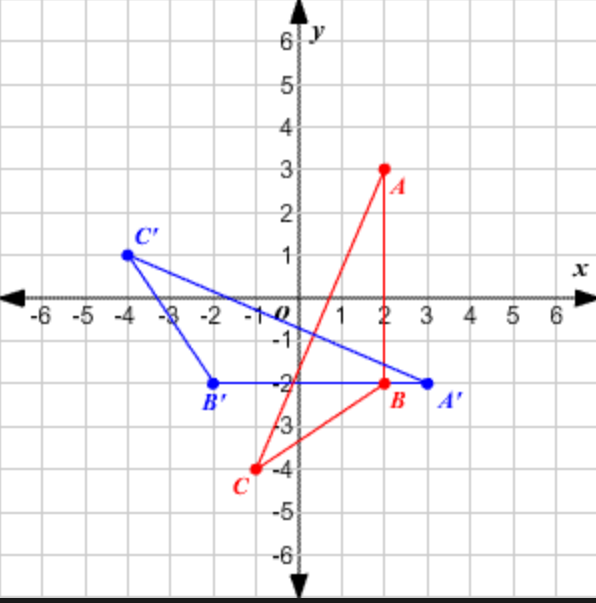
Which of the following transformations was applied to ∆ABC to create ∆A'B'C'?
Sketch the image quadrilateral A'B'C'D' under a translation (x, y) --> (x + 5, y - 3)
Sketch the image quadrilateral A'B'C'D' under a reflection across the line y = x
Sketch the image quadrilateral A'B'C'D' under a 180° counter-clockwise rotation about the origin.
Sketch the image quadrilateral A'B'C'D' under a dilation of magnitude 2.