Log in
Sign up for FREE
arrow_back
Library

Astronomy session 2 test

star
star
star
star
star
Last updated 5 months ago
15 questions
1
1
1
10
1
1
3
1
3
4
1
1
3
3
1
Question 1
1.

When light hits an atom, what is excited and jumps an energy level?

Question 2
2.

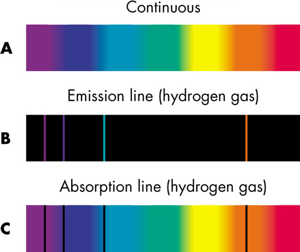
When light from a sun that passes through a thick atmosphere is split with a diffraction grating it appears to emit a

Question 3
3.

When hot dense materials like a tungstun filiment (in an incansecent lightbulb) is split with a diffraction grating it appears to emit a

Question 4
4.

Which has the least momentum?

Question 5
5.

Two objects have the same velocity, but one has twice the mass of the other. Compare the momentums of the two objects.

Question 6
6.

What is plasma in astronomy

Question 7
7.

explain the difference between fission and fusion

Question 8
8.

If an object like a star is moving towards the Earth, the spectral lines are observed to be

Question 9
9.

What is the difference between a mechanical wave and an electromagnetic wave?

Question 10
10.

When an astronomer looks at spectra from a star, they look at four different characteristics. Match the characteristic to what it means.

Question 11
11.

A wave along a string is a transverse wave. The fibers of the string move up and down. What moves along the string, perpendicular to the motion of the string?

Question 12
12.

A light shines red. In order to make the light shine blue you must

Question 13
13.

Before a rocket blasts off, the rocket is motionless and therefore has 0 momentum. When the rocket blasts off the rocket and the fuel are both moving, and therefore have momentum. How can momentum be conserved after a blast like that?

Question 14
14.

Explain why a cloud of a specific gas will emit only light at a specific wavelength but if you shine light through that same cloud, you will get a full spectrum _EXCEPT_ the lines at that specific wavelength.
Question 15
15.

Why does it seem like momentum is not conserved when a ball gains speed moving downhill?