SCHS Spanish 3 APA Semester Midterm Exam 2020-2021
star
star
star
star
star
Last updated about 5 years ago
70 questions
Note from the author:
Spanish 3 Semester Midterm 2020
1
Choose the correct form of the verb in the PRESENT tense int he following sentence:
Los atletas ___ (correr) en el campo todos los días de la semana.
Choose the correct form of the verb in the PRESENT tense int he following sentence:
Los atletas ___ (correr) en el campo todos los días de la semana.
1
Choose the correct form of the verb in the PRESENT tense int he following sentence:
Yo _____ (hablar) por teléfono todos los días con mi mejor amiga.
Choose the correct form of the verb in the PRESENT tense int he following sentence:
Yo _____ (hablar) por teléfono todos los días con mi mejor amiga.
1
Choose the correct form of the verb in the PRESENT tense int he following sentence:
Mis abuelos y yo _____ (pasar) tiempo juntos todos los fines de semana.
Choose the correct form of the verb in the PRESENT tense int he following sentence:
Mis abuelos y yo _____ (pasar) tiempo juntos todos los fines de semana.
1
Choose the correct form of the verb in the PRESENT tense in the following sentence:
Los estudiantes _____ (comer) el almuerzo en la cafetería.
Choose the correct form of the verb in the PRESENT tense in the following sentence:
Los estudiantes _____ (comer) el almuerzo en la cafetería.
1
Choose the correct form of the verb in the PRESENT tense int he following sentence:
Ella _____ (ir) a la escuela todos los días.
Choose the correct form of the verb in the PRESENT tense int he following sentence:
Ella _____ (ir) a la escuela todos los días.
1
Choose the correct form of the irregular verb in the PRESENT tense.
Mis compañeros y yo _____ (jugar) bastante bien.
Choose the correct form of the irregular verb in the PRESENT tense.
Mis compañeros y yo _____ (jugar) bastante bien.
1
Choose the correct form of the irregular verb in the PRESENT tense.
Cuando nuestro equipo _____ (poder) meter un gol, ¡es fabuloso!
Choose the correct form of the irregular verb in the PRESENT tense.
Cuando nuestro equipo _____ (poder) meter un gol, ¡es fabuloso!
1
Choose the correct form of the irregular verb in the PRESENT tense.
Yo no _____ (hacer) la tarea de ciencias.
Choose the correct form of the irregular verb in the PRESENT tense.
Yo no _____ (hacer) la tarea de ciencias.
1
Choose the correct form of the irregular verb in the PRESENT tense.
Tú ____ (tener) que dormir temprano.
Choose the correct form of the irregular verb in the PRESENT tense.
Tú ____ (tener) que dormir temprano.
1
Choose the correct form of the irregular verb in the PRESENT tense.
Mi hermano _____ (jugar) fútbol.
Choose the correct form of the irregular verb in the PRESENT tense.
Mi hermano _____ (jugar) fútbol.
1
Choose the correct form of the irregular verb in the PRESENT tense.
Yo _____ (salir) con mis amigos al cine.
Choose the correct form of the irregular verb in the PRESENT tense.
Yo _____ (salir) con mis amigos al cine.
1
Choose the correct form of the irregular verb in the PRESENT tense.
Yo _____ (oir) a los pájaros cantar.
Choose the correct form of the irregular verb in the PRESENT tense.
Yo _____ (oir) a los pájaros cantar.
1
Choose the correct stem-changing verb in the PRESENT tense.
Después de la escuela yo _____ (preferir) ir al club para jugar al fútbol.
Choose the correct stem-changing verb in the PRESENT tense.
Después de la escuela yo _____ (preferir) ir al club para jugar al fútbol.
1
Choose the correct form of the irregular verb in the PRESENT tense.
Nuestra entrenadora _____ (pensar) que el equipo es bueno.
Choose the correct form of the irregular verb in the PRESENT tense.
Nuestra entrenadora _____ (pensar) que el equipo es bueno.
1
Choose the correct form of the irregular verb in the PRESENT tense.
Aveces nosotras _____ (perder) un partido.
Choose the correct form of the irregular verb in the PRESENT tense.
Aveces nosotras _____ (perder) un partido.
1
Read the following sentence and choose the best reflexive pronoun.
¿Tú ___ cepillas los dientes después de almorzar?
Read the following sentence and choose the best reflexive pronoun.
¿Tú ___ cepillas los dientes después de almorzar?
1
Read the following sentence and choose the best reflexive pronoun.
Laura _____ baña todas las mañanas.
Read the following sentence and choose the best reflexive pronoun.
Laura _____ baña todas las mañanas.
1
Read the following sentence and choose the best reflexive pronoun.
Ramón y Norma _____ toman fotos juntos.
Read the following sentence and choose the best reflexive pronoun.
Ramón y Norma _____ toman fotos juntos.
1
Read the following sentence and choose the best reflexive pronoun.
Yo _____ visto con ropa elegante para la cena formal.
Read the following sentence and choose the best reflexive pronoun.
Yo _____ visto con ropa elegante para la cena formal.
1
Read the following sentence and choose the best reflexive pronoun.
La Sra. Navarro _____ pinta las uñas por la noche.
Read the following sentence and choose the best reflexive pronoun.
La Sra. Navarro _____ pinta las uñas por la noche.
1
Complete the sentence with the correct indirect object pronoun.
A mis padres _____ gustan las buenas notas en la escuela.
Complete the sentence with the correct indirect object pronoun.
A mis padres _____ gustan las buenas notas en la escuela.
1
Complete the sentence with the correct indirect object pronoun.
A ti _____ encanta la música en español.
Complete the sentence with the correct indirect object pronoun.
A ti _____ encanta la música en español.
1
Complete the sentence with the correct indirect object pronoun.
A nosotros _____ interesa ir al cine.
Complete the sentence with the correct indirect object pronoun.
A nosotros _____ interesa ir al cine.
1
Complete the sentence with the correct indirect object pronoun.
A Joaquin _____ importan las canciones de Shakira.
Complete the sentence with the correct indirect object pronoun.
A Joaquin _____ importan las canciones de Shakira.
1
Complete the sentence with the correct indirect object pronoun.
A Uds. _____ importan las tareas para sus clases.
Complete the sentence with the correct indirect object pronoun.
A Uds. _____ importan las tareas para sus clases.
1
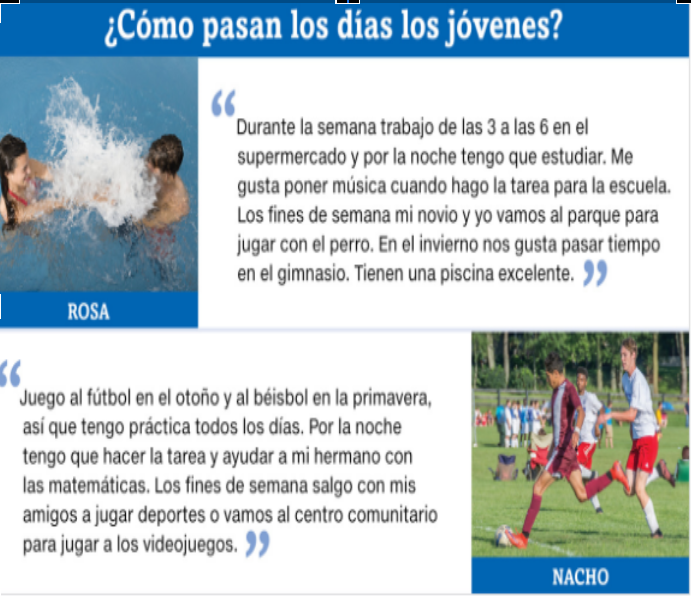
Lectura: Read and answer True or False according to the statements in the reading passage above.
Rosa trabaja en la biblioteca.
Lectura: Read and answer True or False according to the statements in the reading passage above.
Rosa trabaja en la biblioteca.
1
Lectura: Read and answer True or False according to the statements in the reading passage above.
A Nacho le gusta poner música cuando hace la tarea.
Lectura: Read and answer True or False according to the statements in the reading passage above.
A Nacho le gusta poner música cuando hace la tarea.
1
Lectura: Read and answer True or False according to the statements in the reading passage above.
Nacho es un muchacho muy deportivo.
Lectura: Read and answer True or False according to the statements in the reading passage above.
Nacho es un muchacho muy deportivo.
1
Lectura: Read and answer True or False according to the statements in the reading passage above.
A Rosa le gusta ir al gimnacio en el invierno por la piscina.
Lectura: Read and answer True or False according to the statements in the reading passage above.
A Rosa le gusta ir al gimnacio en el invierno por la piscina.
1
Lectura: Read and answer True or False according to the statements in the reading passage above.
Nacho ayuda a su hermano con la tarea por la mañana.
Lectura: Read and answer True or False according to the statements in the reading passage above.
Nacho ayuda a su hermano con la tarea por la mañana.
1
Lectura: Read and answer True or False according to the statements in the reading passage above.
Nacho no es muy sociable.
Lectura: Read and answer True or False according to the statements in the reading passage above.
Nacho no es muy sociable.
1
Read the sentence and choose the correct option: "to go" or "to be".
Yo no ____ a la escuela hoy.
Read the sentence and choose the correct option: "to go" or "to be".
Yo no ____ a la escuela hoy.
1
Read the sentence and choose the correct option: "to go" or "to be".
Los padres de Luis _____ bailarines.
Read the sentence and choose the correct option: "to go" or "to be".
Los padres de Luis _____ bailarines.
1
Read the sentence and choose the correct option: "to go" or "to be".
¿Tú _____ a la fiesta el viernes?
Read the sentence and choose the correct option: "to go" or "to be".
¿Tú _____ a la fiesta el viernes?
1
Read the sentence and choose the correct option: "to go" or "to be".
Juan _____ jugador de fútbol.
Read the sentence and choose the correct option: "to go" or "to be".
Juan _____ jugador de fútbol.
1
Choose the correct form of the preterite stem-changing verb to complete the sentence.
Pilar y yo nos _____ (reir) de los chistes que contó el presentador.
Choose the correct form of the preterite stem-changing verb to complete the sentence.
Pilar y yo nos _____ (reir) de los chistes que contó el presentador.
1
Choose the correct form of the preterite stem-changing verb to complete the sentence.
El entrenador y su equipo se _____ (vestirse) de rojo y blanco.
Choose the correct form of the preterite stem-changing verb to complete the sentence.
El entrenador y su equipo se _____ (vestirse) de rojo y blanco.
1
Choose the correct form of the preterite stem-changing verb to complete the sentence.
Eugenio y tú _____ (dormir) durante los comentarios.
Choose the correct form of the preterite stem-changing verb to complete the sentence.
Eugenio y tú _____ (dormir) durante los comentarios.
1
Choose the correct form of the preterite stem-changing verb to complete the sentence.
Yo me _____ (divertirse) mucho en el campeonato.
Choose the correct form of the preterite stem-changing verb to complete the sentence.
Yo me _____ (divertirse) mucho en el campeonato.
1
Choose the correct form of the preterite stem-changing verb to complete the sentence.
Nadie se _____ (morir) en el accidente después del partido.
Choose the correct form of the preterite stem-changing verb to complete the sentence.
Nadie se _____ (morir) en el accidente después del partido.
1
Cultura: Día de los Muertos - Choose the correct answer.
La familia y los amigos ponen flores amarillas o naranjas en los altares. Esta flor se llama __________.
Cultura: Día de los Muertos - Choose the correct answer.
La familia y los amigos ponen flores amarillas o naranjas en los altares. Esta flor se llama __________.
1
Cultura: Día de los Muertos - Choose the correct answer.
Es un tipo de salsa que tiene una variedad de ingredientes como chiles, chocolate, cebolla, y otras especies. Esta salsa la ponen encima del pollo. Es _______.
Cultura: Día de los Muertos - Choose the correct answer.
Es un tipo de salsa que tiene una variedad de ingredientes como chiles, chocolate, cebolla, y otras especies. Esta salsa la ponen encima del pollo. Es _______.
1
Cultura: Día de los Muertos - Choose the correct answer.
El _________ la gente celebra a los angelitos.
Cultura: Día de los Muertos - Choose the correct answer.
El _________ la gente celebra a los angelitos.
1
Cultura: Día de los Muertos - Choose the correct answer.
Es un dulce tradicional de azúcar.
Cultura: Día de los Muertos - Choose the correct answer.
Es un dulce tradicional de azúcar.
1
Teresa is describing words dealing with nature and camping equipment. Choose the correct answer.
Dormimos en él dentro de la tienda de acampar, cuando vamos de camping.
Teresa is describing words dealing with nature and camping equipment. Choose the correct answer.
Dormimos en él dentro de la tienda de acampar, cuando vamos de camping.
1
Teresa is describing words dealing with nature and camping equipment. Choose the correct answer.
Los usamos para ver de cerca algo que está lejos.
Teresa is describing words dealing with nature and camping equipment. Choose the correct answer.
Los usamos para ver de cerca algo que está lejos.
1
Teresa is describing words dealing with nature and camping equipment. Choose the correct answer.
En este lugar llueve muy poco. Es seco.
Teresa is describing words dealing with nature and camping equipment. Choose the correct answer.
En este lugar llueve muy poco. Es seco.
1
Teresa is describing words dealing with nature and camping equipment. Choose the correct answer.
Si está oscuro, la puedes usar para tener luz.
Teresa is describing words dealing with nature and camping equipment. Choose the correct answer.
Si está oscuro, la puedes usar para tener luz.
1
Teresa is describing words dealing with nature and camping equipment. Choose the correct answer.
En las montañas, puedes escalarlas si son altas.
Teresa is describing words dealing with nature and camping equipment. Choose the correct answer.
En las montañas, puedes escalarlas si son altas.
1
Teresa is describing words dealing with nature and camping equipment. Choose the correct answer.
Es bajo. Tiene montañas alrededor. Napa, por ejemplo.
Teresa is describing words dealing with nature and camping equipment. Choose the correct answer.
Es bajo. Tiene montañas alrededor. Napa, por ejemplo.
1
Teresa is describing words dealing with nature and camping equipment. Choose the correct answer.
La luz que vemos en el cielo cuando hay tormentas.
Teresa is describing words dealing with nature and camping equipment. Choose the correct answer.
La luz que vemos en el cielo cuando hay tormentas.
1
Teresa is describing words dealing with nature and camping equipment. Choose the correct answer.
Lo usamos para no tener problemas con los mosquitos.
Teresa is describing words dealing with nature and camping equipment. Choose the correct answer.
Lo usamos para no tener problemas con los mosquitos.
1
Choose the best answer.
¿Qué hicieron en el bosque?
Choose the best answer.
¿Qué hicieron en el bosque?
1
Choose the best answer.
¿Qué hicieron en el océano?
Choose the best answer.
¿Qué hicieron en el océano?
1
Choose the correct form of the verb in the imperfect tense.
Cuando yo _____ (ser) niño, me gustaba mucho leer.
Choose the correct form of the verb in the imperfect tense.
Cuando yo _____ (ser) niño, me gustaba mucho leer.
1
Choose the correct form of the verb in the imperfect tense.
Todos los días, mi hermano _______ (jugar) en el parque con sus amigos.
Choose the correct form of the verb in the imperfect tense.
Todos los días, mi hermano _______ (jugar) en el parque con sus amigos.
1
Choose the correct form of the verb in the imperfect tense.
A mi me gustaba leer mucho. Yo _____ (leer) muchos libros.
Choose the correct form of the verb in the imperfect tense.
A mi me gustaba leer mucho. Yo _____ (leer) muchos libros.
1
Choose the correct form of the verb in the imperfect tense.
Todos los sábados, mis hermanos y yo _____ (ir) a la biblioteca.
Choose the correct form of the verb in the imperfect tense.
Todos los sábados, mis hermanos y yo _____ (ir) a la biblioteca.
1
Complete the sentence with the correct form of the verb in parenthesis.
Miguel y sus amigos _____ (ir) al gimnasio para entrenarse todos los días.
Complete the sentence with the correct form of the verb in parenthesis.
Miguel y sus amigos _____ (ir) al gimnasio para entrenarse todos los días.
1
Choose the correct form of the verb in the imperfect tense.
Yo ____ (ver) a Margarita y sus amigos en el gimnasio con frequencia.
Choose the correct form of the verb in the imperfect tense.
Yo ____ (ver) a Margarita y sus amigos en el gimnasio con frequencia.
1
Choose the correct form of the verb in the imperfect tense.
Marcela y yo ____ (hacer) un gran esfuerzo para alcanzar nuestras metas.
Choose the correct form of the verb in the imperfect tense.
Marcela y yo ____ (hacer) un gran esfuerzo para alcanzar nuestras metas.
1
Choose the correct form of the verb in the imperfect tense.
Los partidos de fútbol americano _____ (tener) un lugar cerca de la escuela.
Choose the correct form of the verb in the imperfect tense.
Los partidos de fútbol americano _____ (tener) un lugar cerca de la escuela.
1
Choose the correct form of the verb in the imperfect tense.
Mi amigo Javier ___ (ser) el muchacho más atlético de nuestra escuela.
Choose the correct form of the verb in the imperfect tense.
Mi amigo Javier ___ (ser) el muchacho más atlético de nuestra escuela.
1
Choose the correct form of the verb in the imperfect tense.
Tú _____ (jugar) al béisbol cada primavera.
Choose the correct form of the verb in the imperfect tense.
Tú _____ (jugar) al béisbol cada primavera.
1
Cultura.: La leyenda de los volcanes.
¿Cuál era el nombre de la princesa Tolteca?
Cultura.: La leyenda de los volcanes.
¿Cuál era el nombre de la princesa Tolteca?
1
Cultura.: La leyenda de los volcanes.
¿Cuál es el nombre de la tribu del príncipe?
Cultura.: La leyenda de los volcanes.
¿Cuál es el nombre de la tribu del príncipe?
1
Cultura.: La leyenda de los volcanes.
¿Cómo conoció el príncipe a la princesa?
Cultura.: La leyenda de los volcanes.
¿Cómo conoció el príncipe a la princesa?
1
Cultura.: La leyenda de los volcanes.
¿Cómo se sintió el papá de la princesa cuando el príncipe le fue a pedir a su hija como esposa?
Cultura.: La leyenda de los volcanes.
¿Cómo se sintió el papá de la princesa cuando el príncipe le fue a pedir a su hija como esposa?
1
¿Qué pensaban los toltecas de los chichimecas?
1
¿Qué le pasó al príncipe y a la princesa al final?