Day 9 Ch 6 & 7 Re Test

Last updated over 4 years ago
26 questions
4

Read the following statement:
The correlation between a football player’s weight and the position he plays is 0.54.
Explain the mistake in this statement.
Hint: keep in mind the three conditions for calculating the correlation coefficient and what you know about the possible values it can be.

4

Read the following statement:
There is a high correlation (1.09) between height of a corn stalk and its age in weeks.
Explain the mistake in this statement.
Hint: keep in mind the three conditions for calculating the correlation coefficient and what you know about the possible values it can be.

4

Which pattern of points in a scatterplot describes r = –1.0?

4

Two variables that are actually not related to each other may nonetheless have a very high correlation because they both result from some other, possibly hidden, factor.
This is an example of:

4

A regression model examining the amount of distance a long distance runner runs (in miles) to predict the amount of fluid the runner drinks (ounces) has a slope of 4.6.
Which interpretation of the slope is appropriate?

4

A medical researcher finds that the more overweight a person is, the higher his pulse rate tends to be.
In fact, the model suggests that 1-pound differences in weight are associated with differences in pulse rate of 0.33 beats per minute.
Which is true?

4

An 8th grade class develops a linear model that predicts the number of cheerios (a small round cereal) that fit on the circumference(the edge) of a plate by using the diameter in inches.
Their model is

#Cheerios-hat = 0.56 + 5.11(diameter)

The intercept of this model is best interpreted in context as…

4

An 8th grade class develops a linear model that predicts the number of cheerios (a small round cereal) that fit on the circumference(the edge) of a plate by using the diameter in inches.
Their linear model equation is:

#Cheerios-hat = 0.56 + 5.11(diameter)

1. Predict the # of cheerios that would be needed to cover the circumference of a plate that is 8 inches in diameter.
2. The # of cheerios was actually 43.5 to surround the 8 inch plate.
3. Calculate and interpret the residual for this 8 inch plate.

4

The length (in inches) of a coil spring in a mattress depends on the weight (in pounds) on it and is represented by the equation:

Coil Length-hat = 6 - 0.012(pounds)

Use the linear model equation to predict the length of the coil if a 175 lb person laid on the bed.
Enter your answer below, be sure to include units.

4

Use your answer to #9.
If the actual data point was: (175, 4.75)

Calculate the residual.
Enter it below.

4

Do the calculated residuals from #10 show an over prediction or an under prediction?

4

Use the coil linear model equation from #9.

A 203 pound man laid on the mattress.
When checking the accuracy of the linear model equation it was determined that the residual was -1.1 in.

Use the residual equation to determine the actual coil length.
Keep all decimal places, include units.

4

When using midterm exam scores to predict a student’s final grade in a class, the student would prefer to have a...

13. Your new job at PlayStation is to assemble home gaming systems. As you learn the job, you get faster. The data shows your average assembly time for one system during each of your first 10 weeks on the job.
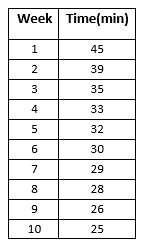

Use the data in the table above to answer the following questions.
4

Enter the data into L1 and L2, do a linear regression.
Stat, Calc, #8
Enter the correlation coefficient below, round to three places past the decimal.

4

What does the correlation coefficient tell you about the relationship between #weeks and assembly time?
Describe it below using 'as # weeks increase...'

4

Now that the data is in L1 and L2, create a scatterplot to observe the relationship.
(2nd, y=, turn Statplot #1 ON, choose scatterplot, make sure the Xlist and the Ylist are correct)
Observe the relationship (zoom, 9)

Describe the relationship between weeks and time, use Form, Direction and Strength.

4

List the three conditions that need to be met to consider doing a linear regression to create a linear model equation for making predictions.

4

Do these conditions appear to be met in the scatterplot you created in #16?
Why or why not?

4

Redo the linear regression so you can look at the given values for the equation.
Match the numbers and variables with the descriptions.

Draggable itemCorresponding Item
#weeks
correlation coefficient
-0.953
Intercept: _________ min.
42.87
Slope: _________ min./week
-1.94
Explanatory Variable (predictor)

Response Variable
#minutes
0.908
4

Using the information above, create the linear model equation for predicting the assembly time with the #weeks on the job.
Use meaningful words and proper notation to show which variable is being predicted.
Use 'time' and 'weeks' for the variables.
No spaces.

4

Graph the residual plot to determine the appropriateness of your model.
Redo the linear regression and store the regression equation: Stat, Calc, #8, 'StoreRegEQ': VARS, Y-VARS, enter, enter, enter, enter
Look at the residual plot: 2nd, y=, open the statplot1, change the YList to RESID (2nd, Stat, select RESID)
Use Zoom #9 to show the plot.

1. Is your model appropriate?
2. How do you know?

4

Your manager asks you about your progress in learning the assembly job.
Which part of the linear model (the intercept or slope) shows the rate of your progress?

4

Find the residual for your linear model’s prediction for 5 weeks. 1. Calculate the prediction for 5 weeks.
2. Check the table, calculate the residual.
Enter the residual below, round to two places past the decimal.

4

Did the linear model over or under predict the time it would take to assemble a system at 5 weeks?

4

The company tells you that you will qualify for a raise if after 13 weeks your assembly time averages under 20 minutes.
Does your model predict you will meet that goal?
Give the estimated time and explain.

4

Why might this prediction not be accurate?
What is this called?