HPC 2.1, 2.3 Review
star
star
star
star
star
Last updated about 2 years ago
24 Nsɛmmisa
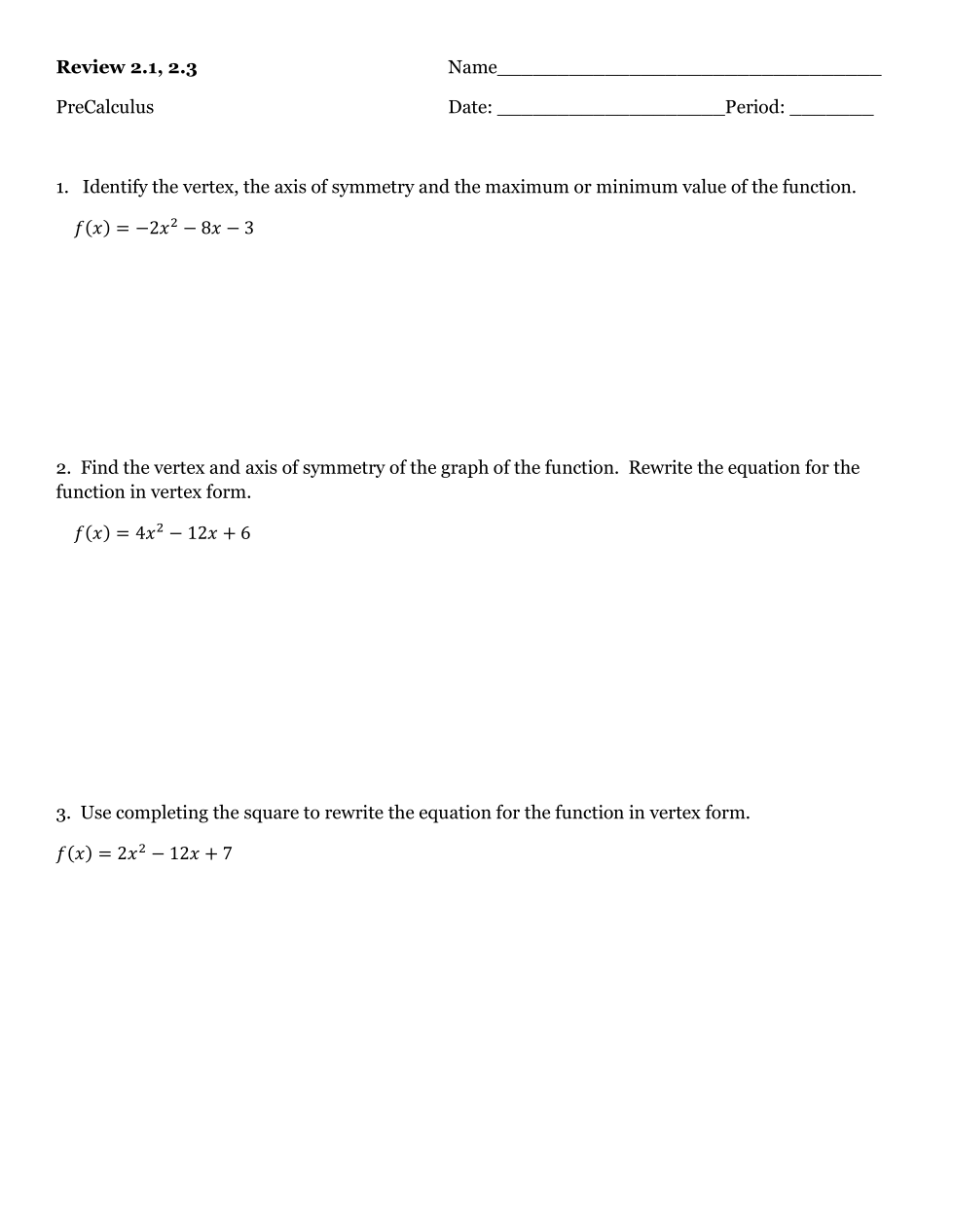
Write the following equation of f(x) in vertex form.
What is the vertex for f(x)? *Note: Your answer must be written as a coordinate (x, y) pair.
What is the axis of symmetry for f(x)?
*Note: Your answer must be written as a linear equation.
True or False: The vertex for f(x) is an absolute maximum.
What is the vertex for f(x)? *Note: Your answer must be written as a coordinate (x, y) pair.
What is the axis of symmetry for f(x)?
*Note: Your answer must be written as a linear equation.
What is f(x) written in vertex form?
What is f(x) written in vertex form?
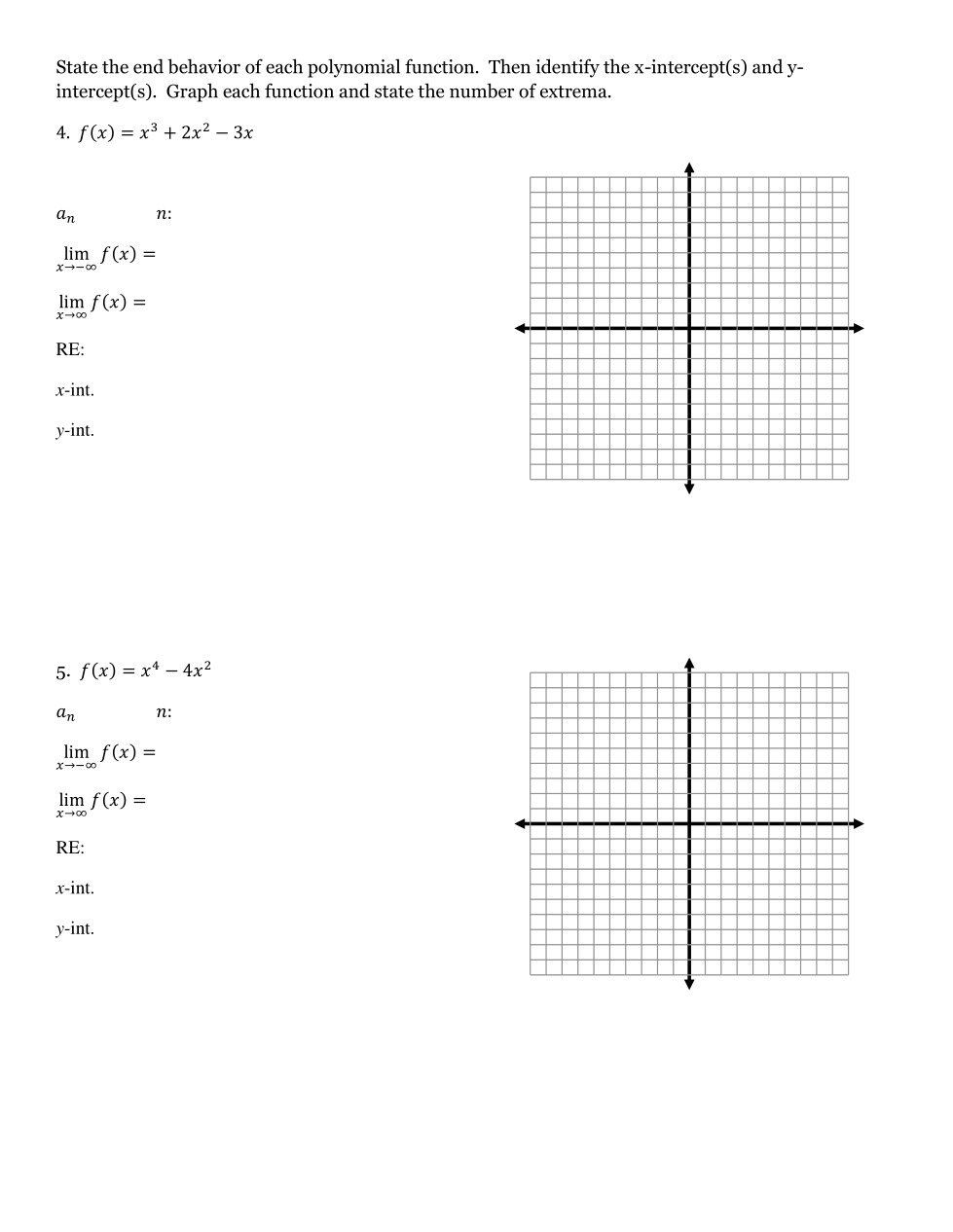
What is the leading coefficient, an ?
What is the degree, n?
What is the end behavior for f(x) as x approaches negative infinity?
What is the end behavior for f(x) as x approaches positive infinity?
What are the possible number of Relative Extrema for f(x)?
What are the x-intercepts for f(x)? Select all that apply.
What is the y-intercept of f(x)? Make sure your answer is a coordinate pair.
Sketch f(x) using the intercepts, endbehavior, and multiplicity of the factors.
What is the leading coefficient, an ?
What is the degree, n?
What is the end behavior for f(x) as x approaches negative infinity?
What is the end behavior for f(x) as x approaches positive infinity?
What are the possible number of Relative Extrema for f(x)?
What are the x-intercepts for f(x)? Select all that apply.
What is the y-intercept of f(x)? Make sure your answer is a coordinate pair.
Sketch f(x) using the intercepts, endbehavior, and multiplicity of the factors.