HPC Unit 2 Test B
star
star
star
star
star
Last updated about 2 years ago
29 Nsɛmmisa
1
1
1
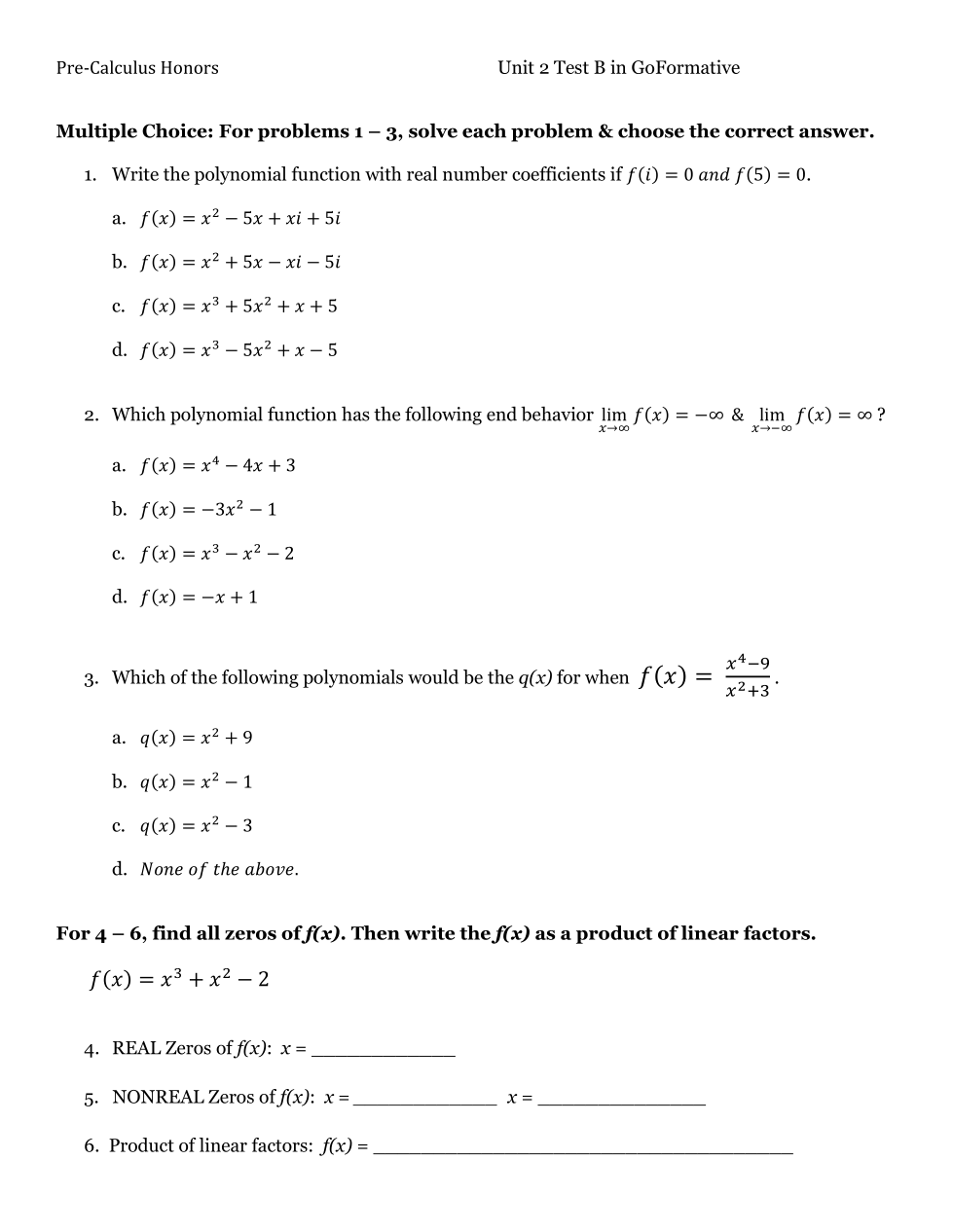
What is the real zero(s) of f(x)?
What are the nonreal zero(s) of f(x)?
Write f(x) as a product of linear factors.
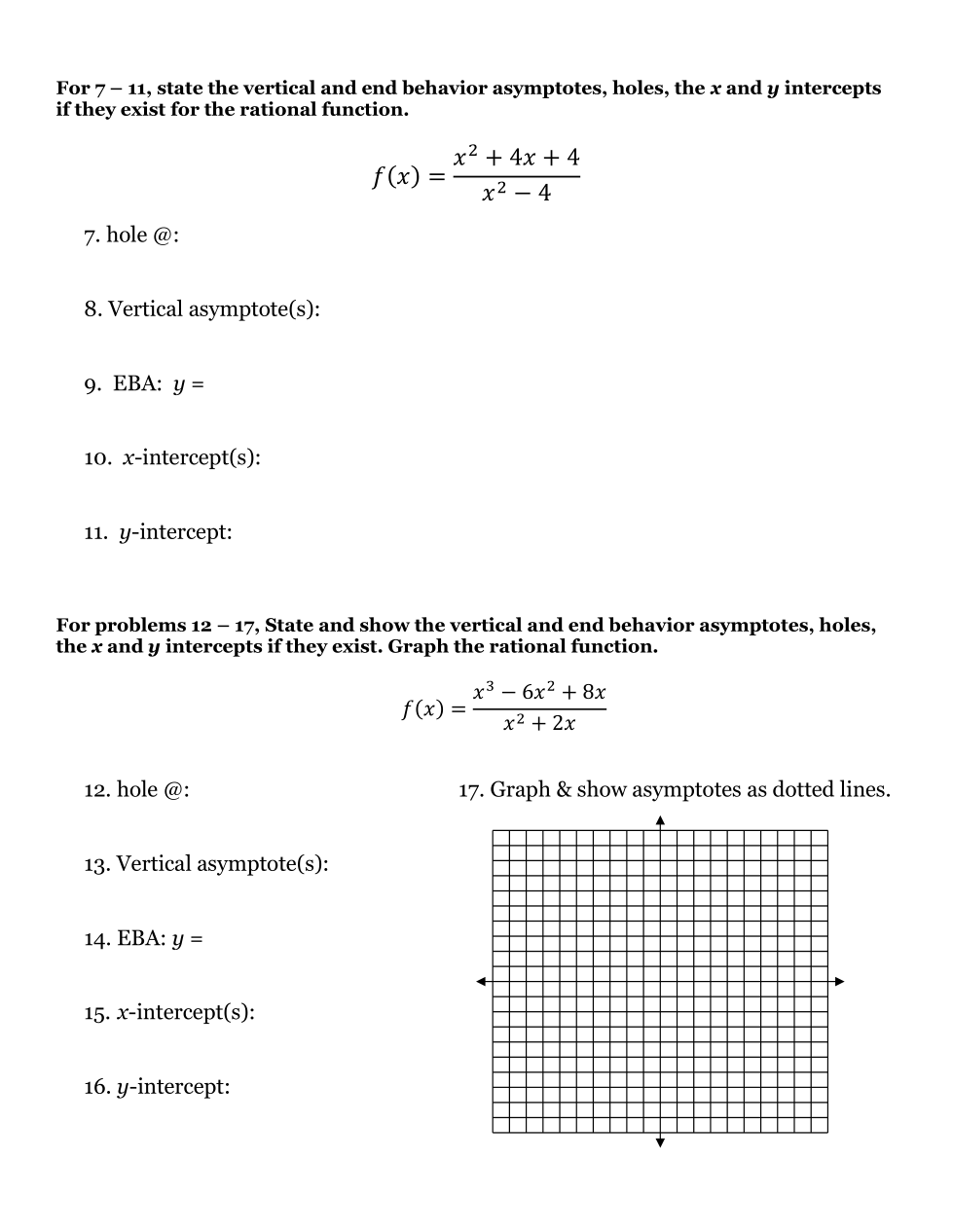
Solve the equation. Check for extraneous solutions.
Solve the inequality. State the solution(s) using interval notation.
Solve the inequality. State the solution(s) using interval notation.
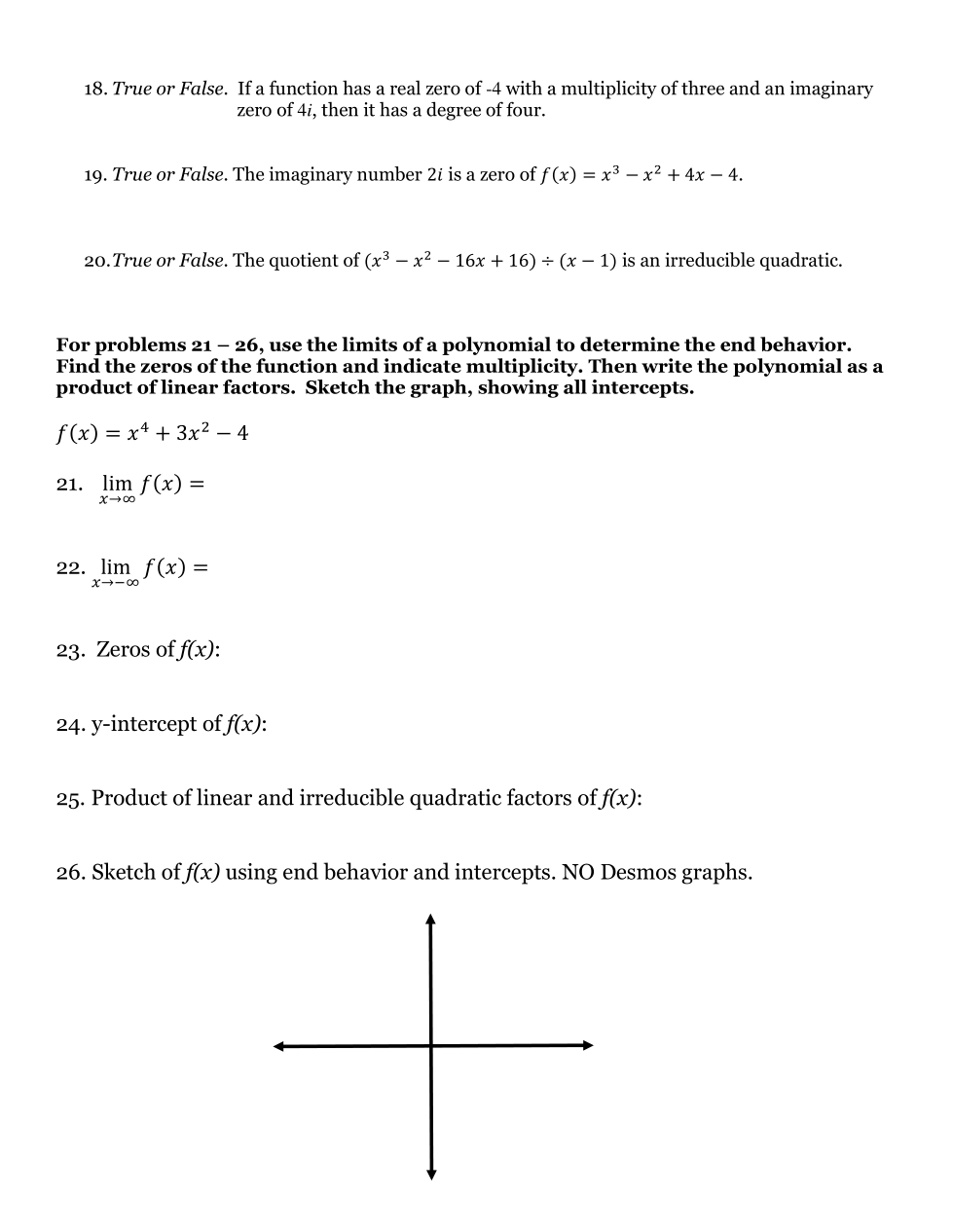
Write f(x) with real coefficients if f(i) = 0 and f(5) = 0.
Which polynomial function has the limit of f(x) as x approaches infinity be equal to negative infinity and as x approaches negative infinity be equal to positive infinity?
Which of the following polynomials would be the quotient function for f(x).
State the hole for f(x) as a coordinate. If there is not one, then write none.
State the vertical asymptote for f(x) as an equation for x.
State the end behavior asymptote for f(x) as an equation for y.
State the x-intercept for f(x) as a coordinate. If there is not one, then write none.
State the y-intercept for f(x) as a coordinate. If there is not one, then write none.
State the hole for f(x) as a coordinate. If there is not one, then write none.
State the vertical asymptote for f(x) as an equation for x.
State the end behavior asymptote for f(x) as an equation for y.
Select the x-intercept(s) of f(x).
State the y-intercept for f(x) as a coordinate. If there is not one, then write none.
Graph f(x). Show any asymptotes, holes, and x- and y-intercepts, if they exist.
If the function has a real zero of -4 with a multiplicity of three and an imaginary zero of 4i, then it has a degree of four.
The imaginary number 2i is a zero of f(x).
The quotient polynomial of ...
... is an irreducibe quadratic.
What is the limit of f(x) as x approaches positive infinity?
What is the limit of f(x) as x approaches negative infinity?
Select the zero(s) of f(x).
State the y-intercept for f(x) as a coordinate. If there is not one, then write none.
Write f(x) as the product of linear and quadratic factors. **Note: Please put the quadratic factor first, then the linear factors.
Sketch f(x) using its end behavior and intercepts. No Desmos graphs.