HPC Unit 2 Test B 2022
star
star
star
star
star
Last updated about 2 years ago
14 Nsɛmmisa
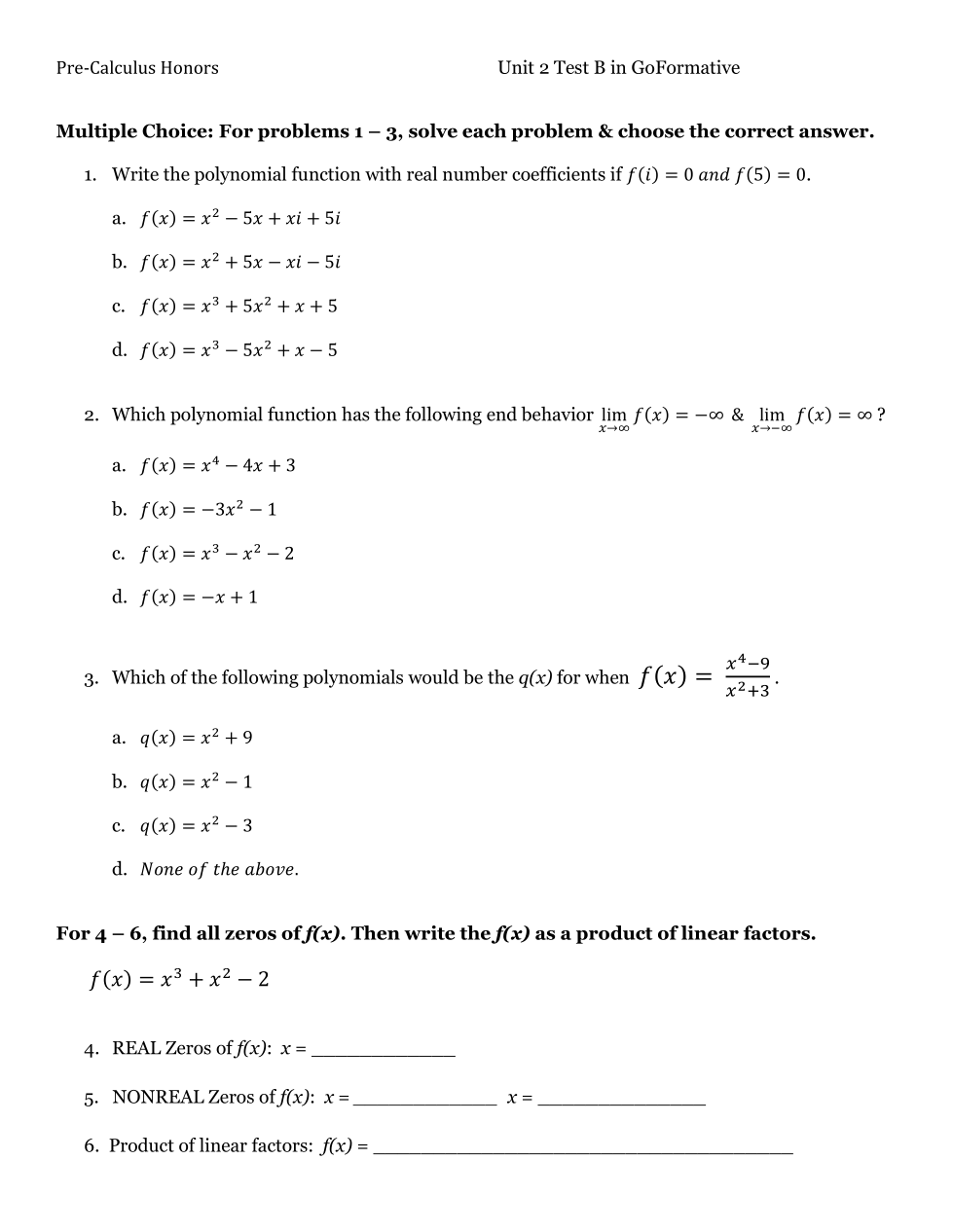
What is the real zero(s) of f(x)?
What are the nonreal zero(s) of f(x)?
Write f(x) as a product of linear factors.
Write f(x) with real coefficients if f(i) = 0 and f(5) = 0.
Which polynomial function has the limit of f(x) as x approaches infinity be equal to negative infinity and as x approaches negative infinity be equal to positive infinity?
Which of the following polynomials would be the quotient function for f(x).
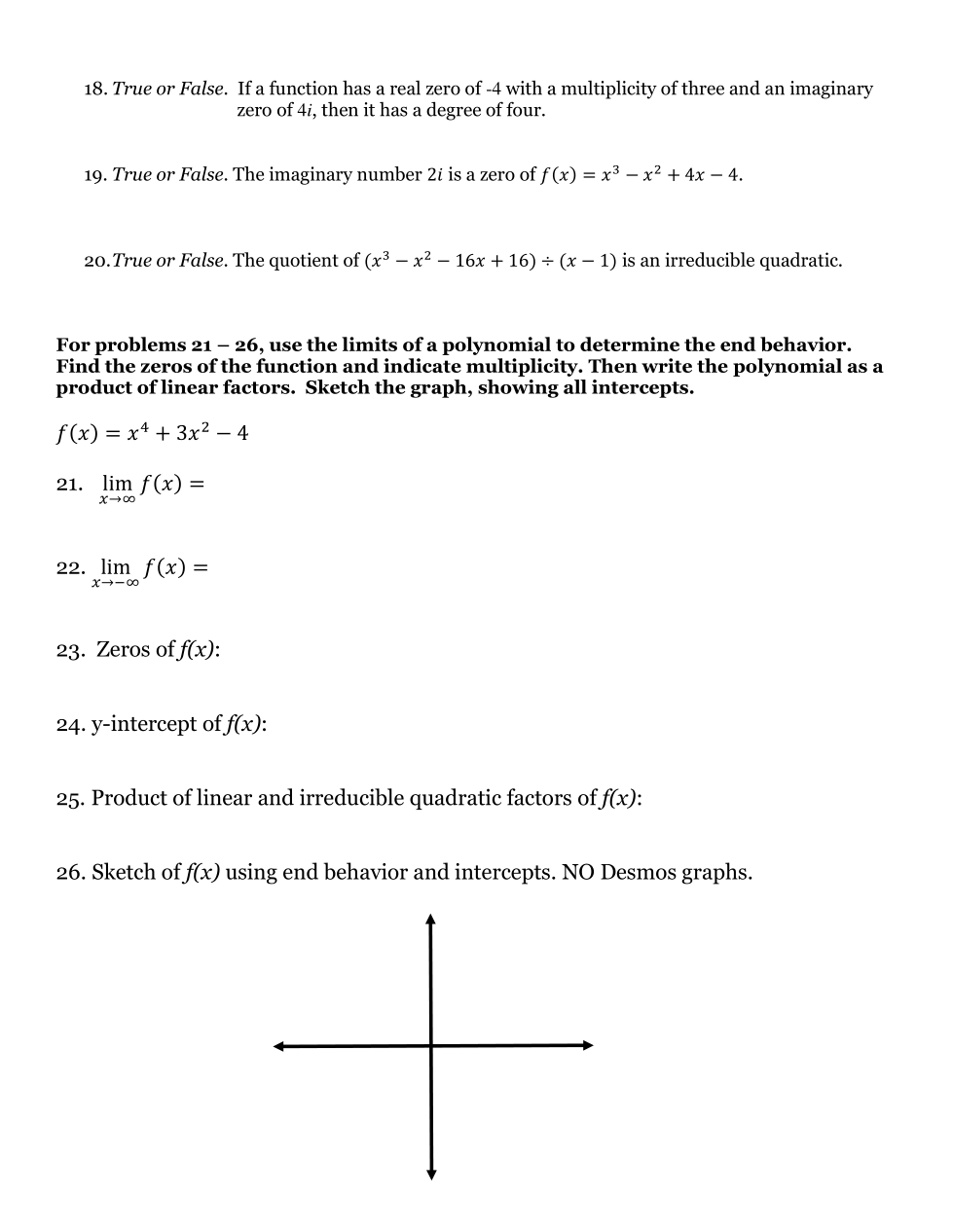
If the function has a real zero of -4 with a multiplicity of three and an imaginary zero of 4i, then it has a degree of four.
The imaginary number 2i is a zero of f(x).
The quotient polynomial of ...
... is an irreducibe quadratic.
What is the limit of f(x) as x approaches positive infinity?
What is the limit of f(x) as x approaches negative infinity?
Select the zero(s) of f(x).
State the y-intercept for f(x) as a coordinate. If there is not one, then write none.
Write f(x) as the product of linear and quadratic factors. **Note: Please put the quadratic factor first, then the linear factors.