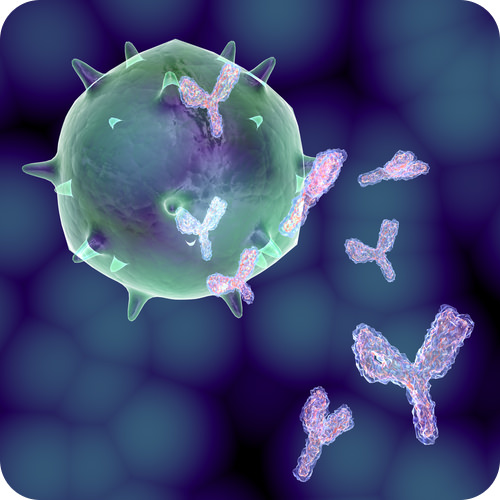
What are those Y-shaped things floating around the cell?
They are antibodies, which are large proteins. And they signal specific antigens for destruction. It does help that the antigens are usually attached to pathogens.
Humoral Immune Response
There are actually two types of immune responses: humoral and cell-mediated. The humoral immune response involves mainly B cells and takes place in blood and lymph.
B Cell Activation
B cells must be activated by an antigen before they can fight pathogens. This happens in the sequence of events shown in Figure below. First, a B cell encounters its matching antigen and engulfs it. The B cell then displays fragments of the antigen on its surface. This attracts a helper T cell. The helper T cell binds to the B cell at the antigen site and releases cytokines that “tell” or signal the B cell to develop into a plasma cell.
Activation of a B cell must occur before it can respond to pathogens. What role do T cells play in the activation process?
Plasma Cells and Antibody Production
Plasma cells are activated B cells that secrete antibodies. Antibodies are large, Y-shaped proteins that recognize and bind to antigens. Plasma cells are like antibody factories, producing many copies of a single type of antibody. The antibodies travel throughout the body in blood and lymph. Each antibody binds to just one kind of antigen. When it does, it forms an antigen-antibody complex (see Figure below). The complex flags the antigen-bearing cell for destruction by phagocytosis.
An antibody matches only one type of antigen.
Memory Cells
Most plasma cells live for just a few days, but some of them live much longer. They may even survive for the lifetime of the individual. Long-living plasma cells are called memory cells. They retain a “memory” of a specific pathogen long after an infection is over. They help launch a rapid response against the pathogen if it invades the body again in the future.
Summary
Activated B cells produce antibodies to a particular antigen.
Memory B cells remain in the body after the immune response is over and provide immunity to pathogens bearing the antigen.
1 point
1
Question 1
1.
B cells are part of what division of the immune system?
1 point
1
Question 2
2.
The parts of the antigen that are recognized by the immune system are called ______.
1 point
1
Question 3
3.
What is it called when a cell is able to develop a specific adaptive immune response?
1 point
1
Question 4
4.
The B cell interacts with antigens through _______ on its surface.
1 point
1
Question 5
5.
Which of the following is NOT an effect of an antibody?
1 point
1
Question 6
6.
The ______ remember the immune response for long periods of time while the ___________ are the factories that produce antibodies specific for a particular pathogen.
1 point
1
Question 7
7.
Specific ___________ are produced by the immune system in response to specific ___________ found on the surface of foreign pathogens, particles, or molecules (i.e. toxins).
1 point
1
Question 8
8.
How do plasma cells help fight pathogens? Include the role of antibodies in your response.
1 point
1
Question 9
9.
If a disease destroyed a person’s helper T cells, how might this affect the ability to launch an immune response?
1 point
1
Question 10
10.
What are memory cells? What is their role?
Cell-Mediated Immune Response
Do cells really attack other cells?
They sure do. Depicted here is a group of T cells attacking a cancer cell. When they can, the T cells search out and destroy “bad” cells.
Cell-Mediated Immune Response
In addition to the humoral response, the other type of immune response is the cell-mediated immune response, which involves mainly T cells. It leads to the destruction of cells that are infected with viruses. Some cancer cells are also destroyed in this way. There are several different types of T cells involved in a cell-mediated immune response, including helper, cytotoxic, and regulatory T cells.
T Cell Activation
All three types of T cells must be activated by an antigen before they can fight an infection or cancer. T cell activation is illustrated in Figure below. It begins when a B cell or nonspecific leukocyte engulfs a virus and displays its antigens. When the T cell encounters the matching antigen on a leukocyte, it becomes activated. What happens next depends on which type of T cell it is.
T cell activation requires another leukocyte to engulf a virus and display its antigen.
Helper T Cells
Helper T cells are like the “managers” of the immune response. They secrete cytokines, which activate or control the activities of other lymphocytes. Most helper T cells die out once a pathogen has been cleared from the body, but a few remain as memory cells. These memory cells are ready to produce large numbers of antigen-specific helper T cells like themselves if they are exposed to the same antigen in the future.
Cytotoxic T Cells
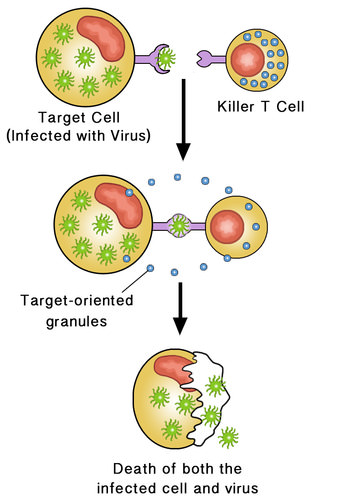
Cytotoxic T cells destroy virus-infected cells and some cancer cells. Once activated, a cytotoxic T cell divides rapidly and produces an “army” of cells identical to itself. These cells travel throughout the body “searching” for more cells to destroy. Figure below shows how a cytotoxic T cell destroys a body cell infected with viruses. This T cell releases toxins that form pores in the membrane of the infected cell. This causes the cell to burst, destroying both the cell and the viruses inside it.
A cytotoxic T cell releases toxins that destroy an infected body cell and the viruses it contains.
After an infection has been brought under control, most cytotoxic T cells die off. However, a few remain as memory cells. If the same pathogen enters the body again, the memory cells mount a rapid immune response. They quickly produce many copies of cytotoxic T cells specific to the antigen of that pathogen.
Regulatory T Cells
Regulatory T cells are responsible for ending the cell-mediated immune response after an infection has been curbed. They also suppress T cells that mistakenly react against self antigens. What might happen if these T cells were not suppressed?
Summary
Activated T cells destroy certain cancer cells and cells infected by viruses.
Memory T cells remain in the body after the immune response and provide antigen-specific immunity to the virus.
Resources
1 point
1
Question 11
11.
The doorways in the video would actually be which of the following?
1 point
1
Question 12
12.
What are the projections actually called?
1 point
1
Question 13
13.
The section of DNA in the nucleus that codes for mRNA is called
1 point
1
Question 14
14.
The bubble that fuses to the cell membrane would be a
1 point
1
Question 15
15.
Describe one way that cytotoxic T cells destroy cells infected with viruses.
1 point
1
Question 16
16.
What are regulatory T cells?
One enemy of our immune system - VIRUSES
Now let's look at viruses themselves.
You probably know most of this, but it is a good review. Take notes on what you don't know. You are responsible for this material.
1 point
1
Question 17
17.
What do all viruses have in common? Choose all that apply
1 point
1
Question 18
18.
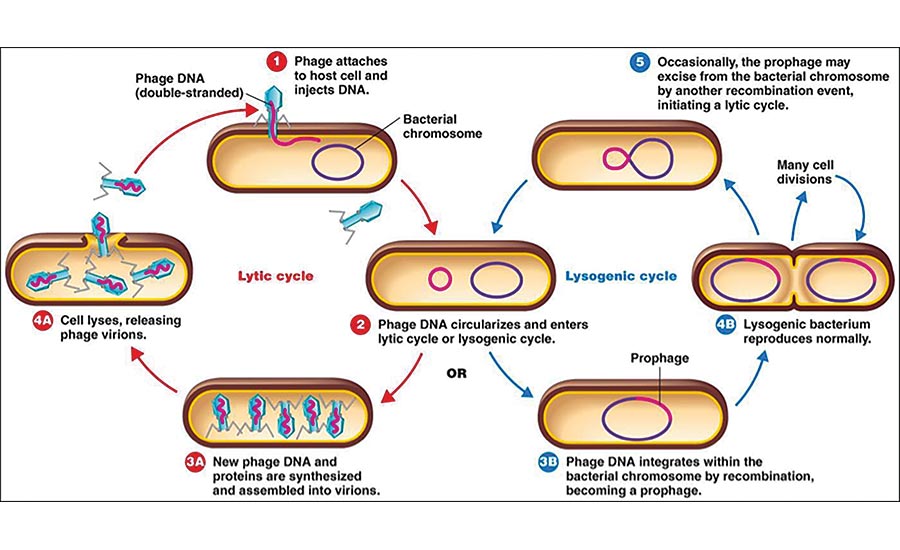
The image above shows viral life cycles. Which of these cycles will cause the host cell to lyse?
1 point
1
Question 19
19.
Using the same diagram above, which cycle is more dangerous in the short-term? Explain why
1 point
1
Question 20
20.
Using the same diagram above, which cycle is more dangerous in the long-term? Explain why
1 point
1
Question 21
21.
HIV as a virus kills which cells in our immune system?
1 point
1
Question 22
22.
Why is the answer to #21 so scary - think about the immune system. Why is killing off this particular type of cell so dangerous to us?
HIV - a specific example
Describe the components of a retrovirus - use the video as a guide
1 point
1
Question 23
23.
CD4 molecules are
1 point
1
Question 24
24.
Reverse transcriptase
1 point
1
Question 25
25.
THINK - why is the "poor proof-reading activity" of reverse transcriptase GOOD for the virus?