Order the following scatterplots from the strongest negative correlation to the strongest positive.

Order the following scatterplots from the strongest negative correlation to the strongest positive.
Order the following scatterplots from the strongest negative correlation to the strongest positive.
Which scatterplot shows a strong association BUT a correlation near 0?
Which of the following are conditions that need to be met in order to calculate a correlation coefficient or a linear regression?
Which of the statements below contains a mistake regarding correlation?
Explain why the statement you chose contains a mistake regarding correlation.
What is it?
This scatterplot shows the relationship between tons of freight and tons of mail transported at 135 large and medium sized airports.
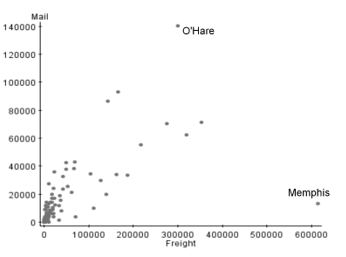
Describe the association between these variables.
Use form, direction and strength for full credit.
This scatterplot shows the relationship between tons of freight and tons of mail transported at 135 large and medium sized airports.
Which point would you remove to strengthen the correlation?
Data was collected to show the relationship between ice cream sales and the number of cases of
sunburn in a small town.
The correlation coefficient was calculated on the data of ice cream sales vs the number of cases of sunburn:
r=0.976
Describe what this means about ice cream sales and sun burn cases, use language a 10 year old would understand.
What might be a lurking variable in the situation above with sunburn cases & ice cream sales?
Explain.
The line of best fit is also called the least-squares regression line or LSRL.
Think back to the demonstration I did with the online Statistics Applets with the line of best fit, what were we trying to do with the line of best fit?
Which statement below is true?
An independent record label sells mp3's of its songs online.
They have been experimenting with different prices for downloading each song.
Based on their data, the linear equation that models the average sales (in # of songs) for each price (in cents):
Sales-hat = 510,198 - 410(price)
Which sentence accurately describes the slope of this linear model (equation)?
If you need to, rewrite the equation using units instead of the name of the variables, this might help.
An independent record label sells mp3's of its songs online.
They have been experimenting with different prices for downloading each song.
Based on their data, the linear equation that models the average sales (in # of songs) for each price (in cents):
Sales-hat = 510,198 - 410(price)
Which sentence accurately describes the intercept of this linear model (equation)?
Use the data in the table below:
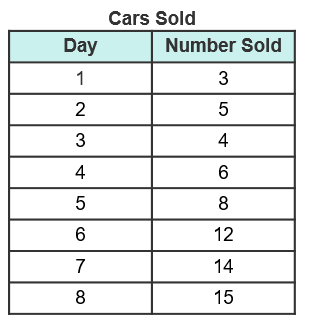
Enter your data into L1 and L2, (Stat, Edit)
Create a scatter plot and check the form.
(2nd, y=, turn the statplot 'on', select scatter plot and make sure Xlist:L1 & Ylist:L2)
Is a linear regression appropriate for creating a model?
(Hint: remember to check the three conditions)
Why?
Use the data in the table below:
No matter what you answered for the previous question, I would like you to create the linear model.
Use Stat, Calc, #8LinReg
Select the correct equation from the list below:
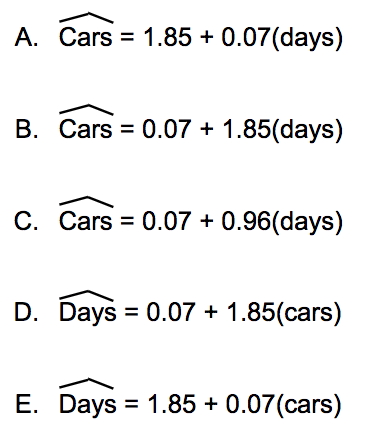
Which is the correct linear model for the data table?
Use your equation from #14 to predict the number of cars sold after 9 days.
Enter your prediction below, round to the nearest whole car since cars aren't sold at dealerships in fractions.
The dealership in #15 actually had a rough day due to cold rainy weather.
If the residual was -4,
what was the actual number of cars sold?
Hint: Use the residual equation.
Use your answer to #16 and the equation for calculating residuals.
Did the linear model overpredict or underpredict the number of cars that would be sold?
Use the following linear regression equation:
height-hat = 3 + 1.16(weeks)
This linear model can be used to predict the height of a plant (in centimeters) after an amount of time (in weeks).
1. Predict the plants height after 5 weeks.
2. The height of a plant was actually 9.2 centimeters after 5 weeks.
3. Calculate and interpret the residual for this plant after 5 weeks.
In general, if the residual is negative what does this mean?
A Line of Best Fit for a linear regression has been calculated and the linear model equation’s residual plot is shown.
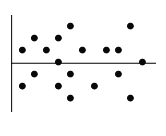
Which is true?
Data was gathered to compare the speed of a motorcycle to braking distance.
The data is shown in the table below.
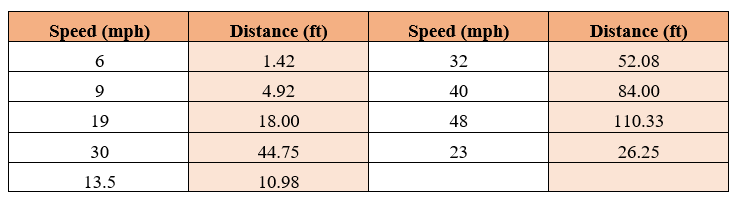
Enter ALL the speed into L1 and ALL the distance into L2 (Stat, Edit).
Create a scatterplot (2nd, y=, turn it on, check the Xlist & Ylist)
For your answer: observe the scatterplot (zoom 9).
Does this data meet the conditions for doing a linear regression?
Data was gathered to compare the speed of a motorcycle to braking distance. The data is shown in the table below.
Now that your data is in L1 and L2 (Stat, Edit).
Do a linear regression, save the regression equation:
Stat, Calc, #8LinReg, 'StoreRegEQ': VARS, Y-VARS, enter, enter, enter, enter
To be more accurate you will check the residual plot.
First: clear the y= equation (press 'y=' then 'clear')
Then:
2nd, y=, in Statplot 1, change the Ylist to 'RESID' use '2nd, Stat'
Observe the residual plot.
For StatPlot 1 change the YList to RESID (2nd, Stat), Zoom 9
What do you see?
What does this mean? (is the linear model appropriate or not appropriate to use?)
Answer both questions for full credit.
Use the following information for numbers 23 - 28.
Carbon Monoxide (CO) is a poisonous, colorless, odorless gas produced as a result of incomplete burning of carbon-containing fuels. Cigarette smoke can contain high levels of CO. Below are tar and CO data for 10 brands of popular cigarettes.
We will answer the question: how is the amount of carbon monoxide produced by these cigarettes related to their tar content?

Enter the data into L1 and L2 (Stat, Edit)
Observe the scatterplot that shows the relationship between Tar and Carbon Monoxide (CO).
2nd, y=, statplot 1, check your Xlist:L1 and Ylist:L2
Describe the relationship between tar and CO (use F, D, S)
Now that the data is in L1 and L2, do a linear regression.
Have your calculator SAVE THE RESIDUALS:
Stat, Calc, #8LinReg, 'Store RegEq' 'VARS', 'Y-VARS', enter, enter, enter, enter.
Check the residual plot to see if it is appropriate to use the linear model to make predictions.
Statplot (2nd, y=), choose the scatterplot,
change the YList to RESID (2nd, Stat).
Check the graph: Zoomstat (zoom #9)
What do you see?
What does this mean?
Answer both questions.
No matter what you answered in #24, create the linear model equation.
Round a and b to two places past the decimal.
Match the parts of the linear model to their role or meaning in the equation.
You may need to do another linear regression if you don't remember the values for 'a' and 'b'.
Note: not all values are used.
| Draggable item | arrow_right_alt | Corresponding Item |
|---|---|---|
0.978 | arrow_right_alt | The intercept, _____ mg CO. |
mg CO | arrow_right_alt | The slope, units are _______ mg CO per 1 mg Tar. |
0.71 | arrow_right_alt | Explanatory variable |
3.83 | arrow_right_alt | Response variable |
mg Tar | arrow_right_alt |
Use the values for 'a' and 'b' from the linear regression.
Create the linear model equation for predicting mg CO.
Be sure to use meaningful words (no x or y) and the correct notation.
If a new cigarette was produced by Marlboro that had 32.4 mg Tar,
use the linear model equation to predict the CO that would be produced.
Round your answer to two places past the decimal.
Use units.
Think about #27:
1. What is this type of prediction called?
Hint: we discussed it in class last time.
2. Is this ok to do with our linear model?
Select both answers below:
BONUS #1:
Use mg CO to predict the mg Tar.
You cannot use your current linear model equation.
What is the new equation that predicts tar?
Enter it below using Tar-hat
BONUS #2:
Use mg CO to predict the mg Tar.
Use your new linear model equation for predicting mg Tar.
If the cigarette has 7.8 mg CO, predict the mg Tar that it will contain.
Round your answer to two places past the decimal point.