Log in
Sign up for FREE
arrow_back
Library

Chinese Immigration to the US (1860s-1900) cloned 12/14/2020

star
star
star
star
star
Last updated about 2 years ago
23 questions
1
1
1
1
1
1
1
Chinese Immigration to the US in the 1850s-1900
PART 1: Push & Pull Factors
Question 1
1.

What was one push factor leading to Chinese immigration to the United States?

Question 2
2.

What was a major "pull factor" attracting Chinese immigrants to the US from 1850-1890?

PART 2: TRANSCONTINENTAL RAILROAD PHOTO ANALYSIS

The completion of the Transcontinental Railroad connected the East with the West of North America, and it allowed the US economy to expand dramatically. But building the railroad was hard, dangerous work, and required skillful planning, engineering, and dedicated workers.

The workers who built the Transcontinental Railroad included Chinese immigrants, Irish immigrants, African Americans, and White Americans.

Here's a a famous picture of the place where the transcontinental railroad was completed (the two parts of the railroad tracks finally came together), and it marked the beginning of a new US economic boom.

Look closely at the faces in the photo and answer the question below.
1
1
Question 4
4.

Is it a problem that historic pictures like these (and often textbooks) omit (exclude) people of color? Why or why not?

PART 3: Two Videos about Chinese Immigrant Contributions
Question 5
5.

Describe the contributions of Chinese immigrants on the construction of the transcontinental railroad.

Question 6
6.

Describe some injustices described in these videos about Chinese immigrant railroad workers.

PART 4: ARTICLE ABOUT CHINESE IMMIGRANTS' EXPERIENCE IN THE UNITED STATES
1
Question 7
7.

What are two ways Chinese immigrant miners were mistreated in the 1850s?

1
Question 8
8.

Why did Charles Crocker, owner of the Central Pacific Railroad, decide to hire Chinese immigrants?

1
Question 9
9.

Chinese workers were rewarded for their work the same as white workers.

1
Question 10
10.

List 2-3 specific ways Chinese immigrant workers were targeted for discrimination and mistreatment. BE SPECIFIC.

1
Question 11
11.

What did the 1882 Chinese Exclusion Act do?

PART 5: Popular Culture's Portrayal of Chinese Immigrants in the late 1800s
In the late 1800s, popular magazines and newspapers printed racist political cartoons that expressed white Americans' growing (but unfounded) fear and hatred of Chinese immigrants.

Instructions: View and analyze the following political cartoons.
1
Question 12
12.

What does this cartoon (drawn by a white American artist) suggest about Chinese immigrants?

1
1
Question 14
14.

By showing these swords in their hands, what does the white cartoon artist suggest Chinese workers will do to European immigrants like this Irish immigrant boot-maker?

1
1
Question 16
16.

By portraying the Irish immigrant and Chinese immigrants this way, what do you think this cartoon suggests about popular views on race and immigration status in America in the 1870s?

1
Question 17
17.

By showing diseases coming from Chinatown, what does this white American artist seem to want people to think?

Part 6: Chinese Exclusion Act
1
Question 18
18.

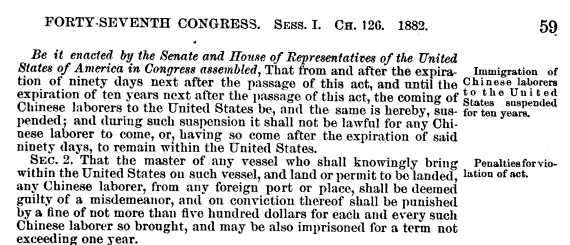
What does this first paragraph say would be illegal starting in 1882?

1
Question 19
19.

Who does the Chinese Exclusion Act say would be fined $500 or be imprisoned for up to a year?

1
Question 20
20.

To what extent do you think the publishing of those racist cartoons contributed to Congress passing the Chinese Exclusion Act?

PART 7: FIGHTING BACK AGAINST INJUSTICE--USING THE 14TH AMENDMENT IN THE COURTS
Question 21
21.

Why did John Wise, the Collector of Customs, not allow Wong Kim Ark to re-enter the United States?

Question 22
22.

Why is Wong Kim Ark's 1898 Supreme Court case important? What rights did it secure and for whom?

Question 23
23.

Explain the push and pull factors leading to Chinese immigration to the US in the mid to late 1800s and describe the experience of those Chinese immigrants once they arrived. Include 2-3 specific details to back up your argument.

Question 3
3.

Why do you think the owners of the railroad companies did not include any Black or Chinese immigrant workers in the photo?

Question 13
13.

How does the artist portray white American women?

Question 15
15.

Why do you think the artist printed the words "cheap labor" on the swords?