USE THIS DIAGRAM FOR QUESTIONS 61-68 (click to enlarge)*
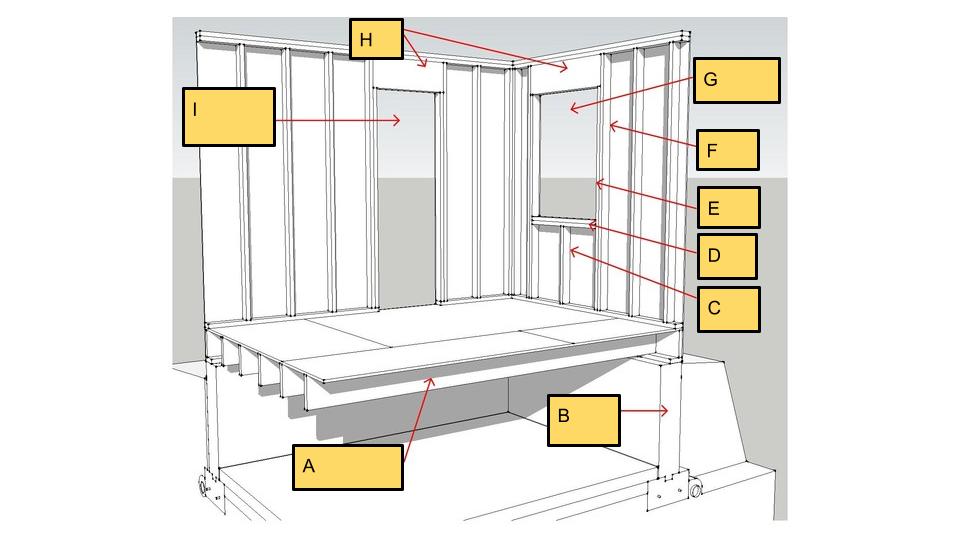
What is A?
USE THIS DIAGRAM FOR QUESTIONS 61-68 (click to enlarge)*
What is A?
1. Building codes refers to product standards to define the quality of materials that are permitted in constructed projects.
2. The International Building Code has been adopted by the Federal government and applies to all communities in the United States.
3. Respirators provide protection from paint thinner, gasoline, and organic solvents.
4. The electric safety device that breaks the circuit immediately when a short or grounded condition occurs is called a trip.
5. Working in cool, low outdoor temperatures can increase fatigue and contribute to hydration.
6. Maintaining all tools on a regular basis is not necessary.
7. Don't operate the tools according to the manufacturer's instructions.
8. PPE stands for personal protective equipment.
9. Certain precautions must be taken and protection must be worn when working with electrical cords.
10. When working with an abrasive wheel, you must remember that it can throw off flying fragments.
11. Your wheel does not have to be equipped with guards.
12. You don’t always have to inspect and test equipment.
13. Guards protect you and others from: point of operation, in-running nip points, rotating parts, and fly chips and sparks.
14. Tools with the following parts require guarding: belts, shafts, sprockets, flywheels, gears, pulleys, spindles, chains, and other moving parts.
15. The header is the lowest portion of the frame of a structure.
16. For a 2” x 4” wall frame, headers are made with two pieces of 2” thick lumber, plus a 1” thick spacer.
17. A roof that has two sloping surfaces is called a gable.
18. Determining if rafter ends form a straight line is not an important step in fascia and roof sheathing installation.
19. Trimmers provide the support necessary to transfer the load carried by the headers to the foundation.
20. Knots in wood are created by disease or insects.
21. The electrical, plumbing, and HVAC systems are inspected before interior wall coverings are installed.
22. In addition to planning and scheduling on-site work, construction managers need to obtain permits before the work begins.
23. A subcontractor has responsibility for the entire construction project.
24. Tools are not a major investment for both individuals and companies.
25. A contract for a specific portion of the work necessary for completion of a project is known as a subcontract.
26. Renting is a way of acquiring the use of a tool for a short period of time.
27. Renting is less expensive that buying construction equipment.
28. OSB stands for Oriented Strand Board.
29. A 2” x 4” is really 1 ½” x 3 ½” dimensionally
30. A 16d nail is smaller than an 8d nail.
31. A roofing nail has a smaller head than a framing nail.
32. A speed square is not commonly used in wall layout.
33. Almost every accident can be avoided by simply paying close attention to safety.
34. Plywood or OSB is most commonly sold in 4’ x 8’ sheets.
35. A straightedge is the best choice for making very long lines.
36. Using hand tools or any tools safely and efficiently requires little skill or training.
37. When using a hammer, a loose grip should be kept on the handle at all times.
38. When swinging the hammer, the path of the swing should be clear of obstructions.
39. Ear protection should always be worn when driving nails with a hammer.
40. Nails should be driven straight and true without wasting time and energy, and without damaging valuable materials.
41. Clamps are often used to position and secure materials so the materials can be safely cut or shaped.
42. Make sure that power tools are in good working order before using it.
43. When using an electric drill, it is best to secure the work piece either by hand or with a work clamp.
44. A screw gun/driver does not have interchangeable tips.
45. A pneumatic nail gun uses water pressure to drive nails into material.
46. The air hose should be connected when loading nails into the pneumatic nail gun.
47. The power switch of the belt sander should be in the OFF position before connecting to a power source.
48. Some electric hand sanders are equipped with a square pad for holding abrasive discs in place.
49. Linear is a term that means relating to a straight line.
50. A circle is divided into 180 individual degrees.
51. The mission of the Occupational Safety and Health Administration (OSHA) is:
52. Electricity travels in closed circuits, and its normal route is through a conductor. Electric shock occurs when:
53. Workers need to take which of the following common-sense steps to protect themselves from falls through skylights, roof and floor openings?
54. The two steps for avoiding hazards that are always taken before the need for PPE is considered are:
55. The three main scaffold types are aerial lifts, supported scaffolds and:
56. Because using cranes or derricks to hoist personnel poses a serious risk to the employees being lifted, any cranes and derricks that hoist personnel must:
57. If the use of a power tool can result in flying sparks, metal shavings, wood chips, splashes, or other debris, workers should:
58. OSHA defines an excavation as:
59. A training program to teach proper lifting techniques should cover:
60. Mechanical demolition refers to demolition using equipment like:
USE THIS DIAGRAM FOR QUESTIONS 61-68 (click to enlarge)*
What is A?
What is B?
Which is the cripple stud?
What is G?
Which are the headers?
Which is the rough sill?
E is a trimmer stud?
I is a rough door opening?
Mr Butts is the best.