Complete the chart below to compare latitude and longitude.
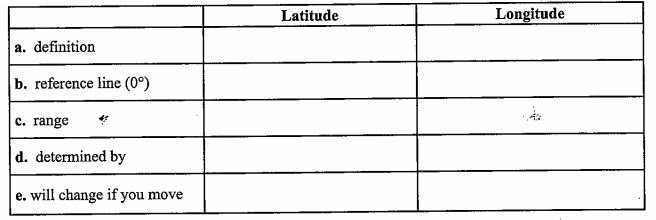
Complete the chart below to compare latitude and longitude.
Complete the chart below to compare latitude and longitude.
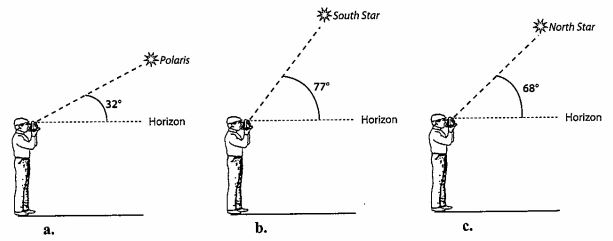
The diagrams below show observations of Polaris (North Star) or Sigma Octantis (South Star) at different locations on Earth's surface. Give the latitude for each ovserver.
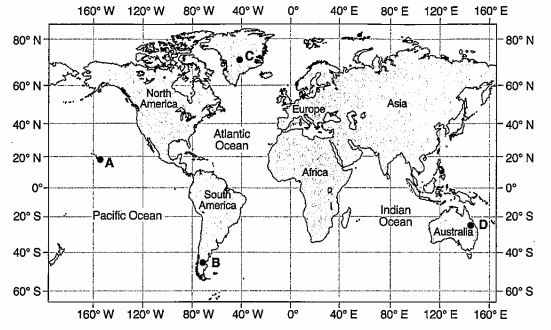
Using the world map below.
a. Draw in the Tropic of Capricorn and label by name and latitude.
b. Draw in the Artic Circle and label by name and latitude.
c. Label the Prime Meridian.
d. Place an "X" at the location that has the same value for latitude and longitude.
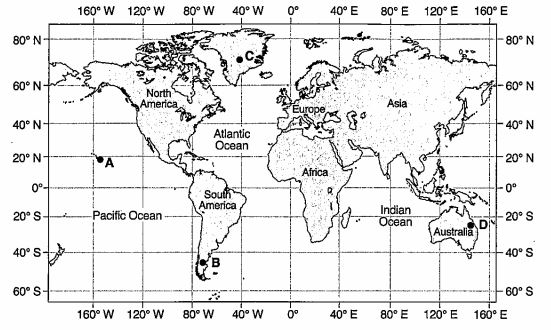
At which lettered position(s) will Polaris be highest in the sky?
At which lettered position(s) will Polaris not be visible? Why not?
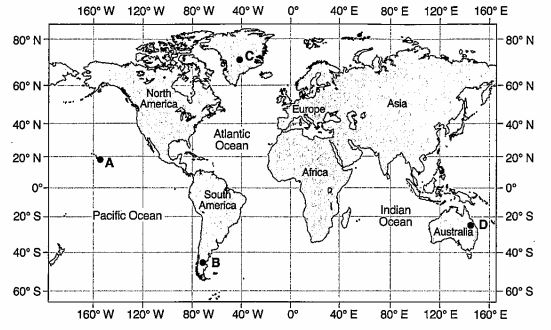
Give the latitude and longitude to the nearest degree for the following positions.
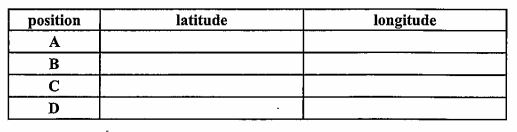
Label these lettered points on the work map based on the given latitude-longitude.
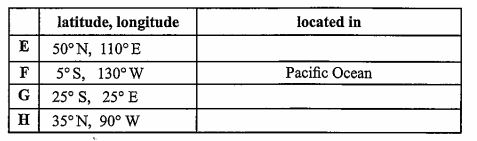
A chronometer is a clock which indicates the time at Greenwich, England (GMT).
a. What is the importance of Greenwich, England?
b. If at your solar noon, the chronometer reads 10 a.m. what is your longitude?
c. It is 2 p.m. at your location when the chronometer reads 7 pm. What is your longitude? (show solution)
The diagram shows parallels of latitude that are 10 degrees apart and meridians of longitude that are 15 degrees apart.
a. What is the latitude of the North Pole?
b. What is the latitude of the Equator?
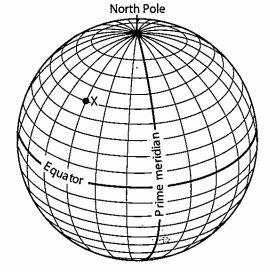
Name the city located on the prime Meridian.

What is the latitude and longitude for point "X"?
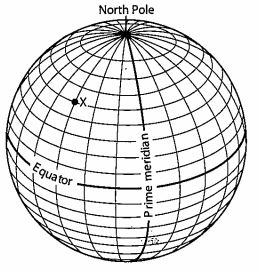
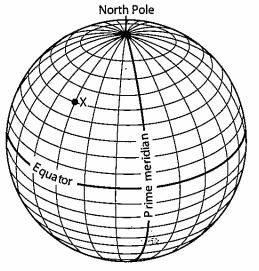
a. A person in city A observes Polaris at 30 degrees above the horizon and is 2 hours ahead of "X".
Locate city A on the diagram.
b. Place a letter "S" at a location that has the same time as "X".
c. Draw a dashed line to show the Tropic of Cancer. Label the line.
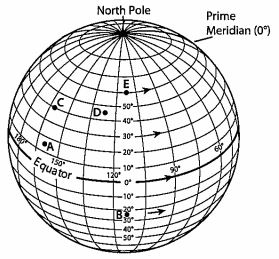
The diagram below shows a part of Earth's surface and its latitude-longitude coordinates.
a. The latitude of point A is?
b. The longitude of point D is?
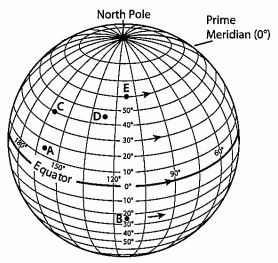
Name two points with the same longitude?
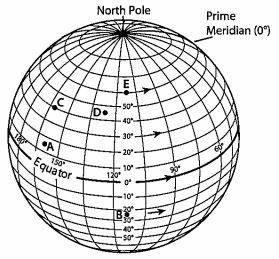
Name two points that have the same solar time?

Which points are ahead of D in solar time?
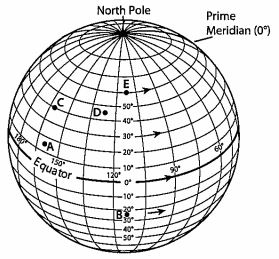
What is the compass direction from point A to point D?
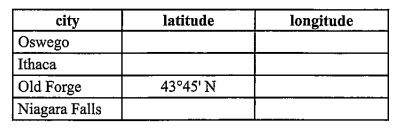
Complete the following chart for cities in New York State. Latitude and longitude should be written to the nearest degrees and arc minutes. (One latitude is completed for you.)
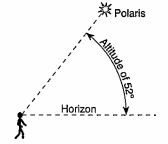
The diagram below shows the angular altitude of Polaris above the horizon at a certain location. The latitude of the observer is?
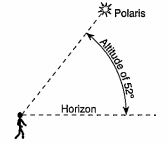
a. Draw an arrow from the observer to zenith. Label the point "zenith".
b. Place an "X" where Polaris would be for an observer at the Arctic Circle.
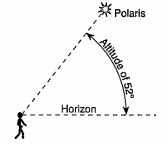
How would this diagram change if the observer was in the Southern Hemisphere?
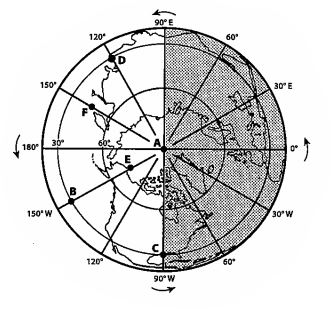
The diagram below shows a North Pole view of Earth, direction of Earth motion, and the shaded nighttime side of Earth. Some latitude and longitude lines have been labeled.
a. Draw in three Sun rays to show the direction of hte Sun for this diagram.
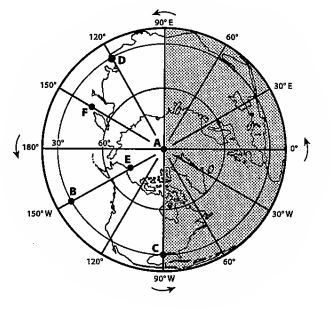
What earth motion is indicated by the arrows?
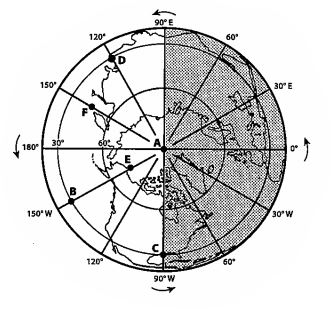
hat earth motion is indicated by the arrows?
The time at point C is approximately?
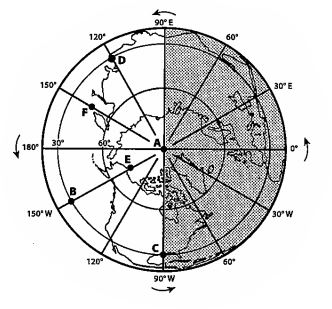
Which points have the same latitude?
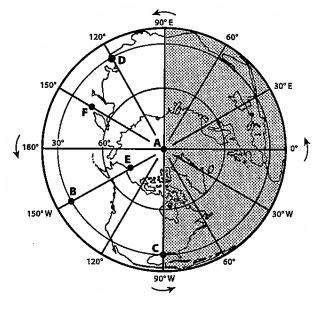
The latitude and longitude for location D is?
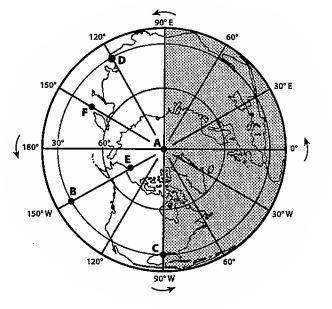
The latitude and longitude for location E is?
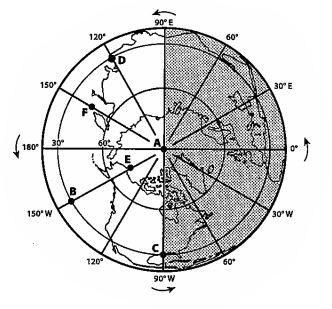
What day(s) of the year are represented by this diagram?
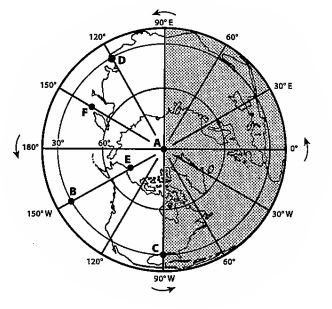
The altitude of Polaris for observer at C would be?
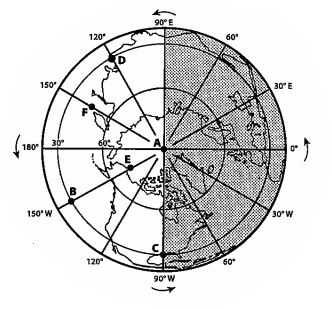
If it is 8 a.m. at location D, what time is it at location F?