Karyotype Virtual Lab Activity PRE-LAB HW
star
star
star
star
star
Last updated over 5 years ago
20 Nsɛmmisa

1
1
1
1
1
1
1
1
1
1
1
1
1
1
1
1
2
1
1
2
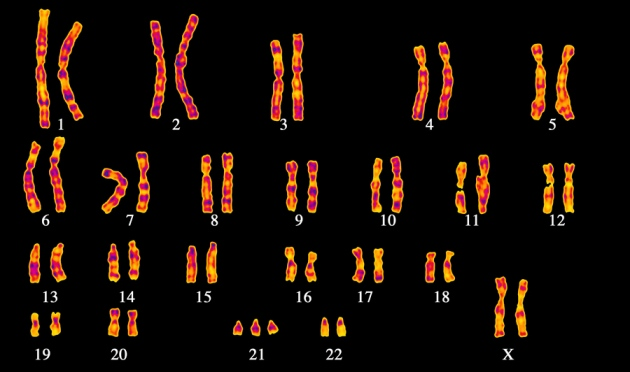
A karyotype is an organized profile of a person's chromosomes. Two chromosomes specify gender, XX for female and XY for male. The rest are arranged in pairs, numbered 1 through 22, from largest to smallest. This arrangement helps scientists quickly identify chromosomal alterations that may result in a genetic disorder.
Un cariotipo es un perfil organizado de los cromosomas de una persona. Dos cromosomas especifican el género, XX para la mujer y XY para el hombre. El resto está organizado en pares, numerados del 1 al 22, de mayor a menor. Esta disposición ayuda a los científicos a identificar rápidamente las alteraciones cromosómicas que pueden resultar en un trastorno genético.
= = = = = = = = = = = = = = = = = = = = = = = = = = = = = = = = = = = = = = = = = = = = = = = = = = = = = = = = = = = = = = =
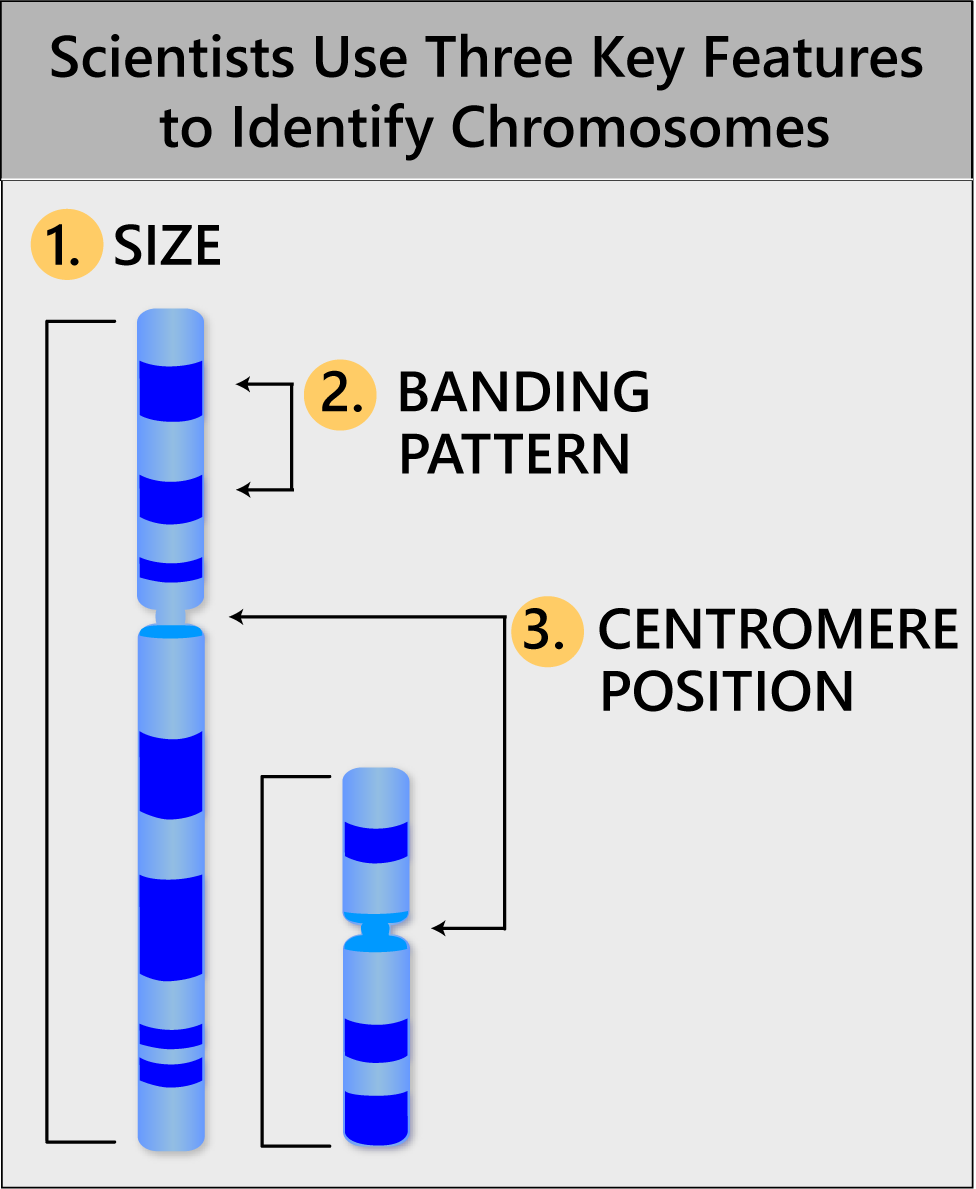
To "read" a set of chromosomes, scientists use three key features to identify their similarities and differences:
Para "leer" un conjunto de cromosomas, los científicos utilizan tres características clave para identificar sus similitudes y diferencias:
Size: This is the easiest way to tell chromosomes apart.
Talla: Esta es la forma más sencilla de diferenciar los cromosomas.
Banding pattern: The size and location of Giemsa bands make each chromosome unique.
Patrón de bandas: El tamaño y la ubicación de las bandas de Giemsa hacen que cada cromosoma sea único.
Centromere position: Centromeres appear as a constriction. They have a role in the separation of chromosomes into daughter cells during cell division (mitosis and meiosis). Using these key features, scientists can identify all 46 chromosomes (one set of 23 from each parent).
Posición del centrómero: Los centrómeros aparecen como una constricción. Desempeñan un papel en la separación de los cromosomas en células hijas durante la división celular (mitosis y meiosis).
Usando estas características clave, los científicos pueden identificar los 46 cromosomas (un conjunto de 23 de cada padre).
(You may visit this page outside the GoFormative here: How Do Scientists Read Chromosomes?)
(Puede visitar esta página fuera de GoFormative aquí: ¿Cómo leen las científicas a los cromosomas?
===========================================================================================
Karyotypes are notated (given a shorthand) by a simple procedure.
Los cariotipos se anotan (se les da una abreviatura) mediante un procedimiento simple.
Count the number of chromosomes in the karyotype. Write this number. In a normal human, the number will be 46.
Cuente el número de cromosomas en el cariotipo. Escribe este número. En un ser humano normal, el número será 46.
Determine the sex chromosomes, whether they are "XX" or "XY". If they are "XX", the subject is a female; "XY", the subject is a male. Write this combination next to the number after a comma. In a normal woman, this will look like this "46, XX".
Determine los cromosomas sexuales, ya sean "XX" o "XY". Si son "XX", el sujeto es una mujer; "XY", el sujeto es un hombre. Escribe esta combinación junto al número después de una coma. En una mujer normal, se verá así "46, XX".
Note any irregularities in the karyotype. If the karyotype has an extra 20th chromosome, write "47, XX, +20" indicating the subject is a woman with 47 chromosomes and the extra chromosome is in the 20th pair. Having three chromosomes in a pair is called "Trisomy." If there is an extra sex chromosome, write 47, then the sex chromosomes; for example, "47, XXX".
Note cualquier irregularidad en el cariotipo. Si el cariotipo tiene un cromosoma 20 adicional, escriba "47, XX, +20" indicando que el sujeto es una mujer con 47 cromosomas y el cromosoma adicional está en el par 20. Tener tres cromosomas en un par se llama "trisomía". Si hay un cromosoma sexual adicional, escriba 47, luego los cromosomas sexuales; por ejemplo, "47, XXX".
In your upcoming activity, you will use a computer model to look at chromosomes and prepare a karyotype. You will diagnose patients for abnormalities and employthe correct notation for characterizing karyotypes.
En su próxima actividad, utilizará un modelo de computadora para observar los cromosomas y preparar un cariotipo. Diagnosticará a los pacientes en busca de anomalías y empleará la notación correcta para caracterizar los cariotipos.
The exercise will be a simulation of human karyotyping using digital images of chromosomes from actual human genetic studies. You will be arranging chromosomes into a completed karyotype, and interpreting your findings just as if you were working in a genetic analysis program at a hospital or clinic.
El ejercicio será una simulación del cariotipo humano utilizando imágenes digitales de cromosomas de estudios genéticos humanos reales. Organizará los cromosomas en un cariotipo completo e interpretará sus hallazgos como si estuviera trabajando en un programa de análisis genético en un hospital o clínica.
(excerpted from SciTable article on Chromosomes and Cytogenetics/extraído del artículo de SciTable sobre cromosomas y citogenética: https://www.nature.com/scitable/topicpage/chromosomal-abnormalities-aneuploidies-290/
by Clare O'Connor, Ph.D. (Biology Department, Boston College) © 2008 Nature Education)
Aneuploidies disturb the delicate balance of gene products in cells. By definition, aneuploid cells have an abnormal number of chromosomes. Because each chromosome contains hundreds of genes, the addition or loss of even a single chromosome disrupts the existing equilibrium in cells, and in most cases, is not compatible with life.
Las aneuploidías alteran el delicado equilibrio de los productos genéticos en las células. Por definición, las células aneuploides tienen un número anormal de cromosomas. Dado que cada cromosoma contiene cientos de genes, la adición o pérdida de un solo cromosoma altera el equilibrio existente en las células y, en la mayoría de los casos, no es compatible con la vida.
In humans, the most common aneuploidies are trisomies, which represent about 0.3% of all live births. Trisomies are characterized by the presence of one additional chromosome, bringing the total chromosome number to 47. With few exceptions, trisomies do not appear to be compatible with life. In fact, trisomies represent about 35% of spontaneous abortions.
En los seres humanos, las aneuploidías más frecuentes son las trisomías, que representan alrededor del 0,3% de todos los nacidos vivos. Las trisomías se caracterizan por la presencia de un cromosoma adicional, lo que eleva el número total de cromosomas a 47. Con pocas excepciones, las trisomías no parecen ser compatibles con la vida. De hecho, las trisomías representan alrededor del 35% de los abortos espontáneos.
Hassold & Hunt, 2001
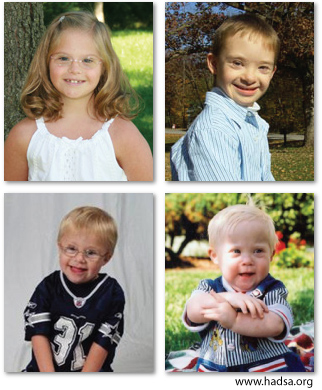
Viable trisomies are restricted to only a few human chromosomes. The most common human trisomy involves chromosome 21 and is known as Down syndrome (DS), named for John Langdon Down, the physician who first described the condition in 1866. Down syndrome is a relatively common birth defect, affecting about 1 in every 750 births. Individuals with DS all demonstrate signs of cognitive impairment, along with a more variable range of other symptoms, but patients routinely live to adulthood.
Las trisomías viables se limitan a unos pocos cromosomas humanos. La trisomía humana más común involucra el cromosoma 21 y se conoce como síndrome de Down (SD), llamado así por John Langdon Down, el médico que describió la afección por primera vez en 1866. El síndrome de Down es un defecto de nacimiento relativamente común, que afecta aproximadamente a 1 de cada 750 nacimientos. Todas las personas con SD muestran signos de deterioro cognitivo, junto con una gama más variable de otros síntomas, pero los pacientes viven habitualmente hasta la edad adulta.
By contrast, trisomies of other autosomes appear to have more severe effects, because they are rarely observed in live births. Indeed, the only other autosomal trisomies that are detected in any appreciable numbers among newborns involve chromosomes 13 (Patau syndrome) and 18 (Edward’s syndrome), but affected babies rarely survive beyond the first few months of life.
Por el contrario, las trisomías de otros autosomas parecen tener efectos más graves, porque rara vez se observan en los nacidos vivos. De hecho, las únicas otras trisomías autosómicas que se detectan en cantidades apreciables entre los recién nacidos son los cromosomas 13 (síndrome de Patau) y 18 (síndrome de Edward), pero los bebés afectados rara vez sobreviven más allá de los primeros meses de vida.
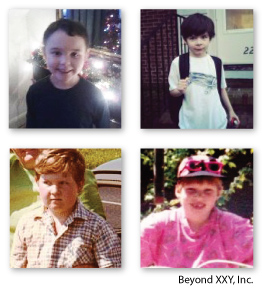
Humans are much more able to tolerate extra sex chromosomes than extra autosomes. Thus, after Down Syndrome, the most common human aneuploidy is the condition known as Klinefelter's syndrome. Klinefelter's males have a total chromosome number of 47, which includes two X chromosomes and one Y chromosome. According to convention, these males are designated as 47, XXY individuals.
Los seres humanos son mucho más capaces de tolerar cromosomas sexuales adicionales que autosomas adicionales. Por lo tanto, después del síndrome de Down, la aneuploidía humana más común es la condición conocida como síndrome de Klinefelter. Los machos de Klinefelter tienen un número total de cromosomas de 47, que incluye dos cromosomas X y un cromosoma Y. Según la convención, estos machos se designan como individuos 47, XXY.
Other configurations of the sex chromosomes have been observed in 47, XXX females and 47, XYY males. Compared to autosomal trisomies, these sorts of sex chromosome trisomies are fairly benign. Affected individuals generally show reduced sexual development and fertility, but they often have normal life spans, and many of their symptoms can be treated by hormone supplementation. The ability of humans to tolerate supernumerary sex chromosomes is quite remarkable, as individuals can survive with as many as four sex chromosomes.
Se han observado otras configuraciones de los cromosomas sexuales en mujeres 47, XXX y hombres 47, XYY. En comparación con las trisomías autosómicas, este tipo de trisomías de cromosomas sexuales son bastante benignas. Las personas afectadas por lo general muestran un desarrollo sexual y una fertilidad reducidos, pero a menudo tienen una esperanza de vida normal y muchos de sus síntomas pueden tratarse con suplementos de hormonas. La capacidad de los humanos para tolerar los cromosomas sexuales supernumerarios es bastante notable, ya que los individuos pueden sobrevivir con hasta cuatro cromosomas sexuales.
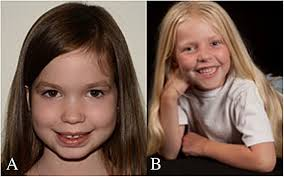
(A and B) Two females with 47, XXX with mild hypertelorism and lack of dysmorphic facial features.
(A y B) Dos hembras con 47, XXX con hipertelorismo leve y ausencia de rasgos faciales dismórficos.
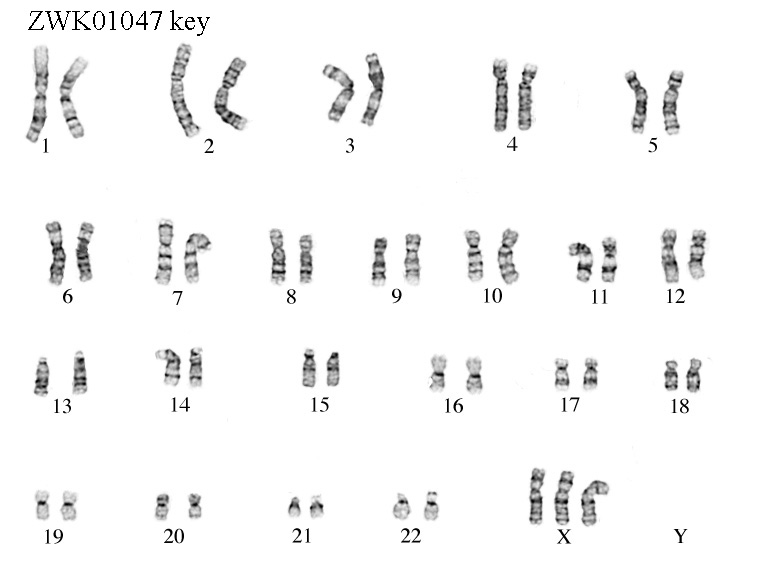
The karyotype below is of a disorder that affects 1:700 children and alters the child's phenotype either moderately or severely. There are three types of this chromosomal condition. People often can’t tell the difference between each type without looking at the chromosomes because the physical features and behaviors are similar.
El cariotipo a continuación corresponde a un trastorno que afecta a 1: 700 niños y altera el fenotipo del niño de forma moderada o grave. Hay tres tipos de esta condición cromosómica. Las personas a menudo no pueden notar la diferencia entre cada tipo sin mirar los cromosomas porque las características físicas y los comportamientos son similares.
What is the gender of this person?/¿Cuál es el género de esta persona?
Did these chromosomes undergo replication before they were separated?
¿Se replicaron estos cromosomas antes de separarse?
Explain your answer for number 2./Explica tu respuesta para el número 2.
Identify the abnormality found in this karyotype./Identifica la anomalía encontrada en este cariotipo.
What disorder does this person have as a result of the abnormality?
¿Qué trastorno tiene esta persona como resultado de la anomalía?
What is the notation for the karyotype?/¿Cuál es la notación del cariotipo?
The disorder represented in this karyotype affects almost every organ system and occurs 1:10,000 live births. These children generally do not live more than a few months. Individuals with this affliction often have slow growth before birth (intrauterine growth retardation) and low birth weight. Affected individuals may have heart defects and abnormalities of other organs that develop before birth.
El trastorno representado en este cariotipo afecta a casi todos los sistemas de órganos y ocurre 1: 10,000 nacidos vivos. Estos niños generalmente no viven más de unos pocos meses. Las personas con esta afección suelen tener un crecimiento lento antes del nacimiento (retraso del crecimiento intrauterino) y bajo peso al nacer. Las personas afectadas pueden tener defectos cardíacos y anomalías de otros órganos que se desarrollan antes del nacimiento.
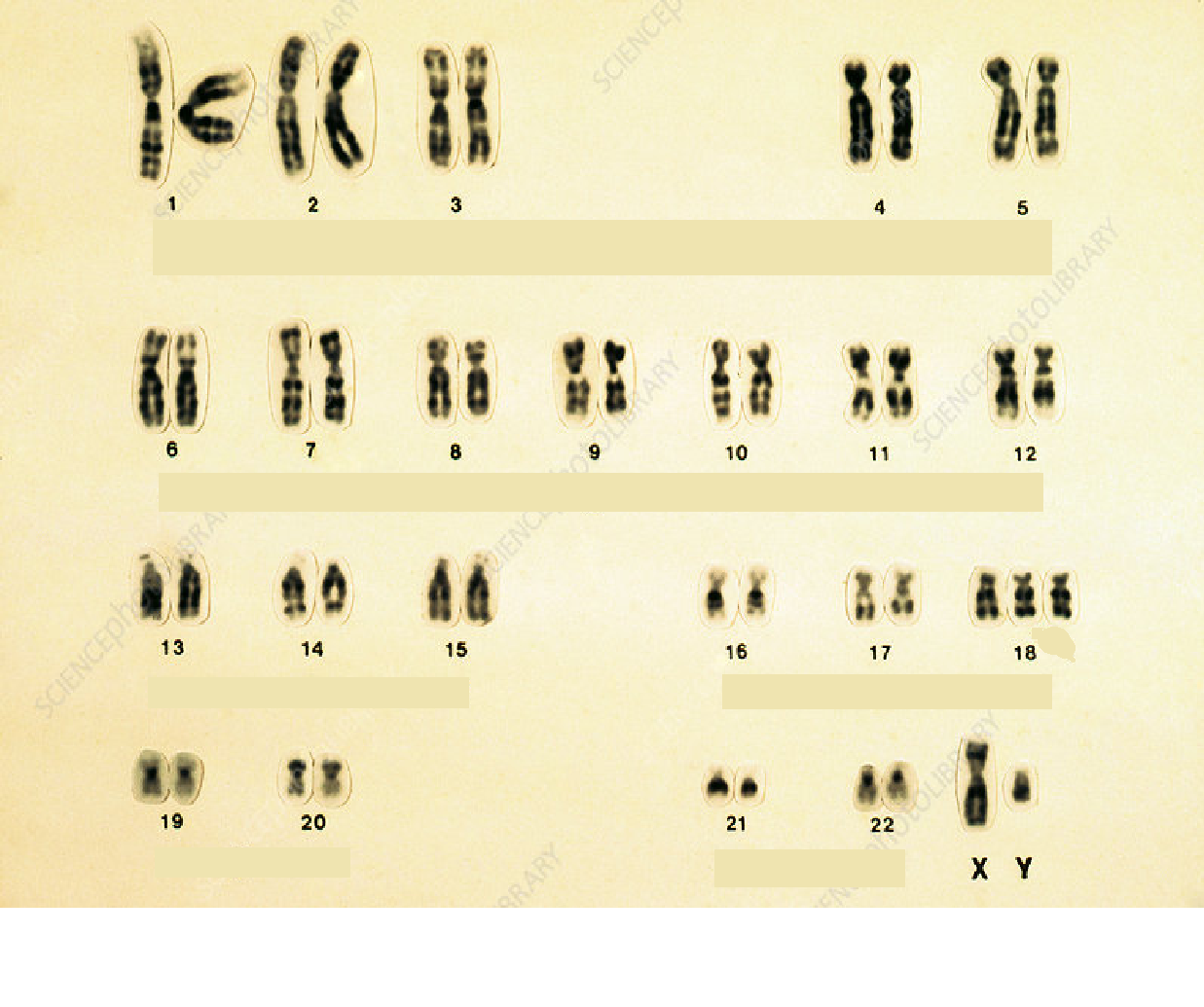
What is the gender of this person?/¿Cuál es el género de esta persona?
Identify the abnormality found in this karyotype./Identifica la anomalía encontrada en este cariotipo.
What disorder does this person have as a result of the abnormality?
¿Qué trastorno tiene esta persona como resultado de la anomalía?
What is the notation for the karyotype?/¿Cuál es la notación del cariotipo?
The following abnormality occurs 1:1000 live births - healthy and fertile - and usually cannot be distinguished from a normal person except by karyotype. Individuals with this chromosomal condition don't experience symptoms or have only mild symptoms. In others, symptoms may be more apparent — possibly including developmental delays and learning disabilities.
La siguiente anomalía ocurre 1: 1000 nacidos vivos, sanos y fértiles, y generalmente no se puede distinguir de una persona normal excepto por el cariotipo. Las personas con esta afección cromosómica no experimentan síntomas o solo tienen síntomas leves. En otros, los síntomas pueden ser más evidentes, posiblemente incluyendo retrasos en el desarrollo y problemas de aprendizaje.
What is the gender of this person?/¿Cuál es el género de esta persona?
Identify the abnormality found in this karyotype./Identifica la anomalía encontrada en este cariotipo.
Nondisjunction can occur if ______ chromosomes fail to separate during meiosis I.
La no disyunción puede ocurrir si los cromosomas ______ no se separan durante la meiosis I.
A person with Turner syndrome has ______ sex chromosome(s).
Una persona con síndrome de Turner tiene ______ cromosomas sexuales.
An egg cell has a(n) ______ chromosome./Un óvulo tiene un cromosoma ______.
A sperm has a(n) ______ chromosome./Un espermatozoide tiene un cromosoma ______.
Choose all that apply. Nondisjunction during spermatogenesis can lead to a sperm with _____.
Elija todas las que correspondan. La no disyunción durante la espermatogénesis puede conducir a un espermatozoide con _____.
Choose all that apply. Nondisjunction during oogenesis can lead to an egg cell with ___.
Elija todas las que correspondan. La no disyunción durante la ovogénesis puede conducir a un óvulo con ___.
Normally, an individual receives ______ autosomes from each parent.
Normalmente, un individuo recibe ______ autosomas de cada padre.
Match the term with its abbreviation./Empareja el término con su abreviatura.
| Draggable item | arrow_right_alt | Corresponding Item |
|---|---|---|
diploid | arrow_right_alt | 2n+1 |
trisomy | arrow_right_alt | 2n-1 |
haploid | arrow_right_alt | 2n |
monosomy | arrow_right_alt | n |