Karyotype Virtual Lab DATA and DIAGNOSES
star
star
star
star
star
Last updated over 5 years ago
18 Nsɛmmisa

1
1
1
1
1
1
1
1
1
1
1
1
1
1
1
1
1
1
In this activity, you will use a computer model to look at chromosomes and prepare a karyotype. You will diagnose patients for abnormalities and employ the correct notation for characterizing karyotypes.
En este actividad, utilizará un modelo de computadora para observar los cromosomas y preparar un cariotipo. Diagnosticará a los pacientes en busca de anomalías y empleará la notación correcta para caracterizar los cariotipos.
The exercise will be a simulation of human karyotyping using digital images of chromosomes from actual human genetic studies. You will be arranging chromosomes into a completed karyotype, and interpreting your findings just as if you were working in a genetic analysis program at a hospital or clinic.
El ejercicio será una simulación del cariotipo humano utilizando imágenes digitales de cromosomas de estudios genéticos humanos reales. Organizará los cromosomas en un cariotipo completo e interpretará sus hallazgos como si estuviera trabajando en un programa de análisis genético en un hospital o clínica.
Patient A is the nearly-full-term fetus of a forty year old female. Chromosomes were obtained from fetal epithelial cells acquired through amniocentesis.
El paciente A es un feto casi completemente desarrollado de una mujer de cuarenta años. Los cromasomas fueron obtenidos de las células epiteliales. Las células fueron adquiridas por amniocentísis.
Click here to access Patient A in English: Patient A
Haga clic aquí para acceder a la Paciente A en español: Paciente A
Insert a screenshot of your completed karyotype for Patient A here. (It will be displayed on the bottom of the page. For the Spanish version of this activity, there is a programming hiccup and it will be displayed three times. They are all the same; just screenshot one.)
Inserte aquí una captura de pantalla de su cariotipo completo para el Paciente A. (Se mostrará en la parte inferior de la página. Para la versión en español de esta actividad, hay un problema de programación y se mostrará tres veces. Son todos iguales; solo captura de pantalla uno).
What is the gender of this patient?/¿Cuál es el género de esta paciente?
Identify the abnormality found in this karyotype./Identifica la anomalía encontrada en este cariotipo.
What is the karyotypic notation for this patient?/¿Cuál es la notación del cariotipo para esta paciente?
Review the list of possible diagnoses provided and indicate your diagnosis. Explain the rationale for your diagnosis and why you ruled out the others.
Revise la lista de posibles diagnósticos proporcionada e indique su diagnóstico. Explique el fundamento de su diagnóstico y por qué descartó los demás.
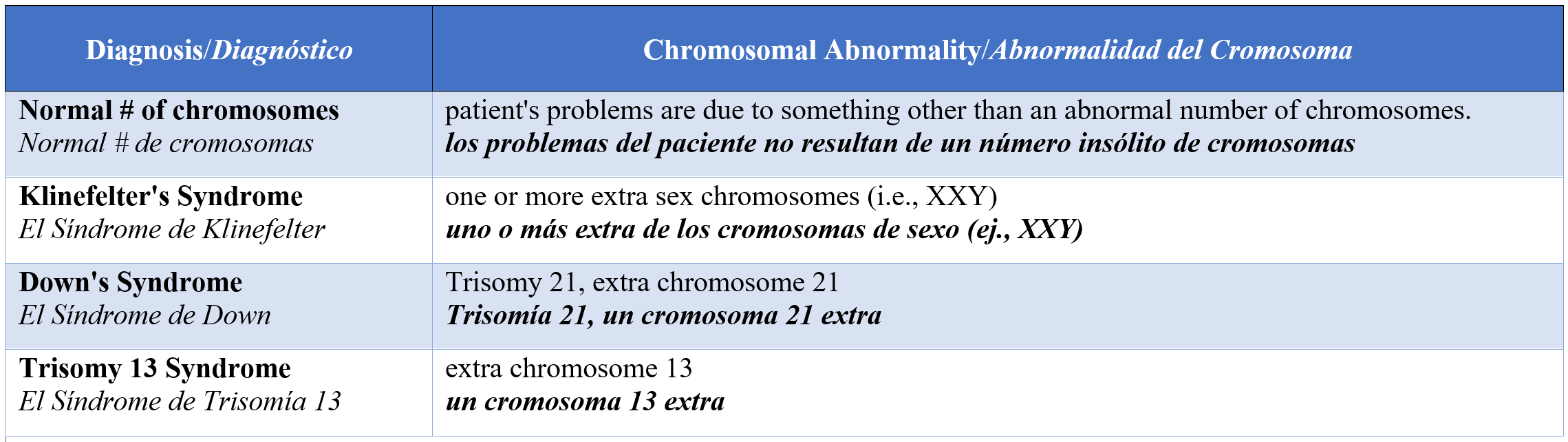
What is your diagnosis for Patient A?/¿Cuál es su diagnóstico para la Paciente A?
Explain the rationale for your diagnosis and why you ruled out the others.
Explique el fundamento de su diagnóstico y por qué descartó los demás.
Patient B is a 28 year old male who is trying to identify a cause for his infertility. Chromosomes were obtained from nucleated cells in the patient's blood. Complete Patient B's Karyotype.
El paciente B es un hombre de 28 años que está tratando de identificar la causa de su infertilidad. Los cromosomas fueron obtenidos de células nucleadas de su sangre. Completa el Cariotipo del Paciente B.
Click here to access Patient B in English: Patient B
Haga clic aquí para acceder a la Paciente B en español: Paciente B
Insert a screenshot of your completed karyotype for Patient B here. (It will be displayed on the bottom of the page. For the Spanish version of this activity, there is a programming hiccup and it will be displayed three times. They are all the same; just screenshot one.)
Inserte aquí una captura de pantalla de su cariotipo completo para el Paciente B. (Se mostrará en la parte inferior de la página. Para la versión en español de esta actividad, hay un problema de programación y se mostrará tres veces. Son todos iguales; solo captura de pantalla uno).
What is the gender of this patient?/¿Cuál es el género de esta paciente?
Identify the abnormality found in this karyotype./Identifica la anomalía encontrada en este cariotipo.
What is the karyotypic notation for this patient?/¿Cuál es la notación del cariotipo para esta paciente?
Review the list of possible diagnoses provided and indicate your diagnosis. Explain the rationale for your diagnosis and why you ruled out the others.
Revise la lista de posibles diagnósticos proporcionada e indique su diagnóstico. Explique el fundamento de su diagnóstico y por qué descartó los demás.
What is your diagnosis for Patient B?/¿Cuál es su diagnóstico para la Paciente B?
Explain the rationale for your diagnosis and why you ruled out the others.
Explique el fundamento de su diagnóstico y por qué descartó los demás.
Patient C/Paciente C
Patient C died shortly after birth, with a multitude of anomalies, including polydactyly and a cleft lip. Chromosomes were obtained from a tissue sample. Complete Patient C's Karyotype.
El paciente C se murió a poco de su nacimiento con muchas anomalías incluyendo el polidactilia y un labio leporino. Los cromosomas fueron obtenidos de una muestra de tejido. Completa el Cariotipo del Paciente C.
Click here to access Patient C in English: Patient C
Haga clic aquí para acceder a la Paciente B en español: Paciente C
Insert a screenshot of your completed karyotype for Patient C here. (It will be displayed on the bottom of the page. For the Spanish version of this activity, there is a programming hiccup and it will be displayed three times. They are all the same; just screenshot one.)
Inserte aquí una captura de pantalla de su cariotipo completo para el Paciente C. (Se mostrará en la parte inferior de la página. Para la versión en español de esta actividad, hay un problema de programación y se mostrará tres veces. Son todos iguales; solo captura de pantalla uno).
What is the gender of this person?/¿Cuál es el género de esta persona?
Identify the abnormality found in this karyotype./Identifica la anomalía encontrada en este cariotipo.
What is the karyotypic notation for this patient?/¿Cuál es la notación del cariotipo para esta paciente?
Review the list of possible diagnoses provided and indicate your diagnosis. Explain the rationale for your diagnosis and why you ruled out the others.
Revise la lista de posibles diagnósticos proporcionada e indique su diagnóstico. Explique el fundamento de su diagnóstico y por qué descartó los demás.
What is your diagnosis for Patient C?/¿Cuál es su diagnóstico para la Paciente C?
Explain the rationale for your diagnosis and why you ruled out the others.
Explique el fundamento de su diagnóstico y por qué descartó los demás.
Submit Part I of the completed Virtual Lab by the end of the class period.
Envíe la Parte I del Laboratorio virtual completo antes del final del período de clases.
Complete and submit Part II (the lab report) for homework.
Complete y envíe la Parte II (el informe de laboratorio) como tarea.