1
Asemmisa {{asɛmmisaAhyɛnsode}}
3.
1
Asemmisa {{asɛmmisaAhyɛnsode}}
4.
1
Asemmisa {{asɛmmisaAhyɛnsode}}
5.
1
Asemmisa {{asɛmmisaAhyɛnsode}}
6.
1
Hypothesis: If we squeeze the clothespin/our fingers/bicep curl for a long time, then
__________________________________________________because,
_________________________________________________________
Hypothesis: If we hold a heavy object out in front of us for a long time, then
__________________________________________________because,
_________________________________________________________
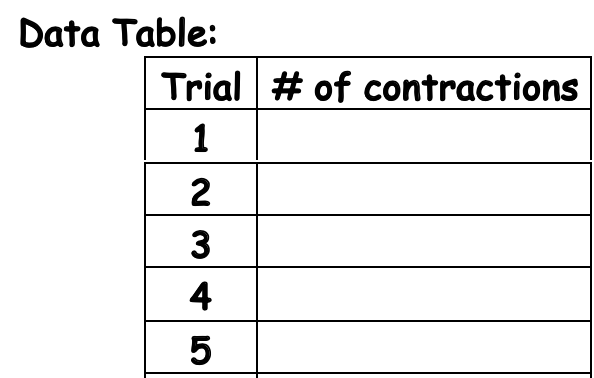
As you completed more trials, what happened to the number of contractions? Why do you think this happened?
How long did you hold your arm out with the heavy object? What did you feel as you held your arm out? Why do you think you felt this?
Background: (use this information to help you answer questions 10-24)
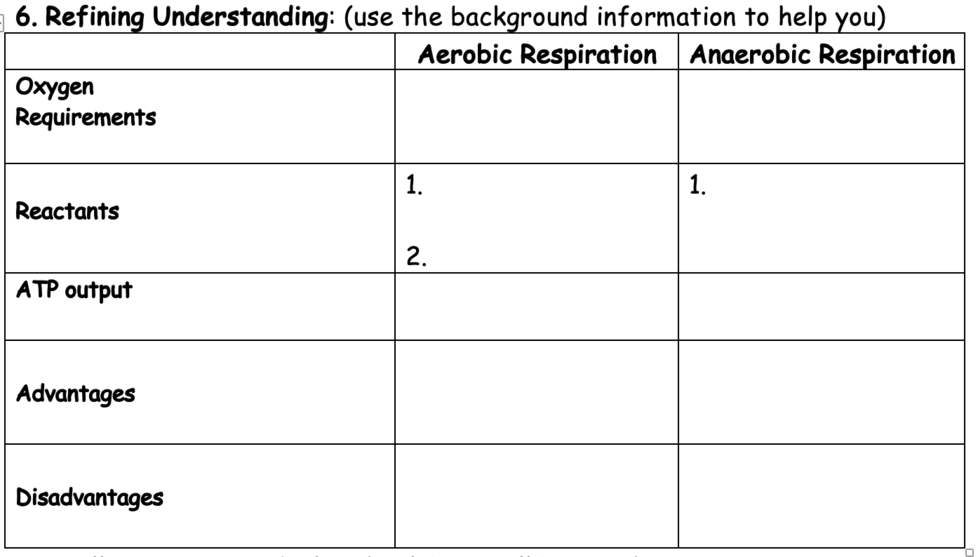
Under normal conditions muscles utilize oxygen (aerobic respiration) to make ATP from glucose. This process is very efficient and produces 38 ATPs for each molecule of glucose. Carbon dioxide and water are the by-products of this reaction. When muscles undergo rigorous exercise they require more oxygen to make ATP than the blood can supply (sprinting). At this point the muscle is forced to produce ATP without oxygen (anaerobic respiration).
Anaerobic respiration produces only 2 ATPs for each molecule of glucose. The product of this reaction is lactic acid. The advantages of anaerobic respiration are that the muscle cell can make ATP without oxygen and it can make ATP very quickly. This is a particular advantage when lifting heavy objects. The big disadvantage to anaerobic respiration is that it produces lactic acid which gives muscles a temporary burning sensation. Muscle fatigue results when the demand for ATP is greater than the rate at which ATP can be produced in the muscle fibers. As a consequence, ATP levels are too low for muscle fibers to produce their maximum force contraction. Under condition of extreme fatigue, muscles become incapable of contracting or relaxing.
In the lab you experienced the use of aerobic respiration and anaerobic respiration by the muscle fibers in your fingers/arms. You experienced the production of lactic acid and the sensation it produces in you muscles. The lab demonstrated how your body used the resources available to provide you with the energy you need to do work.
What are the signs of ATP level getting too low (and lactic acid being produced) ? Did you have any during the lab? Have you ever had this feeling in a muscle before? If so, when?
You are helping your dad lift a HEAVY couch down some stairs and into another room in your house. You lift it up and you say "oh this is not too bad, I can do this!" You make it down the stairs and start to go across the room, suddenly your arms start to burn! You say "dad I need a quick break, put it down for a second!!"
Based on the background information
1. Explain why at first the couch felt ok for you to lift. (discuss what is going on in your cells)
2. Explain why after you got down the stairs and into the next room you suddenly felt burning and needed a break. (discuss what is going on in your cells)
You felt "the burn" during the lab----why would your cells chose to make you feel this pain? In other words: Explain why muscles must use lactic acid fermentation instead of cellular respiration during intense physical activity.
Methanogens are a type of bacteria found in the oxygen-depleted environments like deep in soil, in sediments, and the intestinal tract of humans and animals helping with the digestion of vegetables. What process do you think methanogens perform to make energy to stay alive? Why?
What step of cellular respiration can occur even when oxygen is not present?
Aerobic respiration oxygen requirements.
Anaerobic respiration oxygen requirements.
Aerobic Respiration inputs. (Select all that apply)
Anaerobic Respiration inputs. (Select all that apply)