Day 10 Influential Points Activity
star
star
star
star
star
Last updated over 4 years ago
15 questions
4
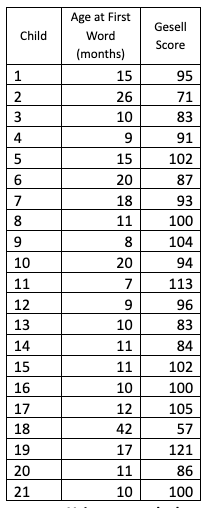
With the data in L1 and L2, create a scatterplot showing the relationship between age and Gesell Score.Use Statplot (2nd, y=).Describe the relationship between age at first word and Gesell Score:Select all answers that apply.
With the data in L1 and L2, create a scatterplot showing the relationship between age and Gesell Score.
Use Statplot (2nd, y=).
Describe the relationship between age at first word and Gesell Score:
Select all answers that apply.
4
Do a linear regression (Stat, Calc, #8) to calculate the correlation coefficient.Enter the value rounded to three places past the decimal point.Be careful to note the sign.
Do a linear regression (Stat, Calc, #8) to calculate the correlation coefficient.
Enter the value rounded to three places past the decimal point.
Be careful to note the sign.
4
Use the linear regression information to create a Linear Model Equation for predicting Gesell Score based on Age at First Word.Match the numbers and variables with the correct description.
Use the linear regression information to create a Linear Model Equation for predicting Gesell Score based on Age at First Word.
Match the numbers and variables with the correct description.
| Draggable item | arrow_right_alt | Corresponding Item |
|---|---|---|
-1.127 | arrow_right_alt | Slope: ___________ points/month |
Gesell Score | arrow_right_alt | Intercept: _________ points |
109.874 | arrow_right_alt | Explanatory Variable |
Age at First Word (in months) | arrow_right_alt | Response Variable |
-0.640 | arrow_right_alt | Correlation Coefficient |
4
Enter the Linear Model Equation for predicting the Gesell Score based on the Age at First Word:Use the correct notation (-hat) and meaningful words.Use 'Age' and 'Score' for the explanatory and response variables in the equation.Slope and intercept should be rounded to three places past the decimal point.No spaces.
Enter the Linear Model Equation for predicting the Gesell Score based on the Age at First Word:
Use the correct notation (-hat) and meaningful words.
Use 'Age' and 'Score' for the explanatory and response variables in the equation.
Slope and intercept should be rounded to three places past the decimal point.
No spaces.
4
Explain the meaning of the slope in this context.Correct the answer below:
Explain the meaning of the slope in this context.
Correct the answer below:
4
Explain the meaning of the intercept in this context.Correct the answer below:
Explain the meaning of the intercept in this context.
Correct the answer below:
4
Now that your data is in L1 and L2, check the Linear Model Equation by graphing the Residual Plot.
1. Do a linear regression, Stat, Calc, #8, Store the Regression Equation (Store RegEQ: VARS, Y-VARS, enter, enter, enter, enter)2. To show the residual plot:StatPlot (2nd, y=)Open Statplot #1, 'ON'YList: RESID (2nd, Stat, RESID)3. Clear the 'y=' function for the line of best fit (seeing the line appear with the residual plot is confusing).4. Zoom, #9 to show the Residual Plot.
What do you see?Does this mean the linear model equation is appropriate for making predictions?
Now that your data is in L1 and L2, check the Linear Model Equation by graphing the Residual Plot.
1. Do a linear regression, Stat, Calc, #8, Store the Regression Equation (Store RegEQ: VARS, Y-VARS, enter, enter, enter, enter)
2. To show the residual plot:
StatPlot (2nd, y=)
Open Statplot #1, 'ON'
YList: RESID (2nd, Stat, RESID)
3. Clear the 'y=' function for the line of best fit (seeing the line appear with the residual plot is confusing).
4. Zoom, #9 to show the Residual Plot.
What do you see?
Does this mean the linear model equation is appropriate for making predictions?
4
Look back at the table for today's activity, or use Stat Edit. There are two children that have unusual results.
Look at child #18, who has unusual results.Use the Age at First Word for this child and find their predicted Gesell Score.Enter it below to two places past the decimal.
Look back at the table for today's activity, or use Stat Edit. There are two children that have unusual results.
Look at child #18, who has unusual results.
Use the Age at First Word for this child and find their predicted Gesell Score.
Enter it below to two places past the decimal.
4
Using the information from #8, find the residual for Child #18.
Enter it below to two places past the decimal.
Using the information from #8, find the residual for Child #18.
Enter it below to two places past the decimal.
4
Look back at the table for today's activity, or use Stat Edit. There are two children that have unusual results.
NOW, look at child #19, who also has unusual results.Use the Age at First Word for this child and find their predicted Gesell Score.Enter it below to two places past the decimal.
Look back at the table for today's activity, or use Stat Edit. There are two children that have unusual results.
NOW, look at child #19, who also has unusual results.
Use the Age at First Word for this child and find their predicted Gesell Score.
Enter it below to two places past the decimal.
4
Using the information from #10, find the residual for Child #19.
Enter it below to two places past the decimal.
Using the information from #10, find the residual for Child #19.
Enter it below to two places past the decimal.
4
Based on looking at the data table (note the age and Gesell scores) and looking at the residuals, why are both children considered outliers?Match their number with the correct reason.
Based on looking at the data table (note the age and Gesell scores) and looking at the residuals, why are both children considered outliers?
Match their number with the correct reason.
| Draggable item | arrow_right_alt | Corresponding Item |
|---|---|---|
Child #18 | arrow_right_alt | The x value(age at first word) is far from the rest of the data values, but making it an outlier even though the residual is not large. |
Child #19 | arrow_right_alt | The actual data point (age at first word, Gesell Score) puts it far away from the main group of the data, making it an outlier with a large residual. |
| arrow_right_alt | The type of outlier and reason cannot be determined with the information provided. |
4
Using the data lists in L1 and L2, let's observe the influence of each of the unusual points.Start with Child #18 (42, 57).Remember the original data gave the correlation coefficient: -0.640 slope: -1.127 pts/month y-intercept: 109.874 points
1. Go into L1 and L2, REMOVE the data for child #18 (use 'del')2. Redo the Linear Regression (stat, calc, #8) WITHOUT the data for child #18.3. Match the information to the new numbers.
Using the data lists in L1 and L2, let's observe the influence of each of the unusual points.
Start with Child #18 (42, 57).
Remember the original data gave the correlation coefficient: -0.640
slope: -1.127 pts/month
y-intercept: 109.874 points
1. Go into L1 and L2, REMOVE the data for child #18 (use 'del')
2. Redo the Linear Regression (stat, calc, #8) WITHOUT the data for child #18.
3. Match the information to the new numbers.
| Draggable item | arrow_right_alt | Corresponding Item |
|---|---|---|
Slope | arrow_right_alt | -0.335 |
Intercept | arrow_right_alt | -0.779 |
Original Intercept | arrow_right_alt | 105.63 |
Original Slope | arrow_right_alt | 109.874 |
Correlation Coefficient | arrow_right_alt | -1.127 |
4
NOW add back the data for child #18, it is ok to just add (42, 57) at the end of L1 and L2.
Using the data lists in L1 and L2, let's observe the influence of the unusual point for child #19 (17, 121).
Remember the original data gave the correlation coefficient: -0.640 slope: -1.127 pts/month y-intercept: 109.874 points
1. Go into L1 and L2, REMOVE the data for child #19.2. Redo the Linear Regression (stat, calc, #8) WITHOUT the data for child #19.3. Match the information to the new numbers.
NOW add back the data for child #18, it is ok to just add (42, 57) at the end of L1 and L2.
Using the data lists in L1 and L2, let's observe the influence of the unusual point for child #19 (17, 121).
Remember the original data gave the correlation coefficient: -0.640
slope: -1.127 pts/month
y-intercept: 109.874 points
1. Go into L1 and L2, REMOVE the data for child #19.
2. Redo the Linear Regression (stat, calc, #8) WITHOUT the data for child #19.
3. Match the information to the new numbers.
| Draggable item | arrow_right_alt | Corresponding Item |
|---|---|---|
Slope | arrow_right_alt | -0.756 |
Correlation Coefficient | arrow_right_alt | -1.193 |
Intercept | arrow_right_alt | 109.305 |
Original Slope | arrow_right_alt | 109.874 |
Original Intercept | arrow_right_alt | -1.127 |
4
Now we will compare Child #18 and Child #19.
Remember: an observation that is influential for a statistical calculation will cause a marked change in the intercept, slope and correlation coefficient when it is REMOVED.
Which of the two points is considered an INFLUENTIAL point?Why?
Choose both correct answers below.
Now we will compare Child #18 and Child #19.
Remember: an observation that is influential for a statistical calculation will cause a marked change in the intercept, slope and correlation coefficient when it is REMOVED.
Which of the two points is considered an INFLUENTIAL point?
Why?
Choose both correct answers below.