
1
Asemmisa {{asɛmmisaAhyɛnsode}}
1.
1
1
1
1
Illustrative Math

Tell me a story of the day's temp
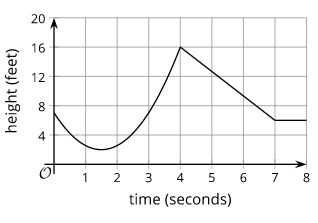
Match each feature of the situation with a corresponding statement in function notation.
| Draggable item | arrow_right_alt | Corresponding Item |
|---|---|---|
starting height | arrow_right_alt | |
height staying the same | arrow_right_alt | |
maximum height | arrow_right_alt | |
minimum height | arrow_right_alt |

The largest:

Yep, I need to grade this!


The height, in feet, of a squirrel running up and down a tree is a function of time, in seconds.
Here are statements describing the squirrel’s movement during four intervals of time. Match each description with a statement about the average rate of change of the function for that interval.
| Draggable item | arrow_right_alt | Corresponding Item |
|---|---|---|
The squirrel starts and ends at the same height. | arrow_right_alt | The average rate of change is large and positive. |
The squirrel runs up the tree slowly. | arrow_right_alt | The average rate of change is zero. |
The squirrel runs up the tree very fast. | arrow_right_alt | The average rate of change is negative. |
The squirrel runs down the tree. | arrow_right_alt | The average rate of change is small and positive. |

The rate of change for what you chose above.
rate of change for what you chose for 25:
Jada walks to school. The function D gives her distance from school, in meters, t minutes since she left home.
Which equation tells us “Jada is 600 meters from school after 5 minutes”?
Which is the largest?
Which is the largest?
Now for a positive rate of change...