A#416 - Eukaryotic Click and Learn - Cell Cycle and Cancer

Last updated almost 5 years ago
18 questions

INTRODUCTION

This handout complements the Click & Learn The Eukaryotic Cell Cycle and Cancer and is intended as an in-depth examination of the cell cycle and the protein players involved.

PROCEDURE
Follow the instructions as you proceed through the Click & Learn and answer the questions in the spaces below.
Click on the “Background” tab on the right side. Most of this should be review
1

What is a "growth factor" and what role does it play in cell division?

1

Cells either divide, die or differentiate. What is differentiation?

Be sure to review the video embedded here about mouse villi - how does the stem cell's progeny change as they move up the villus? Why are they changing? Why do some have to die at the top? Be prepared to discuss

Click on “Cell Cycle Regulators and Cancer” in the center purple circle on the right. Use the information under “Regulators Overview” in the window on the left to answer the questions below.
1

What type of protein that regulates the cell cycle is encoded by proto-oncogenes?

1

What type of protein that regulates the cell cycle is encoded by tumor suppressor genes?

1

The most important cell cycle regulators are the

1

What is a kinase, and what does it do?

1

When are CDKs PRESENT inside the cell during the cell cycle?

1

When are CDKs present ACTIVE the cell during the cell cycle?

1

When are cyclins present inside the cell during the cell cycle?

1

CDKs form molecular complexes with cyclins. What do activated CDK-cyclin complexes do?

Various proteins in the cell turn on or off cycle/CDK complexes. SO - these proteins, by regulating the activity of the cycle/CDK complexes, regulate progression through the cell cycle.
1

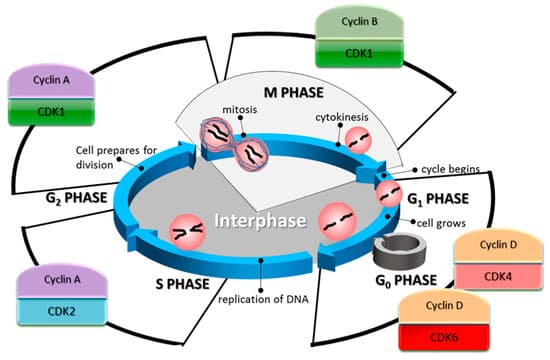
Use the diagram:
Remember that cyclin/CDK complexes enable a cell to progress through a particular stage in the cell cycle. WHICH cyclin is CDK2 bound to during the Sphase checkpoint?

1

Which CDK is Cyclin B bound to in order to make the active cyclin/CDK complex that will move a cell past metaphase?

1


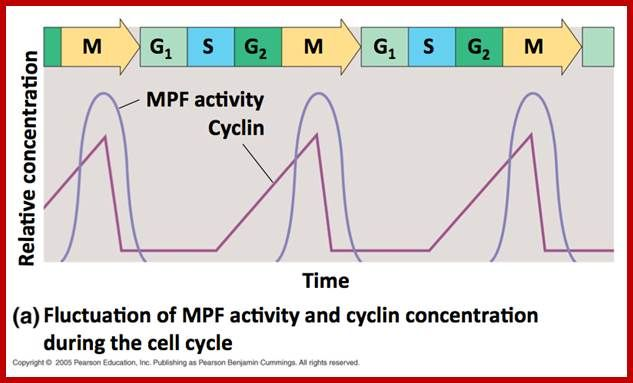
In the diagram above, notice that cyclin levels CYCLE (get the name now?), and MPF (maturation promoting factor, a specific name of a cyclin/CDK complex) follows the same pattern. When cyclin levels are high, MPF activity is high, and vice versa. The height of activity peaks at M phase. This tells us that the role of this active complex is to move through M phase, and then cyclin levels, and MPF activity levels, drop off quickly after that.

Given all this information, what do you know about associated CDK levels during the time shown on this graph?

If you need more info or a different take on how cyclins/CDKs work, please watch below. The first is a good overview. The second (start at 1 minute) is a great example of how genes and CDKs work together.
Using the cell cycle diagram on the right and both links in the center purple circle, review this information. You should be able to tell me (TAKE NOTES ON THIS) what is being "checked" at each checkpoint.

For example - G1 checkpoint - no DNA damage and sufficient resources

Also be able to tell me what would make each check point STOP and GO (use the green and red buttons on the "Cell Cycle Phases" diagram.

For example
G1 checkpoint is driven by growth factors that are circulating in the blood (what type of communication is this?)
G1 checkpoint is inhibited by p53 and Rb (see the second video linked below)

repeat for the other checkpoints. this isn't about memorizing this information, but understanding how it all works together.
Click on “Cell Cycle Regulators and Cancer” in the center purple circle on the right. Then click on the “Cancer Overview” tab in the window to the left (right tab).
1

What is the role of a proto-oncogene in normal, healthy cells?

1

What is the role of a tumor-suppressor gene in normal, healthy cells?

1

What do mutated proto-oncogenes cause?

1

What do mutated tumor suppressor genes cause?

1

Mutations in proto-oncogenes are dominant and cause a gain in function. ONE mutation can lead to cancer. Mutations in tumor-suppressor genes are different. Explain how.

  1. Watch the video clip. Be able to
  2. Using the gas pedal analogy, explain the impact on the cell cycle of a proto-oncogene versus an oncogene.
  3. Using the brake pedal analogy, explain the impact on the cell cycle of one mutated tumor suppressor gene allele versus two mutated tumor suppressor alleles.