Which diagram represents the potential energy of an exothermic reaction?
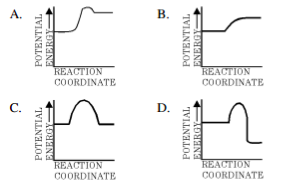
Which diagram represents the potential energy of an exothermic reaction?
A chemical reaction that absorbs heat from the surroundings is said to be __________________ and has a ________________∆H at constant pressure.
a. Endothermic, positive
b. Endothermic, negative
c. Exothermic, negative
d. Exothermic, positive
Which statement best describes the production of a chlorine molecule according to the reaction
Cl + Cl --> Cl2
a. A bond is broken, and the reaction is exothermic.
b. A bond is broken, and the reaction is endothermic.
c. A bond is formed, and the reaction is exothermic.
d. A bond is formed, and the reaction is endothermic
A 1 gram sample of a substance has the largest entropy when it is in the
a. Solid state
b. Liquid state
c. Crystalline state
d. Gaseous state
Which diagram represents the potential energy of an exothermic reaction?
The specific heat capacity of lead is 0.13 J/g K. How much heat (in J) is required to raise the temperature of 15 g of lead from 22 degrees C to 37 degrees C?
a. 29 J
b. 5.8 x 10⁻⁴ J
c. -0.13 J
d. 2.0 J
When ammonium nitrate (NH4NO3) dissolves in water, the solution gets cold.
NH4NO3 (s) --> NH4+ (aq) + NO3- (aq)
Which of the following is true about this system?
a. The sign on the enthalpy change is +; the sign on the entropy change is +
b. The sign on the enthalpy change is -; the sign on the entropy change is –
c. The sign on the enthalpy change is +; the sign on the entropy change is –
d. The sign on the enthalpy change is -; the sign on the entropy change is +
e. There is no change of enthalpy, the but the sign on the entropy change is +
S will be positive for the reaction ______________________.
a. 2H2 (g) + O2 (g) --> 2H2O (g)
b. 2NO2 (g) --> N2O4 (g)
c. BaF2 (s) --> Ba2+ (aq) + 2F- (aq)
d. 2Hg (l) + O2 (g) --> 2HgO (s)
e. CO2 (g) --> CO2 (s)
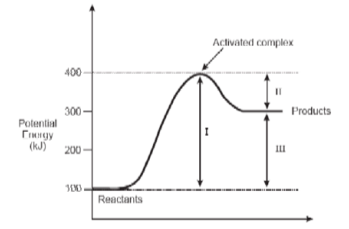
The line that represents the enthalpy (∆H) of this reaction is:
a. I
b. II
c. II + III
d. III
e. III-II
What is the value of the activation energy of this reaction?
a. 100 kJ
b. 200 kJ
c. 300 kJ
d. 400 kJ
e. 500 kJ
Below is a liquid. Complete the model by drawings particles with higher entropy. Include a key and an equal number of particles.
The formation of carbon dioxide is shown below.
C + O2 --> CO2
What are the intermediates of the reaction above? Label is on the diagram below.
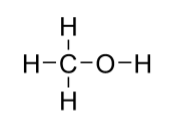
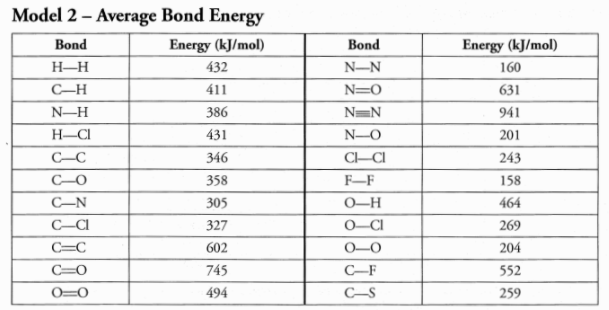
Calculate the total bond energy in the molecule below.
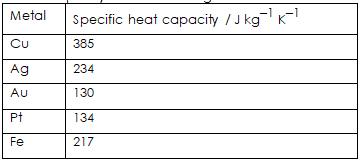
Which metal will show the greatest temperature increase if 50 J of heat is supplied to an equal mass sample of each metal?
A) Cu
B) Ag
C) Au
D) Pt
E) Fe
A 58-gram sample of water has an initial temperature of 32°C. After the sample absorbs 2000 joules of heat energy, the final temperature of the sample is…. (hint specific heat of water is 4.18 J/gxC)
Round to the nearest degree.
Calculate the specific heat capacity of a new alloy if a 15.4 g sample absorbs 393 J when it is heated from 0.0 degrees C to 37.6 degrees C.