1
1
1
1
1
1
1
1
1
1
1
1
1
1
1
1
1
1
1
1
Remember that definite and indefinite articles match the noun. If you don't know what a word means, you can know if it is male, female, singular, or plural by looking at the letter/s at the end of the word. Some nouns don't end in -a or -o. In this case, the gender (male or female) is given for you. Still, you have to decide whether or not the noun is singular or plural.
Choose the English word for el abuelo
Choose the English word for una tía.
Choose the English word for los primos.
Choose the English word for las hermanas.
Choose the Spanish word for a mother.
Choose the Spanish word for some sons.
Choose the Spanish word for a family.
Choose the Spanish word for a female dog.
Choose the Spanish word for the hens.
Choose the Spanish word for a bird.
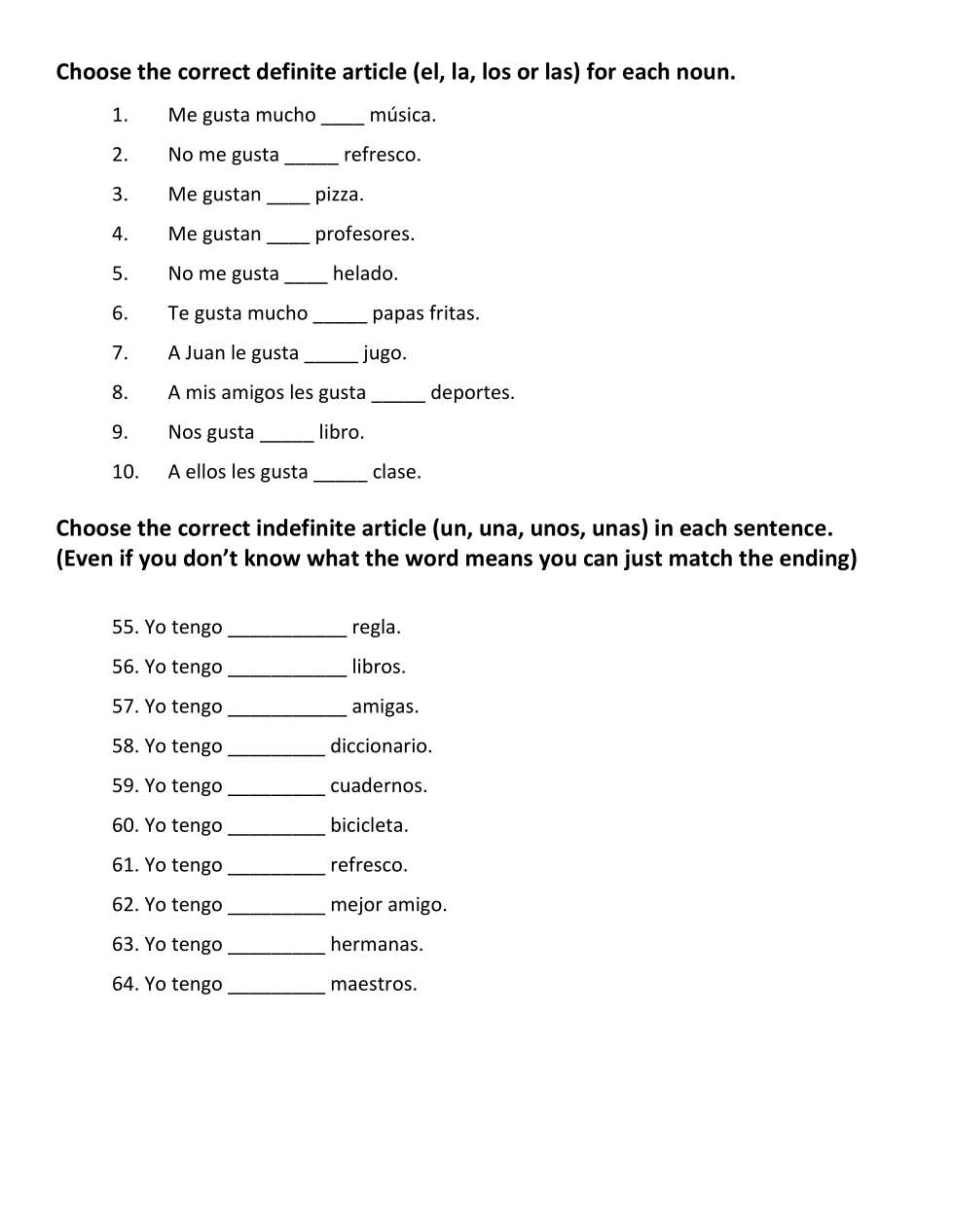
Choose the definite article that goes with the noun.
Choose the definite article that goes with the noun.
Choose the definite article that goes with the noun.
Choose the definite article that goes with the noun. (male plural)
Choose the definite article that goes with the noun.
Choose the definite article that goes with the noun.
Choose the definite article that goes with the noun.
Choose the definite article that goes with the noun. (male plural)
Choose the definite article that goes with the noun.
Choose the definite article that goes with the noun. (feminine singular)
Choose the indefinite article that goes with the noun.
Choose the indefinite article that goes with the noun.
Choose the indefinite article that goes with the noun.
Choose the indefinite article that goes with the noun.
Choose the indefinite article that goes with the noun.
Choose the indefinite article that goes with the noun.
Choose the indefinite article that goes with the noun.
Choose the indefinite article that goes with the noun.
Choose the indefinite article that goes with the noun.
Choose the indefinite article that goes with the noun.