Log in
Sign up for FREE
arrow_back
Library

Environments and Habitats

star
star
star
star
star
Last updated over 5 years ago
18 questions
1
1
1
1
1
1
1
1
1
1
1
1
1
1
1
1
1
1
Question 1
1.

Question 2
2.

Question 3
3.

Question 4
4.

Question 5
5.

Question 6
6.

Question 7
7.

Question 8
8.

Question 9
9.

Question 10
10.

Question 11
11.

Question 12
12.

Question 13
13.

Question 14
14.

Question 15
15.

Question 16
16.

Question 17
17.

Question 18
18.

Alligators live in areas that are warm to hot. They live near freshwater that is often shallow. They eat fish, birds and small mammals. In what type of environment are you most likely to find alligators?
deserts
swamps
grasslands
polar lands
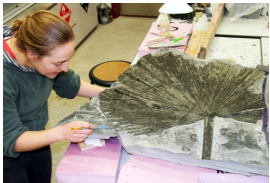
. Alaska is very cold. Below is a fossil of an ancient palm tree found there. Palm trees grow in warm weather. What is the best claim we can make from this evidence?
Palm trees can move from warmer areas.
Palm trees once grew in cold areas.
Alaska was once near the water.
Alaska was once much warmer.
Beavers build dams across streams. This stops the flow of the stream and creates a pond. Plants and animals that live downstream may not have enough water. What is a benefit caused by beaver dams?
The stream may dry up below the dam.
The pond is a new habitat for some animals.
Animals downstream may not have enough water.
Plants that live downstream may dry up.
Beavers build dams across streams. This stops the flow of the stream and creates a pond. Plants and animals that live downstream may not have enough water. What is a benefit caused by beaver dams?

A > B > C > D
D > C > B > A
D > A > C > B
A > D > C > B
The following can occur when people clear forests to build new houses.

1. Animals find fewer trees for food and shelter.
2. People will have more shelter.
3. Animals that thrive in grassland areas have new space.
4. There are more areas for grass and shrubs to grow.
number 1
number 2
number 3
number 4
Fossils of ancient bison have been found in South Carolina. What is the best claim we can make from this evidence?
South Carolina had large forests many years ago.
There were larger rivers many years ago.
South Carolina had grasslands many years ago.
The ocean was farther inland many years ago.
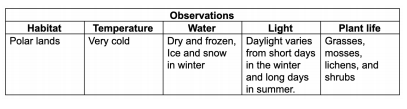
A scientist made the observations below about polar lands. What kind of animals would you most likely find in polar lands?

Turtles because they live in water.
Monkeys because they live in trees.
Arctic foxes because they have extra thick fur.
Alligators because they need warm weather.
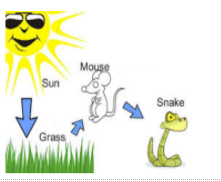
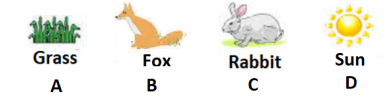
Below is a model of a food chain. Where does the grass get its energy from?

the Sun
the mouse
the producer
the decomposer
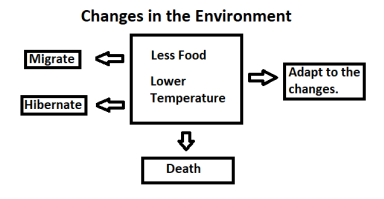
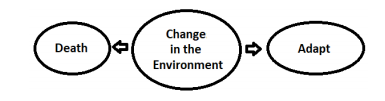
Below is a model that shows how animals might react to changes in the environment. How are bears most likely to respond to changes (less food and lower temperature) in their environment?


they would migrate
they would adapt
they would die
they would hibernate
A student was asked to make a model of a food chain. Which of the following could she use as the producer in her food chain?


fox
sun
rabbit
tree
A student observed cows eating grass in a field. Which of the following is the best claim she can make from this evidence?
Cows are consumers because they get energy from grass.
Cows are producers because they make milk.
Cows are producers because they eat grass.
Cows are decomposers because they get energy from grass.
A student made the model below to show a food chain. What is wrong with his model?

A producer does not get its energy from a decomposer.
A snake is not a consumer.
A consumer does not get its energy from a producer.
A mushroom is not a decomposer.
Forest fires burn the food and shelter that animals use. The fires kill many animals. Fires also burn dead plants and dense foliage. This allows room for new plants to grow and thrive. What is a benefit of forest fires?
Food for animals is destroyed.
New plants have more room to grow.
Many animals may be killed in the fires.
Trees that provide shelter for animals are burned.
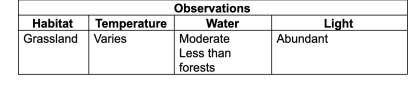
A scientist made the observations below for a certain habitat. Which types of animals are most likely to live in this habitat?

turtles, alligators, and egrets
prairie dogs, bison, and grasshoppers
seals, polar bears, and arctic foxes
amphibians, ducks, and beavers
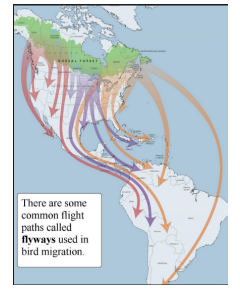
The model below shows the migration paths of birds in winter. Why do the birds most likely fly south?


to avoid cold temperatures
to avoid warm temperatures
to find more predators
to find more water
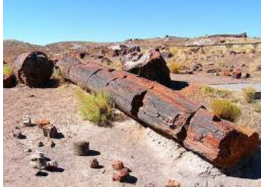
Below is a picture of ancient petrified wood found in the desert. What is the best claim we can make from this fossil evidence?

Trees once grew in the desert.
There was once a forest where the desert is.
The area was a desert a long time ago.
Trees did not need much water long ago.
Deserts are very dry. Some deserts are covered with sand. Deserts are hot during the day and cold at night. Most of the plants in the desert have ways to store moisture. Which of the following best explains which plants usually live in desert areas?
Trees because they can store water.
Trees because they need a lot of water.
Cacti because they can store water.
Cacti because they need a lot of water.
The model below shows the possible responses of animals to a change in Earth’s climate. What would
most likely happen if an entire group of animals could not adapt to the change?

They would increase in population.
They would become extinct.
They would hibernate.
They would migrate.