The events described by Greenblatt illustrate which of the following Atlantic World developments?
Decreased European support for colonization of the Americas
Population increases in native societies
Limited European understandings of native cultures
Increased cooperation between racial groups in the Americas
2. Ultimately, the European-American Indian relationships would be defined by conflict as a result of
the rise of the Atlantic slave trade.
the introduction of new kinds of plants and animals via the Columbian Exchange.
continued European encroachment on American Indian territory.
the diversity of the American Indian populations in different regions.
The passage supports which of the following historical trends?
British conflicts with natives declined as a result of the Pueblo Revolt.
Spanish colonizing efforts in the new world failed because the United States ultimately gained control of the southwest.
Economic growth in the southwest was stagnant because of native resistance.
The Spanish were forced by the Pueblo Revolt to accommodate some aspects of native culture.
As seen in the passage, which of the following was a similarity between Spanish and British colonizers?
Spain and Britain both largely incorporated native cultures into their lifestyles.
Spain and Britain often resorted to violence to control native populations.
Neither Spain nor Britain had any interest in converting native populations.
Neither Spain nor Britain attempted to change the native populations they encountered.
The Pueblo Revolt of 1680 was a reaction to which of the following?
The introduction of the encomienda and repartimiento systems
European disinterest in converting natives to Christianity
Complete assimilation of Native Americans into European culture
The introduction of slave labor into the Americas
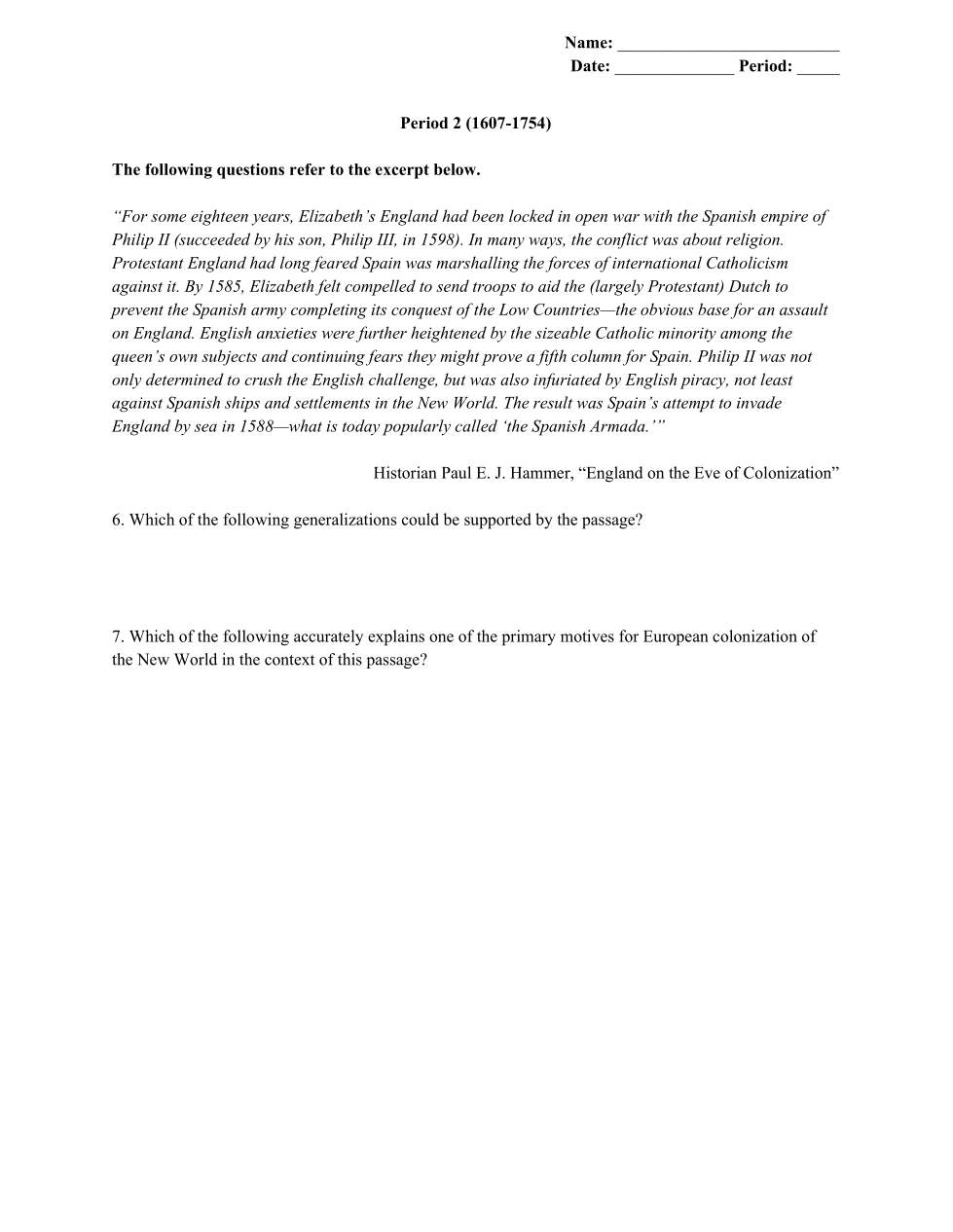
Which of the following generalizations could be supported by the passage?
European rivalries and competition did little to alter technological advancements.
European rivalries and competition occurred simultaneously with the shift from capitalism to feudalism.
European competition between European nations had little impact on the Atlantic world.
European imperial rivalries and competition fueled empire building in the new world.
Which of the following accurately explains one of the primary motives for European colonization of the New World in the context of this passage?
The Spanish needed to identify a new source of labor to sustain its home economy.
Independent explorers sought political recognition for their typically self-funded efforts.
Colonization efforts were delayed by long periods of warfare in Europe.
Europeans sought new sources of wealth to fund their nationalistic conflicts in Europe.
The passage above reflects which of the following historical trends between 1607 and 1754?
The cultivation of labor-intensive products like cotton and tobacco demanded new labor sources in the British colonies.
New Englanders developed close-knit, homogenous communities of religious believers.
The lack of indentured servants led colonists to rely on African slavery.
Slaves often developed covert means to resist slavery.
The British system of slavery was different from the Spanish and French systems because
the British used strict racial categories.
the British embraced the idea of numerous racial gradations.
French and Spanish colonists relied exclusively on Native Americans as slaves.
the Spanish and French did not legally sanction slavery.
Which did NOT cause the development of slavery in the British colonies?
The shortage of indentured servants toward the end of the 17th century
The inability of Europeans to enslave Native Americans
The abundance of arable land in North America
Decreasing European demand for colonial goods
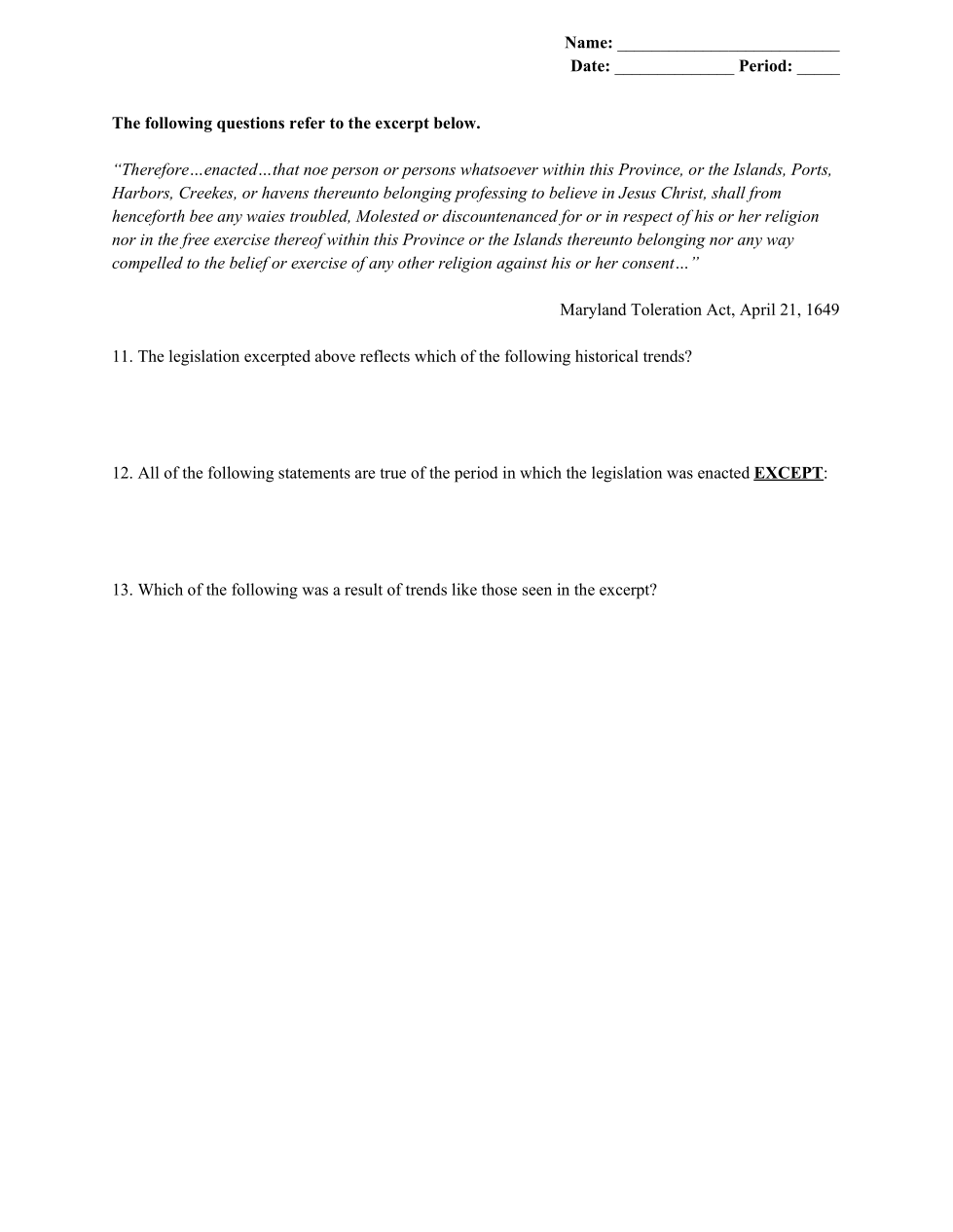
The legislation excerpted above reflects which of the following historical trends?
The middle colonies developed societies which were religiously homogenous.
Religious toleration existed primarily in southern colonies.
Religious toleration existed in some, but not all, of the British colonies.
The New England colonies were founded as a largely homogenous society.
All of the following statements are true of the period in which the legislation was enacted EXCEPT:
Increasing commerce from the colonies promoted a wide exchange of goods in the Atlantic community.
Native American sovereignty was respected by the colonial governments and by the British government.
The colonies were operating relatively independently of the British government.
Protestant evangelism was a significant motivation for settlement of the British colonies.
Which of the following was a result of trends like those seen in the excerpt?
New ideas emerged that challenged the legality and morality of slavery
The development of colonies with distinct religious and ethnic differences
British control of colonial governments increased during this period
Decreasing Anglicization of the American colonies
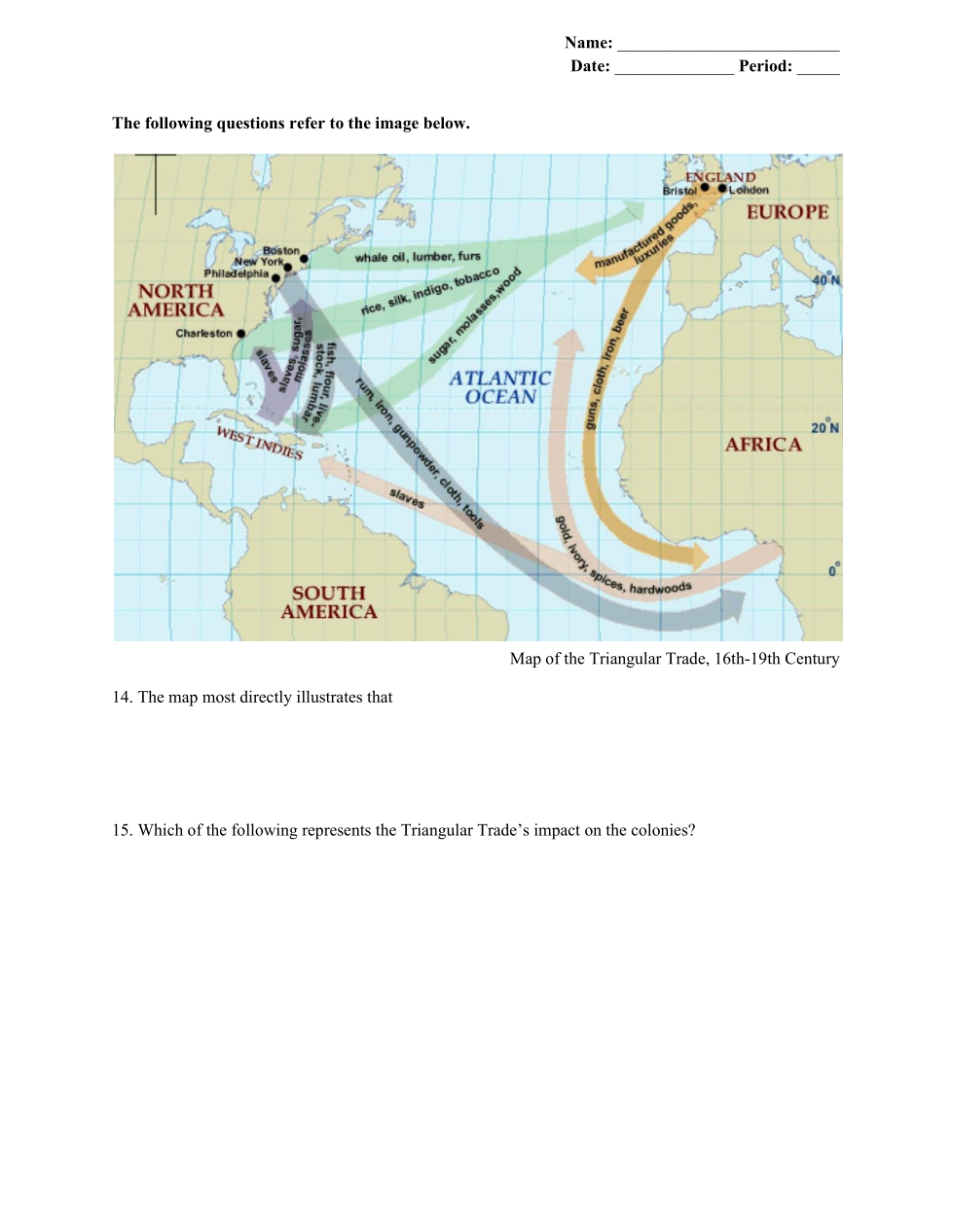
The map most directly illustrates that
Slaves were transported by European merchants from Africa to the New World.
Europe traded manufactured goods in exchange for tobacco, cotton, sugar, and molasses.
Slaves were sent from Africa to Europe in exchange for manufactured goods.
European merchants exchanged raw materials for African slaves.
Which of the following represents the Triangular Trade’s impact on the colonies?
Importation of slaves and manufactured goods to the New World.
Importation of cotton, tobacco, and sugar to the New World
Importation of lumber and furs to the New World.
Importation of rum and gunpowder to the New World.
Which of the following was most likely a causal factor in the development of the kind of legislation seen in the excerpt?
Competition for labor sources led to growing mistrust among Europeans and colonists.
British interest in acquiring trade goods declined in this period.
Settlers on the frontier had different goals and expectations than settlers on the eastern seaboard.
Conflicts between European nations led to increasing economic and political regulation of the British colonies.
The legislation excerpted above reflects which of the following trends?
British attempts to appease colonists after numerous civil insurrections
British attempts to develop regional differences in the colonies
Colonial attempts to bypass British legislation
Limited British attempts to regulate colonial economics
Which of the following was an immediate result of the kind of legislation seen in the excerpt?
Colonists expressed open dissatisfaction with British policies.
The British ruthlessly enforced punitive legislation.
Colonists acquiesced to British demands for compliance. Colonists shifted their economic systems from agriculture to industry.
Colonists shifted their economic systems from agriculture to industry.
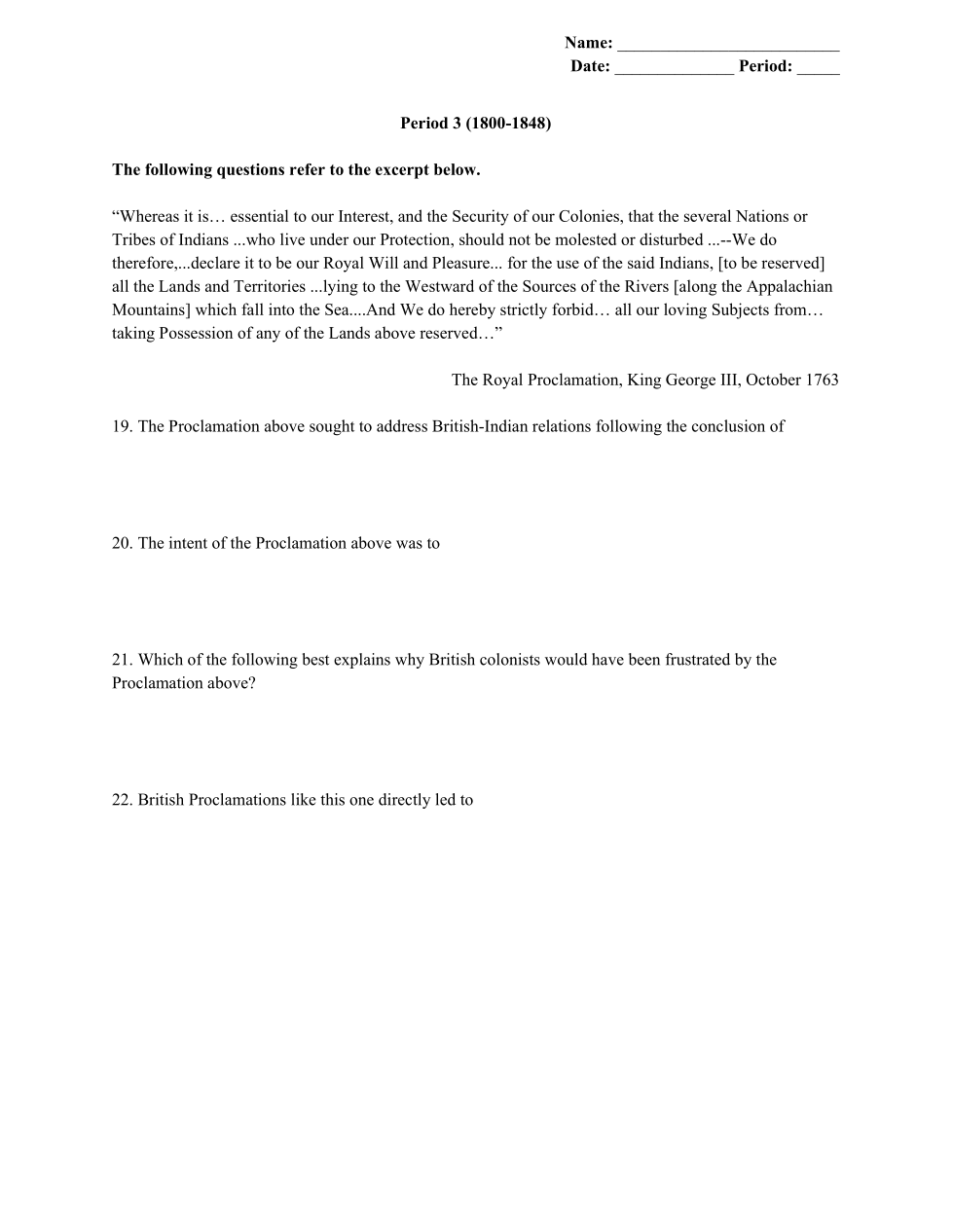
The Proclamation above sought to address British-Indian relations following the conclusion of
the French and Indian (Seven Years’) War.
the American Revolution.
the Atlantic slave trade.
the Pueblo Revolt.
The intent of the Proclamation above was to
reduce the impact of French settlers in New England.
expand British trade networks into French territories.
limit colonial encroachment on traditional tribal lands.
create a political alliance with Native American confederacies.
Which of the following best explains why British colonists would have been frustrated by the Proclamation above?
Increased attempts to regulate the colonial economy led many colonists to protest British rule.
Repeated Native American raids of colonial outposts led to significant hostility among British colonists towards the Native Americans.
Population growth in the British colonies led many to seek land along the frontier between British territory and traditional tribal lands.
Nationalist desires to compete with the French drove many colonists to attempt to expand Northward.
British Proclamations like this one directly led to
the development of a series of alliances between the British colonists and neighboring Native American tribes.
open warfare between the British colonists and their French counterparts.
a growing sense of American identity in the face of perceived injustices.
an increase in the economic profitability of the British colonies in North America.
This painting commemorates a turning point in the Revolutionary War by emphasizing which of the following as a significant reason for the ultimate American victory?
Monetary advantages over the British, who had to maintain long and expensive supply lines
Resilient and resourceful military and political leadership
The development of unity among nearly all American colonists
Overwhelming support of European allies
The troops mustered by the American Continental Army were generally motivated by a belief in
the demise of the aristocracy.
the British imperial system.
the significance of the rights of the individual.
free trade as a means to economic success.
Which of the following best explains the impact of the character of the French Revolution, as described here, in the newly-formed United States?
It led to rising support for international involvement.
It pushed the United States into exclusive ties with Great Britain.
It shook American confidence in the ideas of the Enlightenment.
It fueled the debate over the character of democratic politics.
Because of the nature of the French Revolution, American conservatives
insisted upon avoiding permanent foreign alliances.
expanded the nation’s trade agreements with the French.
sought to compromise with members of the political opposition.
advocated liberalizing the American political system to be more inclusive of the common man.
The character of the American Revolution and earliest American government, as described here, can most closely be attributed to
Americans’ commitment to establishing a centralized government.
America’s belief in the Enlightenment principles of limited government and individual liberty.
America’s rejection of the writings of radical philosophers.
the colonies’ strong political ties to the British system of hereditary privilege.
What was generally accepted as a necessary qualification for the rights of citizenship in the first few decades of the United States’ government?
Ownership of property
Having been born in the territories of the United States
Participation in the American Revolution
Membership in the Federalist Party
Which of the following would have argued most energetically in support of a limited definition of the legitimate participants in government?
Enlightenment philosophers
Thomas Paine
The Federalists
Frontiersmen
Which of the following political features of American government is best explained by the description of founding principles in the passage above?
The decision not to include a Bill of Rights in the original Constitution
The limitations placed on the power of the executive
The abolition of the slave trade
The concentration of power in the hands of the legislatures