What caused the increased temperature and higher CO2 concentrations during the 100 Ma time period?
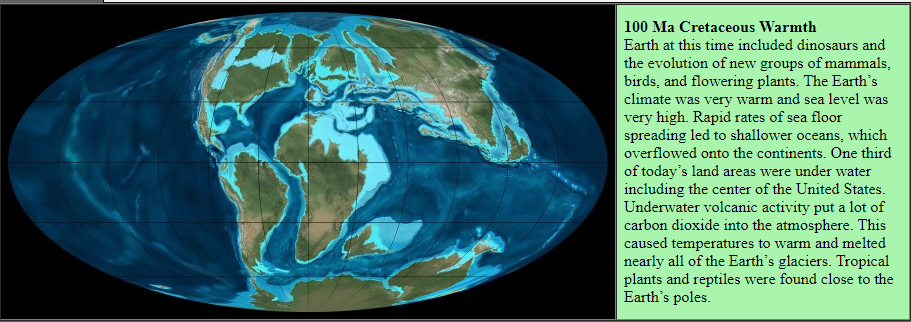
What caused the increased temperature and higher CO2 concentrations during the 100 Ma time period?
HS-ESS2-2 Analyze geoscience data to make the claim that one change to Earth's surface can create feedbacks that cause changes to other Earth systems.
HS-ESS3-5 Analyze geoscience data and the results from global climate models to make an evidence-based forecast of the current rate of global or regional climate change and associated future impacts to Earth systems
Use the timeline below to explore the changes in the Earth's average global temperature, average global CO2 concentration, and % global ice cover.
Click on the Exploration Image for each time period for more information. This will help you answer some of the questions.
You will need to use the horizontal scroll bars to see the entire timeline.
Some quite reminders...
Ma = million years ago
ka = thousand years ago
ºC = degrees Celsius
ppm = parts per million
Use the data for the average global temperature to plot a line graph to represent the changes over Earth's history.
Round the world average temp today to the nearest whole number.
Help video: https://youtu.be/M7OIYcff7ho
What is the current amount of CO2 in the atmosphere today?
Use this link to find the amount of CO2 in the atmosphere today. (Hint: It is in the big green box)
Use the data for average global CO2 concentration to plot a line graph to represent the changes over Earth's history.
Help video: https://youtu.be/vXrnPQSIz7A
What caused the increased temperature and higher CO2 concentrations during the 100 Ma time period?
What contributes to the increased temperature and CO2 concentration between 1880 and 2010?
(This is a 5 point question, you need to list more than one thing that contributed)
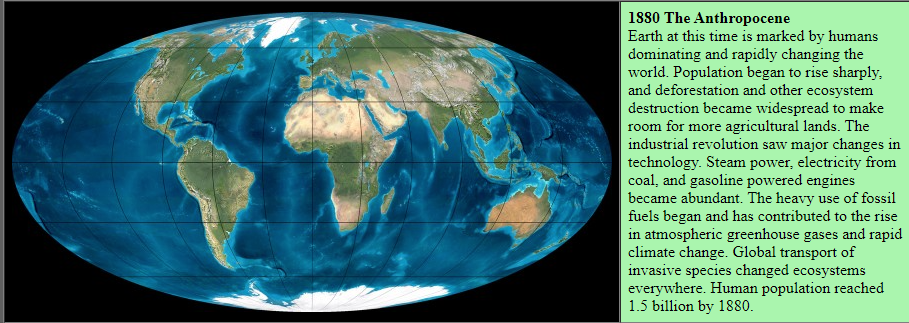
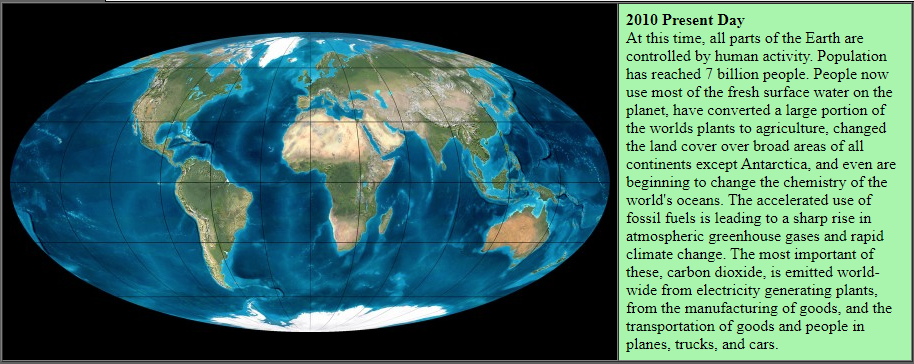
Which time period has the highest average global temperature and average global CO2 concentration based on your graphs?
Which time period has the lowest average global temperature and average global CO2 based on your graphs?
What pattern do you observe between CO2 and temperature? Support your claim with at least 1 piece of evidence found in your graph.
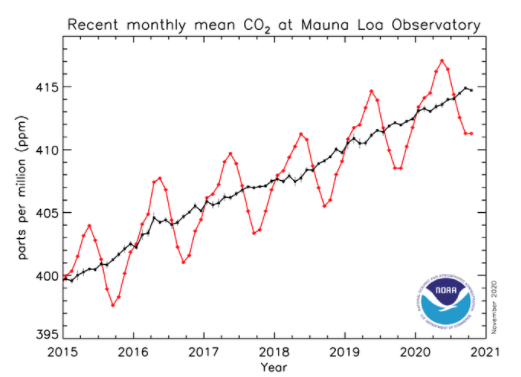
Carbon dioxide levels fluctuate throughout the year as shown by the red line in the graph above. Explain why those fluctuations happen.
HINT: What type of organism removes carbon dioxide from the atmosphere? How does this organism affect the carbon cycle? Why would that organism fluctuate in its removal of CO2 from the atmosphere?
Have humans always contributed to the global warming of our planet? Why?
You can answer using your microphone...click the plus button and choose audio. This will allow you to verbally answer the question.