Unit 6 Day 2 Using Curved Models

Last updated over 4 years ago
23 questions
For each set of data given below,
  1. use your calculator to examine a scatterplot and residual plot to determine if a linear or exponential regression better models the data, (Be prepared to defend your choice.)
  2. make a prediction using your model for the value given,
  3. make a prediction using your model, then find the residual.
6

The availability of leaded gasoline in New York State is decreasing, as shown in the accompanying table.
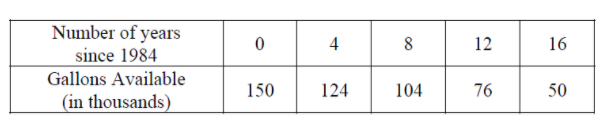
1. Enter the data into L1 and L2 using 'Stat, Edit'.
2. Create a Scatterplot, observe the association of the number of years since 1984 and the gallons of unleaded gas available(in thousands) shown in the scatterplot.
Describe it below using Form, Direction and Strength:

4

Which regression seems to be most appropriate at this time?
Linear or Exponential?

4

Do a linear regression of the data entered into L1 & L2:
Stat, Calc, #8
Store the Regression Equation: 'storeRegEq' enter 'VARS', 'y-VARS', enter, enter, enter, enter

Now graph the residuals (2nd, y=, Statplot #1 ON, change YList: RESID use 2nd, Stat).
Observe the residual plot (zoom, #9).
1. What do you see?
2. What does this mean?

*if you aren't sure of your answer after looking at the linear model residuals, try doing an exponential regession and check the residuals as well(Stat, Calc, #0, storeRegEq, then graph the residuals with zoom9).
Which residual plot is MORE random?

4

Since the residual plot showed random scatter we will use the linear regression information to set up a regression equation.
Use the information from the linear regression and create the Linear Regression Equation, enter it below.
Use 'years' and 'gallons' for the variables,
identify the predicted variable with -hat,
round vaues to one place past the decimal.
No spaces.
Use the format: y=a+bx

4

Use your regression equation for predicting the availability of leaded gasoline in New York for 1990:
Make sure to include units.
Remember we are using 'years since 1984'.

4

Make a prediction for 1988, then calculate the residual:
Residual = Actual - Predicted
Enter the residual, make sure to include units.

4

For 1988, did the model over or underpredict the availability of leaded gasoline in New York?

6

The table below, created in 1996, shows a history of transit fares from 1955 to 1995.


1. Enter the data into L1 and L2 using 'Stat, Edit'.
2. Create a Scatterplot, observe the association of the years since 1900 and Fare $ shown in the scatterplot.
Describe it below using Form, Direction and Strength:

4

Based on your answers above, which regression seems to be most appropriate at this time?
Linear or Exponential?

4

Do an exponential regression of the data entered into L1 & L2:
Stat, Calc, #0
Store the Regression Equation: 'storeRegEq' enter 'VARS', 'y-VARS', enter, enter, enter, enter

Now graph the residuals (2nd, y=, Statplot #1 ON, change YList: RESID use 2nd, Stat)
and observe the residual plot (zoom, #9).
What do you see?
What does this mean?

*if you aren't sure of your answer after looking at the exponential model residuals, try doing a linear regession and check the residuals as well. Which residual plot is MORE random?

4

Use the information from the exponential regression and create the Exponential Regression Equation, enter it below.
Use 'fare' and 'year' for the variables,
identify the predicted variable with -hat and
round values to four places past the decimal.
No spaces.
Use the math keyboard to put an exponent into your equation.

4

Use the regression equation you created in #11 to predict the fare for transportation in 1987.
Remember 'years' are the number of years since 1900.
Round your answer to two places past the decimal since this is money.
Include the $ sign.

4

Calculate the residual for the year 1975.
Hints:
How many years is that since 1900?
What is the prediction for that year?
Calculate the residuals.
Include units in your answer.

4

Look back at the exponential regression equation from #11, explain the meaning of the rate.
Is it increasing or decreasing?
By how much?
Use: The fare is ___________________ by ________% per ____________
Give a verbal explanation using correct context.
I will grade this problem.

4

Using the regression equation from #11, what was the fare in 1900?
Hint: this is the initial value.
Keep all decimal places

4

Would it be wise to use our regression equation to predict the transportation fare for 2020?
Why or why not?
What is this kind of prediction called?
Answer completely for full credit.

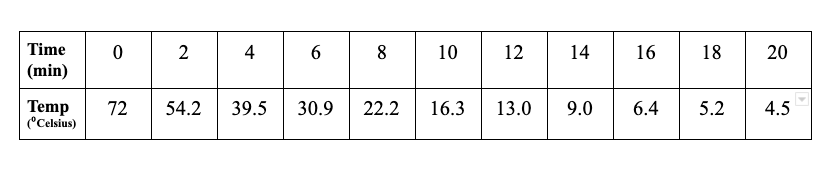
A middle school student doing a science fair experiment put a hot bowl of soup into a refrigerator and checked the temperature (in degrees Celsius) every two minutes. The results are shown in the table below.

Enter the data into L1 and L2.
Create a scatter plot so you can observe the association between time and temperature.
4

Which regression model seems to be appropriate?
Why?

4

Do the regression that you chose in #17.
Use Stat, Calc, #8 for a Linear regression OR Stat, Calc, #0 for an Exponential regression.
Store the regression equation, (storeRegEq: VARS, Y-VARS, enter, enter, enter, enter)
Check the residual plot.
What do you see and what does this tell you?

4

Enter the regression equation below.
Use the math keyboard if needed for entering an exponent.
Round the decimals to three places if necessary.
No spaces.
Use 'min' and 'temp' for the variables.
Use the form shown on the calculator screen when you did the regression.

4

Explain the meaning of the rate in this regression equation.
Remember: Linear uses constant rates, exponential uses percents.
Be sure to specify units and include % value.
Ex:
The ____________________________ decreases/increases by __________________% per ________________________.

4

Estimate the temperature after three minutes.
Round your answer to one place past the decimal.
Include units.

4

Estimate the temperature of the soup after 25 minutes.
Round your answer to one place past the decimal.
Include units.

4

For which prediction (for 3 min or for 25 min) do you have more confidence? Why?
Explain clearly using Statistical terms we have discussed in class.
Hint: what is this kind of prediction called?
is it a good thing to do?