Preskoči na glavni sadržaj
Prijava
Sign up for FREE
arrow_back
Biblioteka

Unit 6 Day 4 Test Review

star
star
star
star
star
Posljednje ažuriranje about 5 years ago
37
4
6
4
4
4
4
4
4
4
4
6
4
4
4
4
4
4
4
4
4
4
4
4
4
4
4
4
4
4
4
4
4
4
4
4
4
4

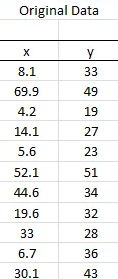
Here is some fictional data for a set of BMX bikes showing their weight and maximum number of inches a rider was able to get them in the air for a trick.

Enter the data into L1 and L2.

Create a scatter plot. Observe the relationship between weight of the BMX bike and the height of the jump.

What did you use as your explanatory variable? Why?

Pitanje 1
1.

What did you use as your explanatory variable? Why?

Pitanje 2
2.

Describe the relationship you see between weight and height in the scatter plot (Form, Direction & Strength).

Pitanje 3
3.

Give the verbal description of the relationship in this context between the weight of a bike and the height of the jump it is able to reach.

Pitanje 4
4.

Based on the scatterplot, which model seems to be more appropriate? Why?

Pitanje 5
5.

Check the model you have chosen by doing the regression.

Be sure to store your regression equation and record the a & b values.

a =

Round to three places past the decimal.

Pitanje 6
6.

b =

Round to three places past the decimal.

Pitanje 7
7.

Check the residual plot, draw it in the 'show your work' area using the line tool.

Pitanje 8
8.

Based on the residuals, is the linear model is appropriate?

(the residuals should look fairly random)

Pitanje 9
9.

Write the linear regression model below, be sure to use correct notation and meaningful words.

No spaces, round a and b to three places past the decimal.

Use 'height' and 'weight' for the variable names.

Pitanje 10
10.

Use your model to predict the height that a 25 pound bike can jump.

Round to two places past the decimal.

Pitanje 11
11.

Do you have confidence in this prediction?

Why or why not?

What is this called?

Pitanje 12
12.

Use your model to predict the height that a 20.5 bike can jump.

Round to two places past the decimal.

Pitanje 13
13.

Calculate the residuals for the 20.5 bike using information from the table. What does this tell us about the model?

Foot lenght(in cm) was used to predict the height(in cm) of students, data was entered and a regression was calculated using the computer output information below.

Pitanje 14
14.

What is the explanatory variable?

Pitanje 15
15.

What is the response variable?

Pitanje 16
16.

Create a Linear Regression equation for the Line of Best Fit for the relationship between foot length(cm) and height(cm).

Round decimals to two places past the decimal point.

Use 'height' and 'length' for the variable names.

Be sure to indicate which variable is being predicted.

No spaces.

Pitanje 17
17.

Interpret the meaning of the slope in this context:

Use numbers!

Pitanje 18
18.

Interpret the meaning of the y-intercept if it has one:

Pitanje 19
19.

Predict the height of someone with a 29.5 cm foot:

Pitanje 20
20.

If the person from g was actually 180.3 cm, what is the residual? What does this tell us about the model?

Pitanje 21
21.

Use the computer output to determine the correlation coefficient:

Round to three places past the decimal.

Bacteria have the ability to multiply at an alarming rate, where each bacteria splits into two new cells, doubling the number of bacteria present.

NOTE:

for x=4, y should equal 1200 (NOT 12000) that is MY mistake. Sorry about that!

Pitanje 22
22.

Enter the data into L1 and L2 on your calculator, create a scatterplot.

Describe the relationship. Which model will you use?

Pitanje 23
23.

Which model will you use?

Why?

Pitanje 24
24.

Do a regression for your model,

store the regression equation and observe the residual plot.

What do you see and what does this mean?

Pitanje 25
25.

Write the regression equation below.

Use 'hours' and 'bacteria' for the variable names.

No spaces.

Round decimals to two places.

Pitanje 26
26.

Describe the rate in the context of the bacteria growth:

Pitanje 27
27.

Use your regression equation to predict the number of bacteria that will be present after 3.5 hours:

Round the decimal to two places.

Pitanje 28
28.

Predict the number of bacteria that will be present after 24 hours:

Round to two places past the decimal.

Pitanje 29
29.

For which prediction do you have the least confidence?

Why?

What is a prediction outside the range of our data values called?

Use the following data table, enter the values into L1 and L2.

Pitanje 30
30.

Create a scatter plot of the data.

Do a linear regression, stat calc #8

Enter the R-squared value:

Round to four places past the decimal

Pitanje 31
31.

Do an exponential regression, stat calc #0

Enter the R-squared value:

Round to four places past the decimal

Pitanje 32
32.

Do a power regression, stat, calc, alpha, math

Enter the R-squared value:

Round to four places past the decimal

Pitanje 33
33.

Based on the coefficient of determination (R-squared), which regression model is the most appropriate for the data set?

Why?

Pitanje 34
34.

A residuals plot is useful because

I. it will help us to see whether our model is appropriate for making predictions.

II. it might show a pattern in the data that was hard to see in the original scatterplot.

III. It shows the residual for each data point.

Pitanje 35
35.

Although there are annual ups and downs, over the long run, growth in the stock market averages about 9% per year.

A model that best describes the value of a stock portfolio is probably:

Pitanje 36
36.

A business owner notes that for every extra hour his store is open, his total sales increase by a fixed amount. His most useful predictive model is probably…

Pitanje 37
37.

What are some of the effects of outliers in a scatterplot: