Unit 6 Day 5 Re-Quiz

Last updated over 4 years ago
22 questions
4

Which is false?
I. Random scatter in the residuals indicates a model with high predictive power.
II. The ressidual plot is used to check the appropriateness of a model for making predictions.
III. Residual = Predicted - Actual

2

To more easily determine the age of a tree (without cutting it down and counting the rings) a forester measured 27 trees of the same species that had been cut down and counted the rings to determine if the ages were correlated to the diameter of the trunk.
The computer output information is shown below, age is in years and diameter is in cm:

Variable Coefficient R-Squared: 84.5% S: 3.4219
Constant -0.7368
Diameter 2.9516

What is the correlation coefficient (r) of the relationship between the tree diameter in cm and age in years?

Round to three places past the decimal.
Hint: you will need to use a number above and do a calculation.
Another hint: what letter represents the correlation coefficient?

4

To more easily determine the age of a tree (without cutting it down and counting the rings) a forester measured 27 trees of the same species that had been cut down and counted the rings to determine if the ages were correlated to the diameter of the trunk.
The computer output information is shown below, age is in years and diameter is in cm:

Variable Coefficient R-Squared: 84.5% S: 3.4219
Constant -0.7368
Diameter 2.9516

Set up the linear regression equation to predict the age of the tree based on the diameter.
Use 'years' and 'diameter' for the variable names.
Make sure to indicate which variable is being predicted.
Keep all decimal places.
No spaces
Use the math keyboard if needed to enter an exponent.

4

Use your equation for predicting the age of the tree to calculate the age of a tree that was 36.7 cm in diameter.

Round to one decimal places.

4

If our calculation of the tree's age gave a residual of -9.4, what was the tree's actual age?

Keep all decimal places.

4


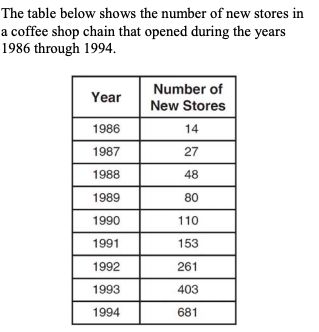
Enter your data into L1 and L2.
For L1 use the number of years since 1980, your list should begin: 6, 7, 8, 9, 10, ...

Do an Exponential Regression (stat, calc, 0) to predict the number of coffee shops using the number of years that have passed.
Create the equation below.


Round the decimals to three places past the decimal point.
Use the math keyboard to create an exponent if needed.
Use 'coffee shops' and 'years' for variable names.
Use the math keyboard if needed to enter an exponent.
4

Using your equation for predicting the number of coffee shops based on the number of years that have passed, explain the rate of increase/decrease.

Use units and %.

Ex. The _____________________ decrease/increase by __________ % per ______________.

6

Predict the number of coffee shops present after 20 years.

1. Enter your prediction rounded to the nearest whole coffee shop.
2. What kind of a prediction is this? Why?
3. Is this a wise or risky thing to do?

Answer all three questions for full credit.

6


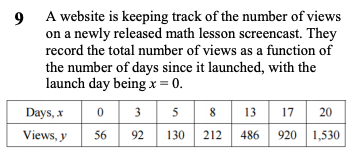
Enter the data into L1 and L2 of your calculator.
Create a scatterplot to observe the relationship between days and views used.
Describe it below:

4

Which regression seems to be the best model after looking ONLY at the scatterplot.

4

Do a linear regression (stat, calc, 8), store the regression equation (StoreRegEq: VARS, Y-VARS, enter, enter, enter, enter)

Observe the residual plot, what do you see? (2nd, y=, change the ylist to RESID with 2nd, Stat, then zoom 9)

4

Now check the exponential regression model, do an Exponential Regression (Stat, calc, 0)

Store the regression equation. (StoreRegEqn: VARS, Y-VARS, enter, enter, enter, enter)

Observe the residual plot (see the previous question with instructions). (2nd, y=, change Ylist: RESID)
then zoom 9
What do you see and what does this mean?

4

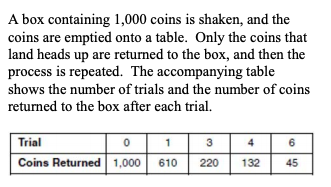
Enter the data below into L1 and L2.
We will us the trial number to predict the coins returned to the box.


We are only considering the Linear Regression model or the Exponential Regression model.

Do a linear regression, noting the Rsquared value.
Check the Coefficient of Determination (Rsquared) to decide which is the better model to use.

Select the Rsquared value for the linear regression:
LOOK CAREFULLY!

4

Use the data entered into L1 and L2, using trial number to predict the number of coins returned to the box.

Do an exponential regression, noting the Rsquared value.
You will check the Coefficient of Determination (Rsquared) to decide which is the better model to use.

Select the Rsquared value for the linear regression:
LOOK CAREFULLY!

4

Based on your calculations and comparison of the Rsquared values, which regression is the better model?
Linear or Exponential?
Explain why for full credit.

4

Create the regression equation for making predictions of the number of coins returned to the box based on the number of trials.

Use 'coins' and 'trials' for the variable names.
Indicate which variable is being predicted.
Round to four places past the decimal point.
No spaces.
Use the Math keyboard if needed to enter an exponent.
4

Observe your regression equation carefully, explain the rate/slope clearly.
Make sure to include units.

Ex. use 'The __________________ decreases/increases ____________ per ______________.'

4

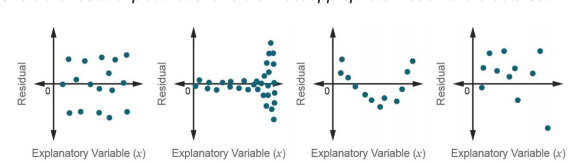
Observe the residual plots shown below:
1. 2. 3. 4.
If each plot represents the residual plot from a regression equation, which plot(s) would cause you to accept the regression equation?
Why?

Select all answers.

4

If America's Biggest Loser contestant weighed 386 lb at the start and lost about 4.7% of their weight each week...

is this equation going to be linear, exponential or power?

4

Write an equation for the following situation:
A water tank had 3.75 gallons in it and needed to be filled, the hose filled at a rate of 1.5 gallons each hour.

Use the time that has passed to predict the gallons in the tank.

Use 'gallons' and 'hours' for variables.
No spaces.
Be sure to indicate which variable is being predicted.

0

BONUS
If a company being studied originally had $954,000 worth of sales and increased them by 9.4% each year , create an equation to predict their sales based on the years that had passed.

Use the correct notation to show what variable is being predicted.
Use the math keyboard to insert an exponent if needed.
No spaces3

0

BONUS:
If a person started out on America's Biggest Loser weighing 453 lb and lost at a rate of 7.4% each week, create a regression equation to predict their weight based on the number of weeks that had elapsed.

Use the correct notation to show what variable is being predicted.
Use the math keyboard to insert an exponent if needed.
No spaces.