What type of growth is shown in the diagram?
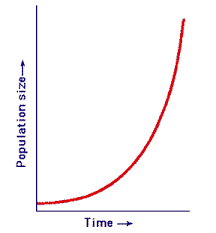
What type of growth is shown in the diagram?
If the number of births in a population is the same as the number of deaths in a population, what will happen to the growth of the population?
If the number of births is greater than the number of deaths in a population, what will happen to the growth of the population?
What growth pattern describes a population who's growth rate slows or stops following a period of exponential growth?
What type of growth is shown in the diagram?
Largest number of individuals of a population that the enviroment can support....
Which type of growth is best illustated by this rabbit population?

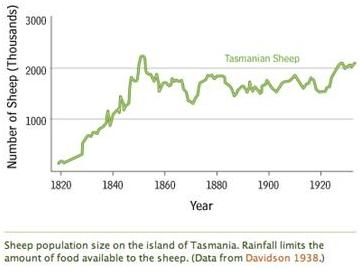
What is the carrying capacity for this sheep population?
What point on the graph represents the carrying capacity?
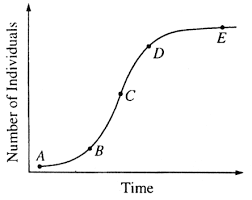
When a population grows past the ecosystem's carrying capacity, what happens to the population?
Food, water, sunlight, shelter, and space are resources that are often________.
If there is less food than usual in an ecosystem, then the population will most likley....
Anything or any organism that regulates the size of a population of another organism is known as ______?
In a forest ecosystem, which of the following is the best example of a limiting factor for a rabbit population?
Will competition increase/decrease the carrying capacity of an ecosystem for the animal in competition?
Natural disaster can be considered limiting factors
Natural disasters and weather patterns like earthquakes, floods, and tornadoes, blizzards, and heatwaves are considered ______ ______ limiting factors
Competition, disease, predation, and parasitism are considered _____ _____ limiting factors
Density-dependent limiting factors have a(n) _________ affect on populations depending on the density of the population.
Density-independent limiting factors have a(n) ________ affect on poulations regardless of population density.
Exponetial growth is representative of a population in a enviroment with _______ recources.
Logisitc growth is representative of a population in an envirement with _______ recources.
A factor that is NOT one of the factors of population growth rate is:
There are 2000 Hydrilla verticilla species per square kilometer in a certain area of a body of water. To which population characteric does this information refer?
Organisms moving into an area from another area , is called
If organisms move out of an area, this is known as
In a population that grows, what is happening?
In a population that decreases the following is happening :
When resources in a population become less available, the population growth
As the exponential phase of a logistic growth curve of a population stops,
What levels of ecological organization have only biotic factors?
What ecological organization have both biotic and abiotic factors?
All the members of the same species living in the same area at the same time is called?
Would all the alligators, frogs, plants, algae, fish, bacteria, etc. living in the St. Johns River be >>>>>
What will happen to a population that has mostly old individuals?
What type of curve is logistic population growth?
What type of curve is expontential population growth?
Factors that limit the population from growing is ?
The largest population size an environment can sustain is called?