Log in
Sign up for FREE
arrow_back
Library

Wed 1/6: Enzymes

star
star
star
star
star
Last updated about 5 years ago
13 questions
1
1
1
1
1
3
1
1
1
1
1
1
Question 1
1.

Question 2
2.

Question 3
3.

Question 4
4.

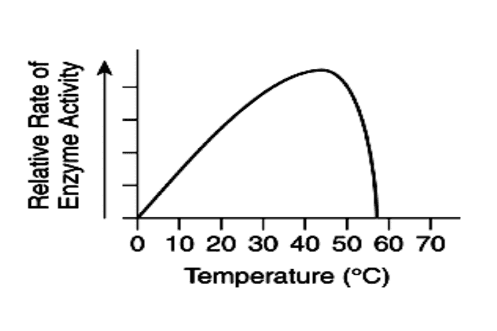
Use the following graph to answer #19 below:
Question 5
5.

Question 6
6.

Label the parts of this diagram showing the catalyzed reaction breaking down hydrogen peroxide into water and oxygen using the terms (A) enzyme, (B) substrate, and (C) products.

Question 7
7.

Question 8
8.

Figure 8.16a
1
Question 9
9.

At what temperature do BOTH the human enzyme and thermophilic enzyme have some function? Write the numerical value only.

Question 10
10.

Question 11
11.

Question 12
12.

Question 13
13.

Various enzymes in our bodies are:
Lipids
Carbohydrates
Nucleotides
Proteins
Enzymes only work with specific substrates because each enzyme:
Has an active site which only fits substrates with a particular shape.
Can only make ionic bonds.
Cannot change shape.
Becomes denatured when it is heated.
Structural changes in an enzyme can affect its ability to function correctly. This denaturation can occur as a result of _______________.
Extreme temperature change
Change in pH
Addition of substrates
Both A and B are correct
Is the following graph a depiction of an endothermic or exothermic reaction?
endothermic
exothermic
What is the optimal temperature for this enzyme?
20℃
32℃
45℃
60℃
This type of reaction releases energy
endothermic
activation energy
exothermic
This type of reaction absorbs energy
endothermic reaction
activation energy
exothermic reaction
D
In the lock and key model of of enzyme function shown above, what is happening in step 2?
The enzyme is causing new bonds to form between the substrate
The substrates are beginning to bind to the enzyme
The active sites are restructuring the enzyme.
The catalyzed reaction is releasing a product.
What point on the graph represents the activation energy?
A
B
C
D
E
How do enzymes speed up a chemical reaction?
By making it hotter.
By lowering the activation energy.
By increasing the activation energy.
By binding to a substrate and allowing the chemical reaction to skip step 2.
Which line on the graph represents the reaction with an enzyme?
Red line
Black line