Fri 1/8: Macromolecule Review
star
star
star
star
star
Last updated over 5 years ago
18 Nsɛmmisa
1
4
1
1
1
1
1
1
1
1
1
1
1
1
1
1
1
10
Explain the relationship between monomers and polymers.
Match the monomer on the left with the macromolecule that it is makes on the right.
| Draggable item | arrow_right_alt | Corresponding Item |
|---|---|---|
Nucleotide | arrow_right_alt | Protein |
Monosaccharide | arrow_right_alt | Nucleic acid |
Amino acid | arrow_right_alt | Lipid |
Fatty acid/hydrocarbon chain | arrow_right_alt | Carbohydrate |
Which type of macromolecule should you consume more of if you need a quick boost of energy?
Which type of macromolecule should you consume more of if you want to grow strong nails?
Which type of macromolecule should you consume more of if you want to grow healthy hair? FYI: If your hair starts to fall out in large quantities it is an indicator you need more of this in your diet!
Which type of macromolecule should you consume if you are planning to participate in a physically demanding event, such as running in a 10K race, the next day?
Which type of macromolecule should a bear consume as it prepares to go into hibernation for the winter?
Which type of macromolecule should you consume if you are trying to build more muscle?
Which type of macromolecule should you consume if your next meal will be in a week?
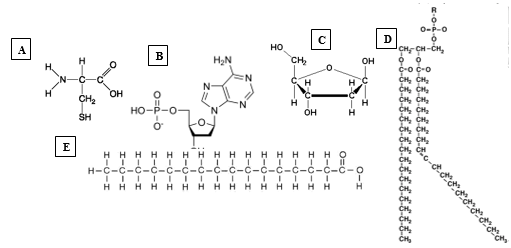
Which molecule/molecules above (A - E) is/are an amino acid?
Explain how you know this/these is/are an amino acid.
Which molecule/molecules above (A - E) is/are a monosaccharide or simple sugar?
Explain how you know this/these is/are a monosaccharide or simple sugar.
Which molecule/molecules above (A - E) is/are a nucleotide?
Explain how you know this/these is/are a nucleotide.
Which molecule/molecules above (A - E) is/are a lipid or fat?
Explain how you know this/these is/are a fat or lipid.
Match the term on the left with the BEST choice on the right.
| Draggable item | arrow_right_alt | Corresponding Item |
|---|---|---|
-saccharide | arrow_right_alt | Two |
Hydrophobic | arrow_right_alt | Sugar |
Peptide | arrow_right_alt | One |
Covalent | arrow_right_alt | The bond that is found between amino acids |
Poly- | arrow_right_alt | examples include DNA and RNA |
Dehydration synthesis | arrow_right_alt | The bond that is found in ALL macromolecules |
Hydrolysis | arrow_right_alt | Does not like water |
Mono- | arrow_right_alt | many |
Di- | arrow_right_alt | the process that bonds monomers together |
Nucleic acid | arrow_right_alt | the process that break macromolecules of down |