Log in
Sign up for FREE
arrow_back
Library

Start of Performance Task
star
star
star
star
star
Last updated over 4 years ago
3 questions
1
1
Question 2
2.

If you are working with others, who are they?
(NO more than THREE people in the group TOTAL)

1
Performance Task: Picture Book Directions

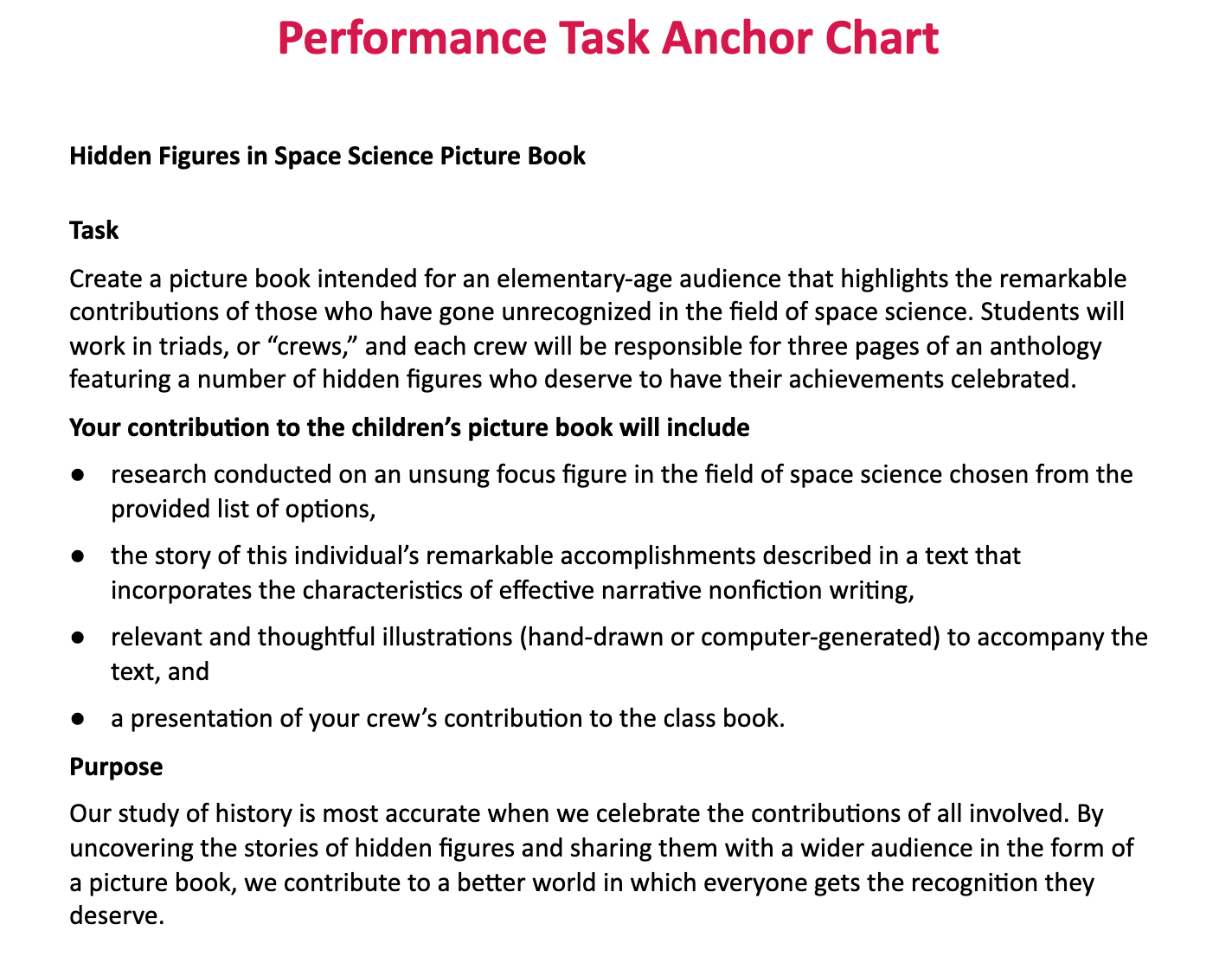
Houston, we have a problem. A problem with individuals not getting the credit they deserve for their remarkable accomplishments. Throughout this module, you have discovered that despite the contributions of many, sometimes only a few key individuals get recognition for incredible achievements, such as landing humans on the moon. For this performance task, you will research other stars of space science who have been underrepresented, just as Margot Lee Shetterly did in Hidden Figures. In small crews of three, you and your peers will write and illustrate one section of a children’s picture book, focusing your section on just one of many “hidden figures” in the field of space science. Your story should reflect the factual information you discover during your research but be written to appeal to a young audience. Then you will compile your section with those written by your fellow crewmates to make one stellar picture book to be shared with elementary Earthlings.

Mission Objectives
  • In crews of three (or on your own), choose a focus figure, and conduct research on this individual’s remarkable contributions to space science.
  • Determine which accomplishments should be highlighted, keeping in mind that each crew will be responsible for three pages of content.
  • Collaborate on the completion of the narrative nonfiction picture book, sharing duties as authors, illustrators, and editors with the rest of your crew.
  • Present your crew’s pages of the picture book to the class, explaining why these particular achievements were highlighted.
  • Compile your story into a class anthology to be shared with the school community.

YOUR contribution to the picture book will include
  • research conducted on an unsung focus figure in the field of space science chosen from the provided list of options
  • the story of this individual’s remarkable accomplishments described in a text that incorporates the characteristics of effective narrative nonfiction writing,
  • relevant and thoughtful illustrations (hand-drawn or computer-generated) to accompany the text, and
  • a presentation of your crew’s contribution to the class book.
Question 1
1.

Will you be working by yourself?

Question 3
3.

Directions:
Choose ONE individual from the list provided to be the focus of your research for the Performance Task: Hidden Figures in Space Science Picture Book.
Aglaonice: (c. 1st or 2nd century): The first female Greek astronomer, she learned to predict lunar eclipses, which gained her a reputation as a sorceress.
Bell Burnell, Jocelyn: (1943– ) The 1974 the Nobel Prize for Physics was awarded to British astrophysicist Bell Burnell’s male colleagues for discovering pulsars, though it was she who discovered the weird, fast-spinning stellar bodies first.
Cannon, Annie Jump: (1863–1941) Cannon’s stellar classification system, developed in the early twentieth century, is still in use today as the instrument for organizing and classifying stars.
Cobb, Jerrie: (1931–2019) Cobb was an aviatrix and a member of the First Lady Astronaut Trainees, an elite group of women pilots who underwent astronaut testing but never got the chance to go into space due to gender discrimination.
Cochran, Jacqueline: (1906–1980) An American pilot and the first woman to break the sound barrier, Cochran then went on to sponsor the Mercury 13 program, an effort to test the ability of women to be astronauts.
Collins, Eilleen: (1956– ) After retiring as a Colonel in the US Air Force, Collins went on to become the female pilot and first female commander of a Space Shuttle.
Easley, Annie: (1933–2011) Easley started as a computer at NACA, just like the other hidden figures. In her thirty-year career at NASA, she worked on many projects, most notably the Centaur rocket which landed Apollo 11 on the moon and is still being used today to send spacecraft to Mars.
Ghez, Andrea: (1965– ) Astronomer and black hole hunter, Ghez helped prove the existence of the black hole at the center of our Milky Way galaxy.
Hamilton, Margaret: (1936– ) An American computer scientist, Hamilton coined the term software engineer. She helped write the computer code for the command and lunar modules used on the Apollo missions.
Herschell, Caroline: (1750–1848) Herschel discovered eight comets and became the first woman to be awarded the gold medal of the Royal Astronomical Society.
Howard, Ayanna: (1972– ) Working at NASA’s Jet Propulsion Laboratory as a roboticist, Howard developed the next generation of Mars rover.
Jemison, Mae: (1956– ) In 1991, Jemison became the first African American woman in space as a research scientist on the shuttle Endeavor.
Mitchell, Maria: (1818–1889) Mitchell was the first female astronomer in the United States and the first American scientist to discover a comet.
Mukai, Chiaki: (1952– ) A doctor and an astronaut, Mukai was the first Japanese woman in space.
Ocampo, Adriana: (1955– ) Ocampo works for NASA as a Program Executive. She leads the Juno mission to Jupiter, the New Horizons mission to Pluto, and an asteroid sample return mission
Ochoa, Ellen: (1958– ) As the first female Hispanic astronaut, Ochoa has flown on four shuttle missions, working as a mission specialist, payload commander, and flight engineer.
Porco, Carolyn: (1953– ) An imaging scientist, Porco led several missions to map the outer solar system and has regularly consulted on major motion pictures, such as Contact.
Ride, Sally: (1951–2012) Ride was selected as a candidate for NASA’s astronaut program in the same year she received her Ph.D. in astrophysics. She became the first American female in space.
Roman, Nancy: (1925–2018) Known as the “Mother of Hubble,” Roman led the drive to get the Hubble Space Telescope launched. She also served as the first chief of astronomy at NASA.
Shoemaker, Carolyn: (1929– ) Shoemaker is an American astronomer who, until 2002, held the record for discovering the most comets.
Smith, Eunice Gray: (1923–2006) During her forty-year career at NASA, Smith contributed to research on aircraft antiskid braking systems, the use of photographic evidence for aeronautic research, aircraft tire behavior during high-speed operations, and more.
Tartar, Jill: (1944– ) As the former director of the Center for SETI Research, Tartar led the institute’s search for extra-terrestrial Intelligence. She earned the Lifetime Achievement Award from Women in Aerospace and was named one of the fifty most important women in science by Discover magazine.
Tereskova, Valentina: (1937– ) In 1963, at age twenty-six, Tereskova became the first woman in space and the only woman to have ever been on a solo space mission.
Tucker, Virginia: (1910–1985) Tucker was one of the first five women hired by the Langley Memorial Aeronautical Laboratory as a computer. As the first Head Computer, she recruited hundreds more women computers to NASA.
Whitson, Peggy: (1960– ) Dr. Whitson completed two six-month tours of duty aboard the International Space Station before serving as Chief of the Astronaut Corps, for which she prepared other astronauts for their missions aboard the ISS.
Williams, Sunita: (1965– ) Williams holds the records for most spacewalks by a woman (seven), and the longest total amount of time spent on spacewalks (50 hours, 40 minutes). She also was the first person to run a marathon in space!