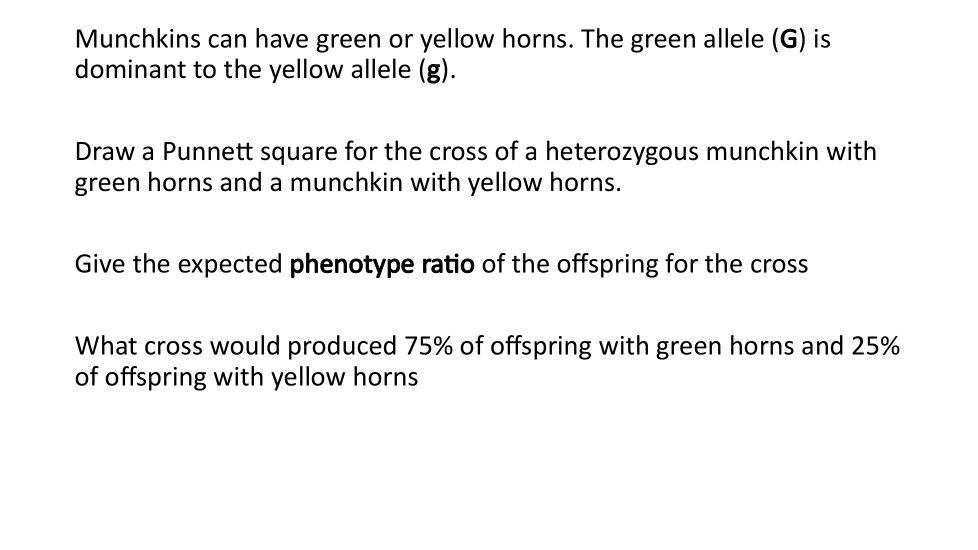
Munchkins can have green or yellow horns. The green allele (G) is dominant to the yellow allele (g).
Draw a Punnett square for a heterozygous munchkin and a homozygous recessive munchkin.
1
1
Question 1
1.
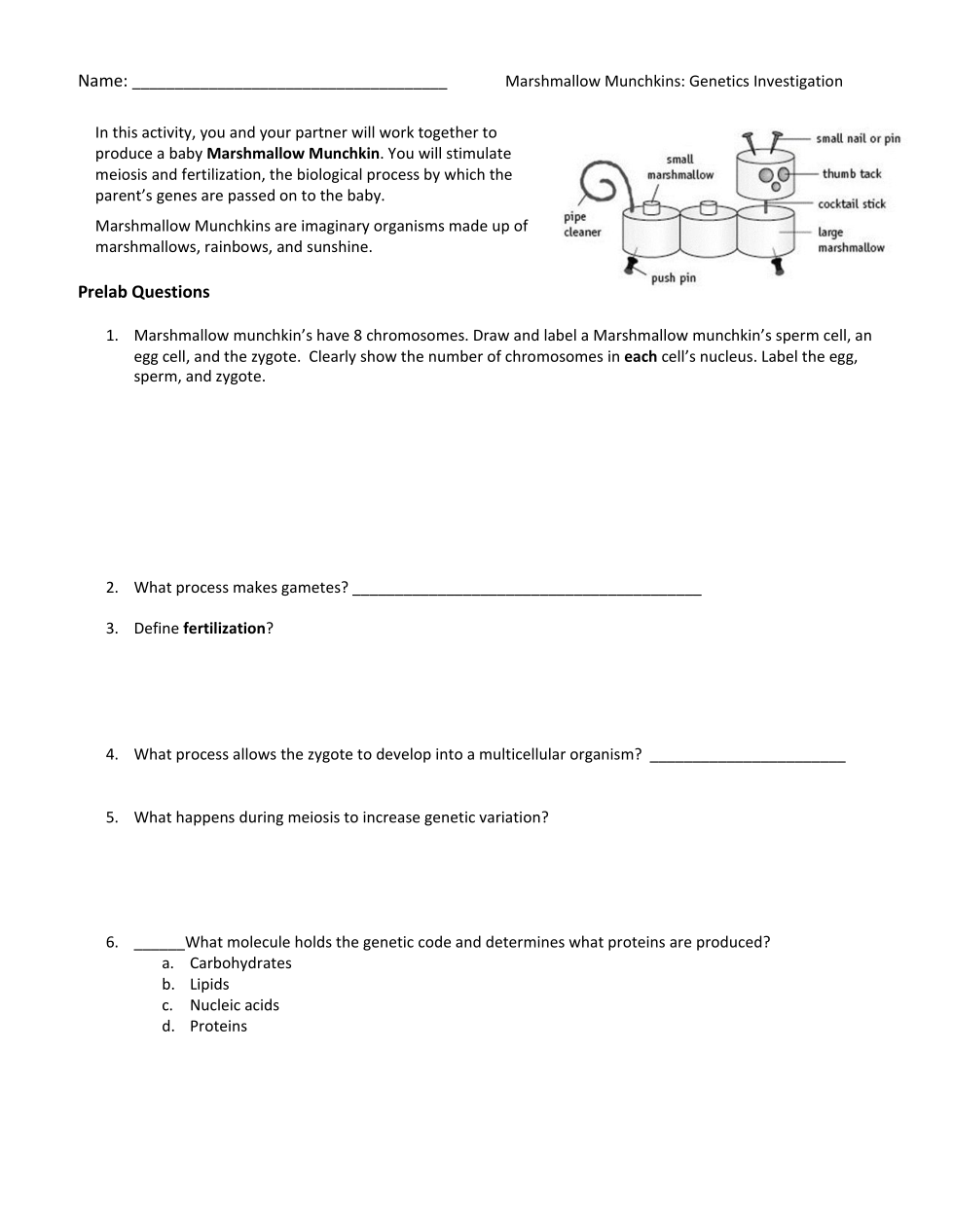
Marshmallow munchkin's have 8 chromosomes. Draw and label a munchkin's sperm, an egg, and the zygote. Clearly show the number of chromosomes in each cell. Label the egg, sperm, and zygote.
Question 2
2.
Question 3
3.
Question 4
4.
Question 5
5.
Question 6
6.
Question 7
7.
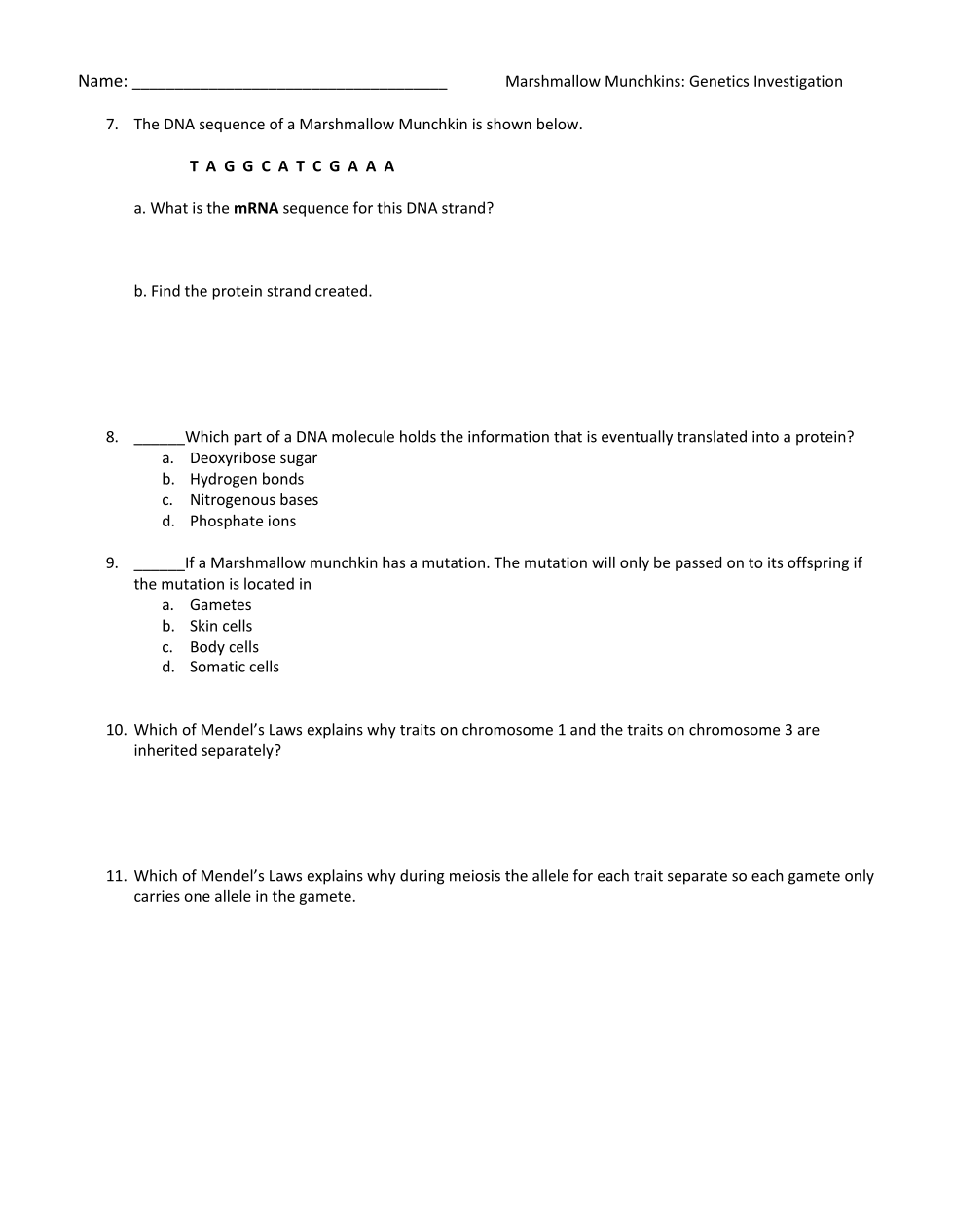
The DNA sequence of a Marshmallow Munchkin is show below:
T A G - G C A - T C G- A A A
Question 8
8.
Question 9
9.
Question 10
10.
Question 11
11.
Question 12
12.
Question 13
13.
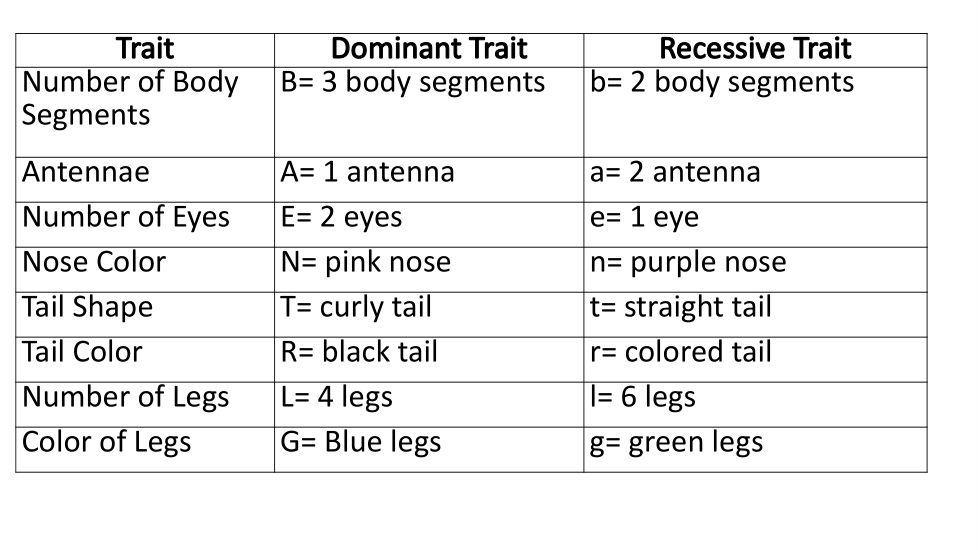
What letters are used to represent nose color?
Question 14
14.
What letters are used to represent tail color?
Question 15
15.
The letter “L” is used as a symbol to represent
Question 16
16.
Write the genotype for a homozygous dominant Marshmallow with 3 body segments.
Question 17
17.
Write the genotype for a homozygous recessive Marshmallow with green legs?
Question 18
18.
Write the genotype for a heterozygous Marshmallow with a pink nose.
Question 19
19.
What is the phenotype for a Marshmallow with the genotype Ee
Question 20
20.
What is the phenotype for a Marshmallow with the genotype Nngg
Question 21
21.
What is the phenotype for a Marshmallow with the genotype TTrr
Question 22
22.
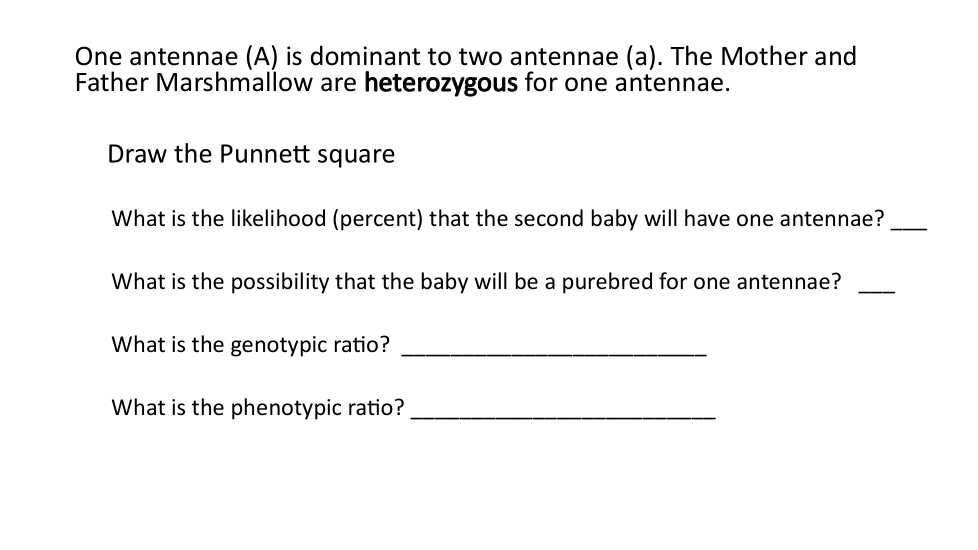
One antennae (A) is dominant to two antennae (a).
Draw the punnett square for a two Marshmallows who are heterozygous for one antennae.
Question 23
23.
Look at #22, what percent of the babies will have one antennae?
Question 24
24.
Look at #22, what percent of the babies will be purebred for one antennae?
Question 25
25.
Look at #22, what is the genotypic ratio?
Question 26
26.
Look at #22, what is the phenotypic ratio?
Question 29
29.
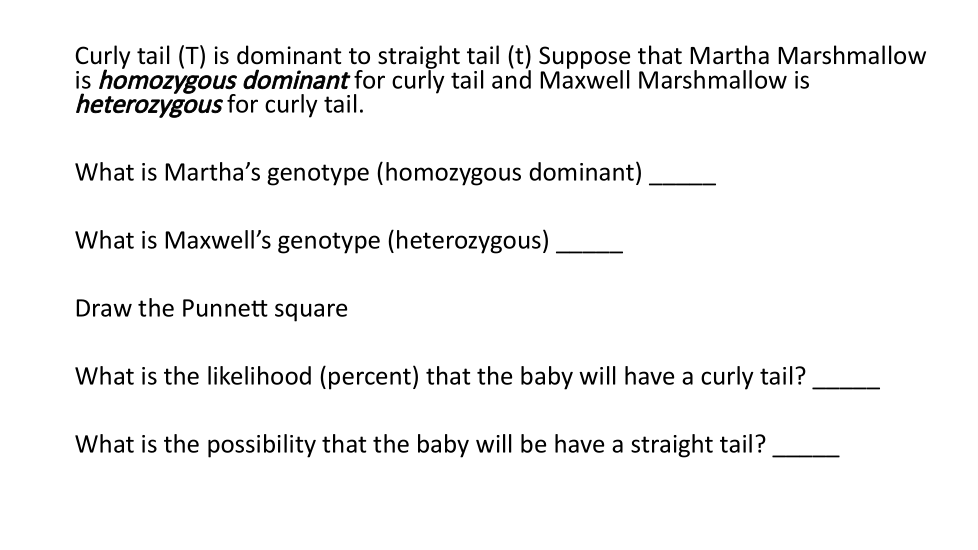
Draw the punnett square between Maxwell (Tt) and Martha (TT)
Question 30
30.
Look at #29. What percent of the children will have curly tails?
Question 31
31.
Look at #29. What percent of the children will have straight tails?
Question 34
34.
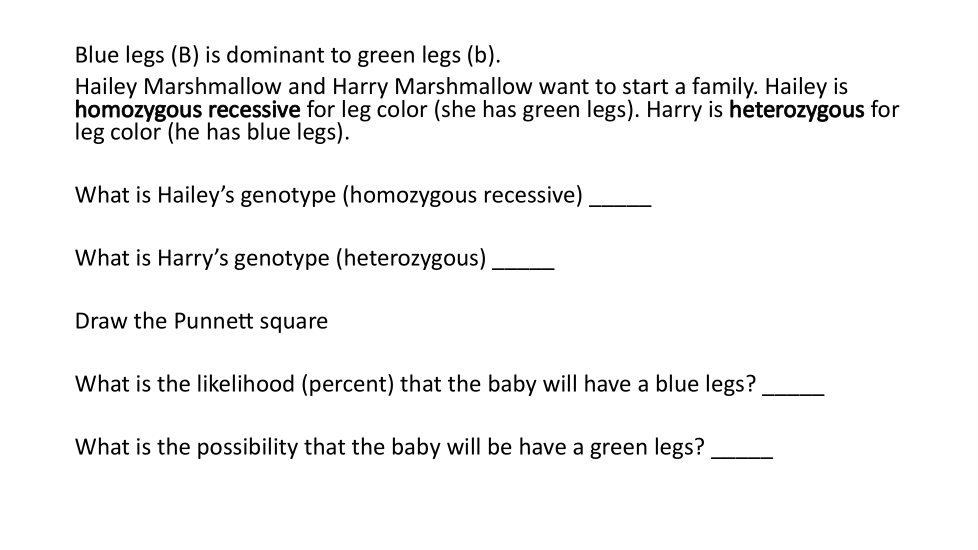
Draw a punnett square between Hailey (bb) and Harry (Bb)
Question 35
35.
Look at #34. Blue (B) is dominant to green legs (b). What percent of the offspring will have blue legs?
Question 36
36.
Look at #34. Blue (B) is dominant to green legs (b). What percent of the offspring will have green legs?
Question 38
38.
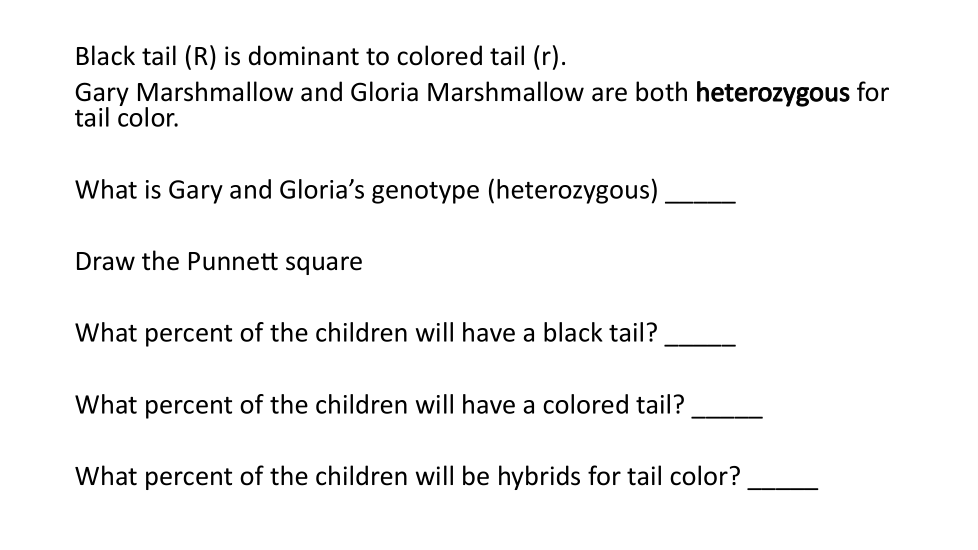
Gary Marshmallow and Gloria Marshmallow are both heterozygous for tail color. Black tail (R) is dominant for colored tail (r). Complete the Punnett square.
Question 39
39.
Look at #39. What percent will have a black tail?
Question 40
40.
Look at #39. What percent will have a colored tail?
Question 41
41.
Look at #39. What percent will be a hybrid?
Question 43
43.
Question 44
44.
What process makes gametes?
mitosis
meiosis
fertilization
transcription
Define fertilization
water moving from high to low
process that makes gametes
process where an egg and sperm combine to make a zygote
process that converts sunlight into glucose
What process allows the zygote to develop into a multicellular organism?
mitosis
transcription
meiosis
fertilization
What happens during meiosis to increase genetic variation?
active transport
crossing over
translation
cellular respiration
Which molecules holds the genetic code?
A. carbohydrates
B. lipids
C. nucleic acids
D. proteins
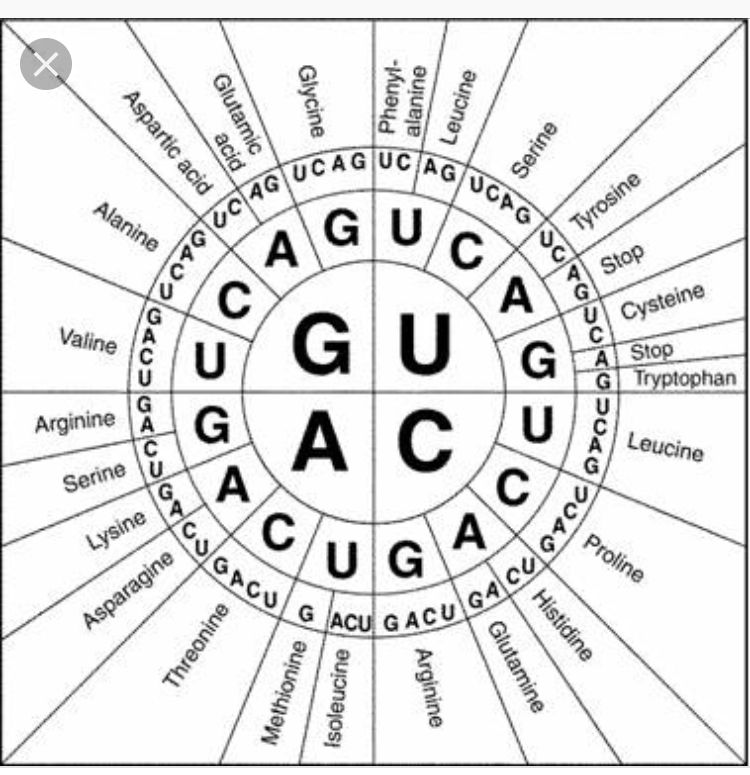
Find the protein chain for the mRNA sequence:
AUC - CGU-AGC-UUU
met-his-pro-thr
lys-arg-met-glu
ala-ser-try-pro
iso-arg-ser-phe
Which part of a DNA molecule holds the information that is eventually translated into a protein?
deoxyribose sugar
hydrogen bonds
nitrogenous bases
phosphate ions
If a Marshmallow munchkin has a mutation. The mutation will only be passed on to its offspring if the mutation is located in
skin cells
body cells
gametes
somatic cells
Which of Mendel's Laws explains why traits on chromosome 1 and the traits on chromosomes 3 are inherited separtely?
Law of indpendent assortment
Law of segregration
Which of Mendel's Laws explains why during meiosis the allele for each trait separate so each gamete only carries one allele in the gamete?
Law of indpendent assortment
Law of segregration
Look at #43, what is the phenotypic ratio
3:1
2:2
4:0
What cross would produce 75% offspring with green horns and 25% with yellow horns?