01.06.20 HW - Cells of the Nervous System

Last updated almost 5 years ago
18 questions

Cells of the Nervous System

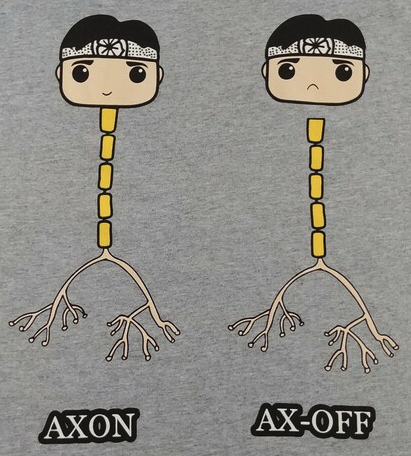
(Don't get it? Feel free to watch this clip from an awesome 80's movie)

Objectives:
  • Identify and distinguish between the different cells present in nervous tissue
  • Determine and describe the function of the different cells present in nervous tissue
  • Identify and distinguish between various structures of a neuron
Now that we know the function and divisions of the nervous system, it's time for us to learn about the cells that make up the nervous system. Similar to the cells you have learned about in other systems, nerve cells look quite different from the "animal cell" you may have learned about in previous science classes. As with all cells, nerve cells have a specific structure that assists with a specific function.

Introduction

(this text, along with the other text in this exercise, was retrieved from Openstax. Some text was edited for simplicity)

Nervous tissue is composed of two types of cells, neurons and glial cells. Neurons are the primary type of cell that most anyone associates with the nervous system. They are responsible for the computation and communication that the nervous system provides. They are electrically active and release chemical signals to target cells. Glial cells, or glia, are known to play a supporting role for nervous tissue. Ongoing research pursues an expanded role that glial cells might play in signaling, but neurons are still considered the basis of this function. Neurons are important, but without glial support they would not be able to perform their function.

Part 1: Neurons

For a brief introduction to neurons, watch the video below. As you watch, answer questions 1-2 below.

1

What is the primary functional unit of the nervous system?

1

Using the video, match the following terms with the best description. Remember that it is OK to rewatch the video a few times!

Draggable itemCorresponding Item
Receive messages from other neurons via neurotransmitters
Dendrites
Part of the neuron covered in myelin
Cell body
Send messages to other neurons via neurotransmitters
Axon hillock
Contains the nucleus and DNA of the neuron
Axon
Part of the neuron between the cell body and the axon
Axon terminals
1

Read the following text about neurons. Some of the terms were introduced in the video, and some are new. As you read, label the diagram in the 'Show your Work' box using the bolded terms below.


Parts of a Neuron

The main part of a neuron is the cell body, which is also known as the soma (soma = “body”). The cell body contains the nucleus and most of the major organelles. But what makes neurons special is that they have many extensions of their cell membranes, which are generally referred to as processes. Neurons are usually described as having one, and only one, axon—a fiber that emerges from the cell body and projects to target cells. That single axon can branch repeatedly to communicate with many target cells. It is the axon that propagates the nerve impulse, which is communicated to one or more cells. The other processes of the neuron are dendrites, which receive information from other neurons at specialized areas of contact called synapses. The dendrites are usually highly branched processes, providing locations for other neurons to communicate with the cell body. Information flows through a neuron from the dendrites, across the cell body, and down the axon. This gives the neuron a polarity—meaning that information flows in this one direction.

Where the axon emerges from the cell body, there is a special region referred to as the axon hillock. This is a tapering of the cell body toward the axon fiber.

Many axons are wrapped by an insulating substance called myelin, which is actually made from glial cells (which you will learn about in the next section.) Myelin acts as insulation much like the plastic or rubber that is used to insulate electrical wires. A key difference between myelin and the insulation on a wire is that there are gaps in the myelin covering of an axon. Each gap is called a node of Ranvier and is important to the way that electrical signals travel down the axon. At the end of the axon is the axon terminal, where there are usually several branches extending toward the target cell (another neuron or the target organ.)

1

Synapses are IN neurons

1

Using the reading from #3, place the following structures in order of where a message is first received by a neuron to where it leaves a neuron.

  1. dendrites
  2. cell body
  3. axon
  4. axon terminals
  5. axon hillock

Part 2: Glial Cells

For a brief introduction to glial cells, watch the video below. As you watch, answer questions 6-7 below:

1

What was the original hypothesis on the function of glial cells?

1

Using the video, match the following terms with the best description. Remember that it is OK to rewatch the video a few times. (Note: Not all cells discussed in the video are included below.)

Draggable itemCorresponding Item
Protect the central nervous system from potentially damaging substances. Translates to "small glia"
Microglia
Macroglia that covers cells of the central nervous system with myelin
Macroglia
Translates to "large glia"
Astrocytes
Macroglia that supports and protect neurons in the peripheral nervous system
Oligodendrocytes
A star shaped macroglia that support neurons and maintain the blood brain barrier
Schwann Cells
Macroglia that covers cells of the peripheral nervous system with myelin
Satellite Cells
For this class, we are only going to focus on two glial cells: Astrocytes and Schwann Cells. Read the excerpt below, then answer questions 8-12.

Glial Cells of the CNS

One cell providing support to neurons of the CNS is the astrocyte, so named because it appears to be star-shaped under the microscope (astro- = “star”). Astrocytes have many processes extending from their main cell body (not axons or dendrites like neurons, just cell extensions). Those processes extend to interact with neurons, blood vessels, or the connective tissue covering the CNS that is called the pia mater. Generally, they are supporting cells for the neurons in the central nervous system.
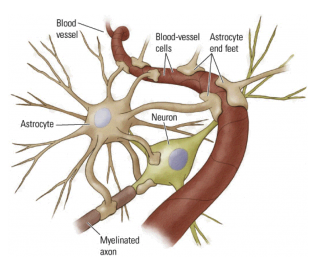
(image retrieved from the article Astrocytes Control Synapse Function)

Some ways in which astrocytes support neurons in the central nervous system are by maintaining the concentration of chemicals in the extracellular space, reacting to tissue damage, and contributing to the blood-brain barrier (BBB). The blood-brain barrier is a physiological barrier that keeps many substances that circulate in the rest of the body from getting into the central nervous system, restricting what can cross from circulating blood into the CNS. Nutrient molecules, such as glucose or amino acids, can pass through the BBB, but other molecules cannot. This actually causes problems with drug delivery to the CNS. Pharmaceutical companies are challenged to design drugs that can cross the BBB as well as have an effect on the nervous system.


Glial Cells of the PNS
One of two types of glial cells found in the peripheral nervous system is the Schwann cell, which insulate axons with myelin. A Schwann cell wraps around a portion of only one axon segment. The nucleus and cytoplasm of the Schwann cell are on the edge of the myelin sheath.
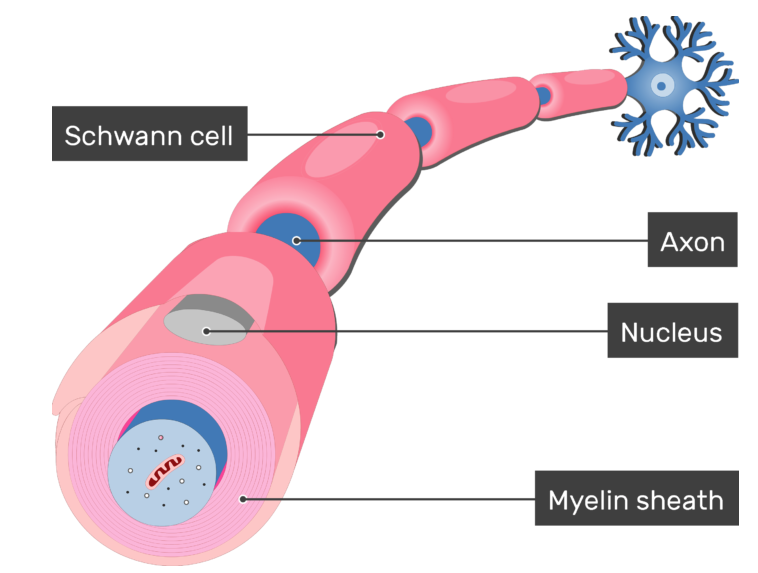
Myelin is a lipid-rich sheath that surrounds the axon and by doing so creates a myelin sheath that facilitates the transmission of electrical signals along the axon. The appearance of the myelin sheath can be thought of as similar to the pastry wrapped around a hot dog for “pigs in a blanket” or a similar food. The glial cell is wrapped around the axon several times with little to no cytoplasm between the glial cell layers.
1

What, in addition to neurons, do astrocytes connect to?

1

Most substances in a person's blood can pass through the blood brain barrier.

1

What property of the myelin in Schwann cells makes it a good insulator? In other words, what characteristic of myelin makes it so helpful in sending electrical signals down the axon of a neuron?

1

Compare and contrast the structure of astrocytes and Schwann cells. Please do not list every structure of the cells - rather, describe general similarities and differences.

1

Compare and contrast the function of astrocytes and Schwann cells. Consider your answer for #7 as you answer this. (Remember: the cells function in the way that they do because of their structure.)

Part 3: Radiolab

Below is an embedded episode of Radiolab titled Bringing Gamma Back, Again. The episode is 39 minutes long, but you are only expected to listen to the first 22 minutes (0:00 - 22:20)

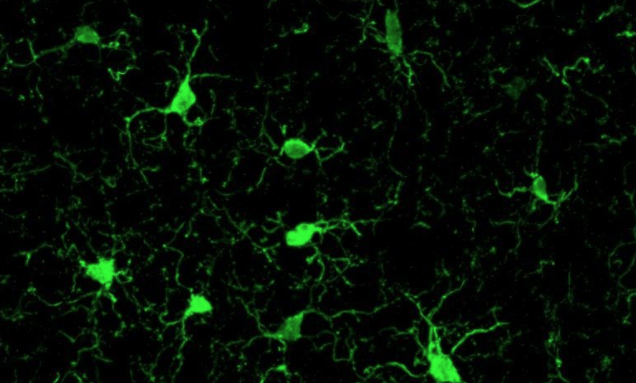
Photo of the microglia discussed in the podcast


Again, you are only expected to listen to the first 22 minutes. As you listen, answer questions 13-17.
1

What disease is the focus of the podcast?

1

According to the podcast, what is the "gamma frequency"?

1

In the space below, draw a basic picture of the experiment discussed starting at minute 9.

1

Place the methods used in the three Gamma experiments from earliest method (top) to latest method (bottom).

  1. Holes were drilled in mouse skulls, then a laser was pulsated at 40 beats/second through a fiberoptic cable for one hour
  2. Mice were placed in a room where LED lights were flashed at 40 flashes/second for one hour
  3. Mice were in a room where a gamma sound was emitted at 40 beats/second for one hour
1

In 3-5 sentences, summarize the results of the study described in the podcast. Use the following terms in your description:
  • microglia
  • neuron
  • gamma frequency
  • plaque

1

What questions do you still have about neurons and/or glial cells?