Double check that this is the correct regression model.
Do an exponential regression (Stat, Calc, #0)
Store the regression equation & save the residuals (StoreRegEq: VARS, Y-VARS, enter, enter, enter, enter)
Graph the residual plot (change the YList to RESID, use 2nd, Stat) show it with Zoom9.
What do you see? Remember what this looks like.
NOW double check, do a LINEAR REGRESSION (Stat, Calc, #8)
Store the regression equation & save the residuals (StoreRegEq: VARS, Y-VARS, enter, enter, enter, enter)
Observe the residual plot with zoom9.
1. Which regression seems to be better: linear or exponential?
2. How do you know based on the residual plots?
Be sure to explain your answer.
"_________________________, because the residual plot _______________________________________________"
I will grade this question :)
4 points
4
Question 2
2.
Use the information from the exponential regression and create the Exponential Regression Equation, enter it below.
Use 'barrels' and 'year' for the variables,
identify the predicted variable with -hat and
round values to three places past the decimal.
No spaces.
Use the math keyboard to put an exponent into your equation.
4 points
4
Question 3
3.
Using the regression equation, how many barrels were predicted to be produced in 1900?
Hint: this is the starting value.
Units are million barrels
4 points
4
Question 4
4.
Using the exponential regression equation in number 3, explain the meaning of the rate.
Ex. what is the rate? is the oil production increasing or decreasing each year?
Express it as a % per year.
'The oil production is ______________________ by ______ % each year.'
4 points
4
Question 5
5.
Use the regression equation, predict the world oil production for 2015 (that would be 115 years since 1900).
Round your answer to the nearest whole number.
Include units.
Units are million barrels
4 points
4
Question 6
6.
If the actual world crude oil production for 2015 was 29,121 million barrels, what was the residual?
Be sure to include units.
4 points
4
Question 7
7.
Your answer to #7 seems like a very large over prediction.
1. What is this type of prediction called?
2. Is this a good idea to do?
6 points
6
Question 8
8.
Suppose you have fit a model to some data and now take a look at the residuals (the residual plot).
For which of the possible residual plots would you reject your model?
Why?
Select all answers that apply.
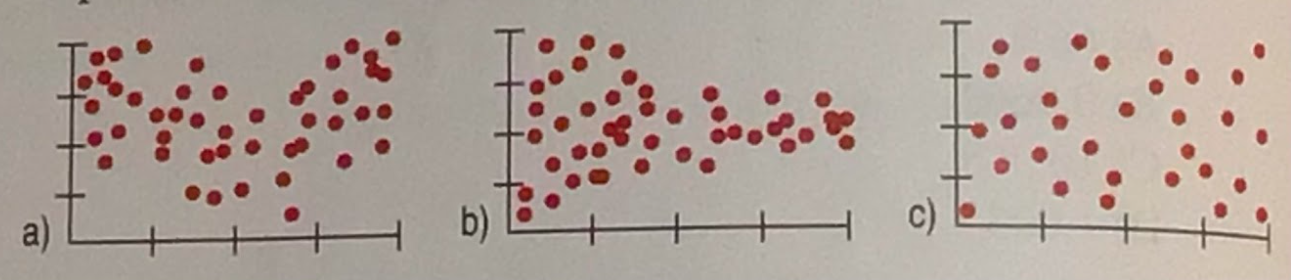
2 points
2
Question 9
9.
Use the situation below to answer the question:
Is this model linear, exponential or power?
4 points
4
Question 10
10.
Does the equation for toxin level show a decrease or an increase?
How do you know?
Select both answers.
4 points
4
Question 11
11.
Use the situation below to answer the question:
How many milligrams of the toxin were in the water initially?
Use units with your answer.
4 points
4
Question 12
12.
Use the situation below to answer the question:
At what rate does this reaction reduce the level of toxin?
Use: _________________ per ________________
Make sure to include percent
4 points
4
Question 13
13.
Use the situation below to answer the question:
To what level should the toxin be reduced in half an hour?
Round your answer to two places past the decimal.
Include units.
4 points
4
Question 14
14.
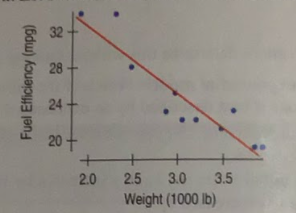
One of the important factors in determining a car's Fuel Efficiency is its Weight.
Look at the relationship for 11 cars.
A linear regression was calculated and the regression equation stored.
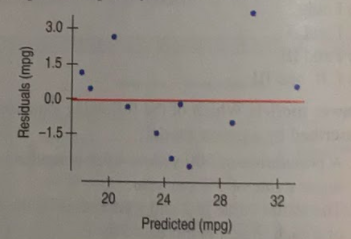
Use both the scatterplot and the residual plot to answer the question below.
Do you think the linear model is appropriate for this data?
Use the residual plot to explain your decision, be sure to look at the residual plot from left to right.
I will grade this answer.
4 points
4
Question 15
15.
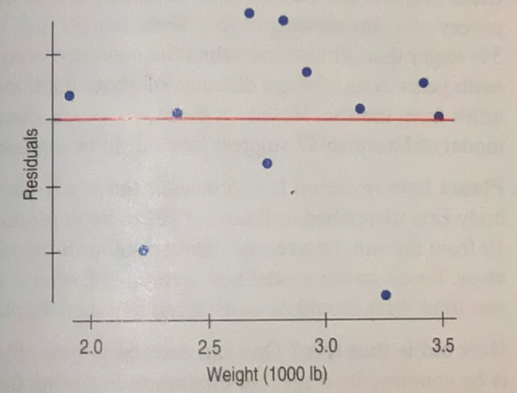
Using the same data, let's try a power model to look at the association between fuel efficiency and weight of the 11 cars.
The residual plot for the power regression is shown below.
Explain why the power regression model appears to be better than the linear model.
I will grade this question.
4 points
4
Question 16
16.
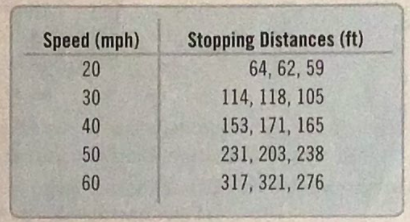
The following table shows the stopping distances in feet for a car tested 3 times at each of 5 speeds. We hope to create a model that predicts the stopping distance from the speed of the car.
Enter the data into L1 and L2.
NOTE: you will have three entries in L1 for 20, three for 30, three for 40, etc.
There will be a total of 15 entries so each distance is matched with a speed. Ask for help if you have questions.
Observe the scatterplot, then do a linear regression.
Record the Coefficient of Determination below.
Round to three places past the decimal.
4 points
4
Question 17
17.
Use the data you have entered for the speed and stopping distance for the car.
Now do an exponential regression (Stat, calc, #0).
What is the coefficient of determination now?
Enter it below, round to three places past the decimal.
4 points
4
Question 18
18.
Use the data you have entered for the speed and stopping distance for the car.
Now do a power regression (Stat, calc, alpha, math).
Store the regression equation & save the residuals (StoreRegEq: VARS, Y-VARS, enter, enter, enter, enter)
What is the coefficient of determination now?
Enter it below, round to three places past the decimal.
4 points
4
Question 19
19.
Based on the Coefficient of Determination:
1. Which regression model do you think is the most appropriate?
2. Now observe the residual plot, what do you see?
Select both answers.
4 points
4
Question 20
20.
Use the data for the stopping distance from the speed of the car below.
Using the regression you think is appropriate, enter the equation below using the math keyboard to show exponents.
Use 'speed' and 'distance' for the variables.
No spaces.
Be sure to show which variable is being predicted.
Round to four places past the decimal.
Don't worry about the funny way the letters look for 'distance'.
4 points
4
Question 21
21.
Using your regression equation, estimate the stopping distance for a car traveling 55 mph.
Round to 2 places past the decimal.
Use units.
4 points
4
Question 22
22.
Use your regression equation to estimate the stopping distance for a car traveling 70 mph.